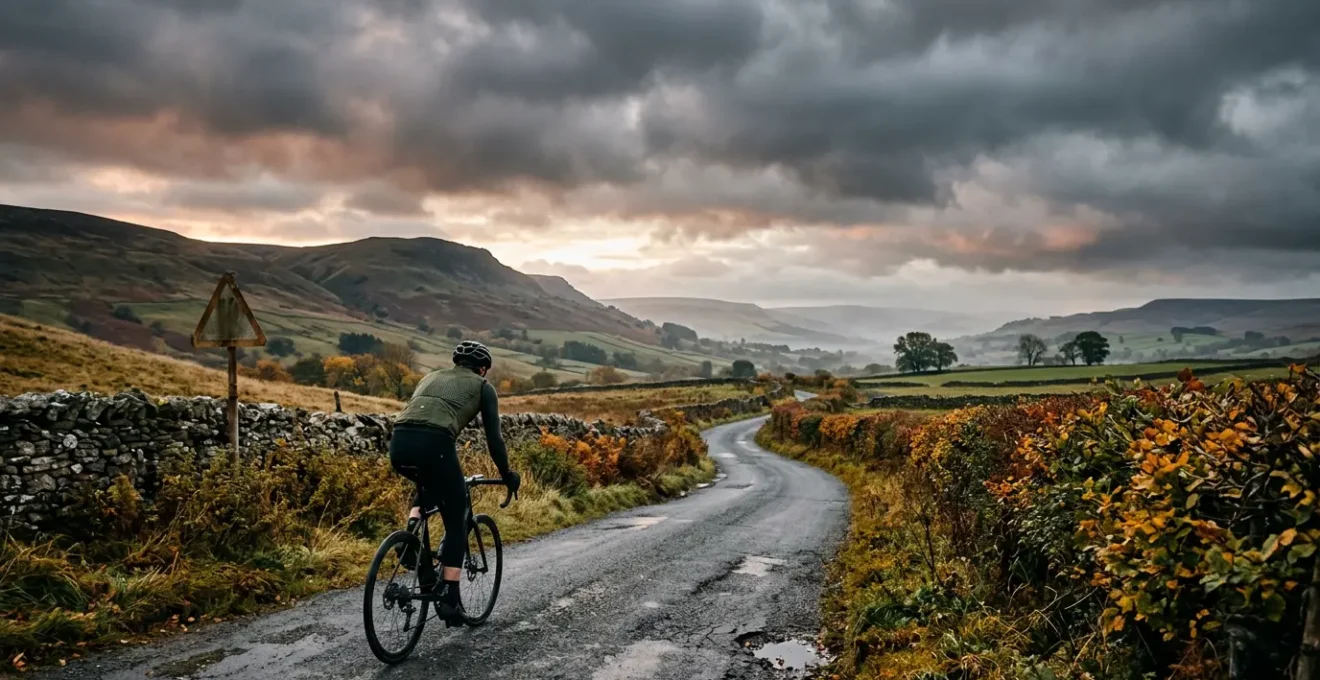
The windproof gilet isn’t just an extra layer; it’s the most versatile thermal regulation tool a UK cyclist can own, allowing you to perfectly manage core temperature without overheating.
- Its value lies in enabling micro-adjustments for the 10°C+ temperature swings common on British rides.
- Features like two-way zips and mesh backs are not luxuries but essential for dynamic ventilation and comfort.
Recommendation: Prioritise a gilet with a highly breathable back panel and a two-way zip over one with maximum waterproofing; its primary role is managing wind chill and body heat, not a downpour.
Every UK cyclist knows the routine. You leave home in the crisp morning air, core chilled, zipping your jacket to the chin. An hour later, you’re grinding up a 15% gradient, the sun has made a cameo, and you’re cooking. Then comes the descent, where the wind-chill bites through your now-damp jersey, leaving you colder than when you started. For years, the solution was a bulky, often non-breathable jacket, packed “just in case” and invariably causing more problems with overheating than it solved. This cycle of being too hot or too cold is a classic British cycling problem, a constant battle against unpredictable weather.
Many riders resign themselves to this discomfort, accepting it as part of riding in the UK. They might focus on complex layering systems or invest in jackets that promise the world but deliver a clammy, “boil in the bag” reality. But what if the solution wasn’t a better jacket, but a smarter, more minimalist approach? What if the key to all-day comfort wasn’t about blocking everything out, but about precisely managing what matters most: core temperature and wind chill?
This is where the humble windproof gilet, or vest, transforms from a simple garment into a strategic tool. Its genius lies not in what it is, but in the series of micro-decisions it enables. This guide re-frames the gilet as the heart of a dynamic kit ecosystem. We’ll dissect the features that truly matter—from the weave of a mesh back to the function of a two-way zip—and demonstrate how this single, pocket-sized item gives you the power to master the variable conditions that define British cycling, ensuring you’re always at the optimal temperature.
To help you select and master this essential piece of kit, we will explore the critical details that separate a great gilet from a mere fashion accessory. This article provides a comprehensive overview of everything you need to consider.
Summary: The Ultimate Guide to the Most Versatile Piece of UK Cycling Kit
- Pocket Storage: How to Fold a Gilet to Fit in a Jersey Pocket?
- Mesh Backs vs Solid: Which Gilet Prevents the “Greenhouse Effect”?
- Reflective Piping: Is It Enough for Dusk Riding or Do You Need High-Vis?
- Two-Way Zips: Why Being Able to Unzip from the Bottom Matters?
- Insulated Gilets: When Is It Too Warm to Wear One?
- The “Boil in the Bag” Effect: How to Avoid Overheating in Rain Jackets?
- Jersey Pockets vs Saddlebag: Which Is Better for Centre of Gravity?
- Merino vs Synthetic: Which Base Layer Handles 10°C Temperature Swings Best?
Pocket Storage: How to Fold a Gilet to Fit in a Jersey Pocket?
The gilet’s primary advantage is its versatility, a quality entirely dependent on its packability. If a gilet is too bulky or difficult to stow, you’re less likely to carry it, defeating its purpose. The goal is to make it disappear into a single jersey pocket, ready for deployment in seconds. Modern ultralight gilets have revolutionised this, with some weighing as little as 86 grams for ultralight gilets, barely more than a couple of energy gels. This minimalist design means there’s no excuse to leave it at home.
However, even the lightest gilet becomes a cumbersome burden if not packed correctly. Stuffing it randomly creates a dense, awkward ball that sags in your pocket and can affect your comfort. The key is a tight, uniform roll that minimises air pockets and creates a compact cylinder. This not only saves space but also distributes the minimal weight more evenly across your lower back. Mastering a simple folding technique transforms the gilet from just another piece of clothing into a seamless part of your riding system, always accessible but never a nuisance.
Action Plan: The Pro Roll Technique for Compact Gilet Folding
- Lay the gilet flat on a clean surface with the front facing down, ensuring the zip is fully closed to maintain structure.
- Fold the gilet vertically in half lengthwise, aligning the armholes precisely to create a narrow rectangle.
- Starting from the bottom hem, tightly roll the gilet upward toward the collar, expelling air as you roll to minimize bulk.
- Secure the rolled gilet with the elastic hem gripper or use a small rubber band if needed.
- Insert the rolled gilet into the deepest center jersey pocket first, allowing the weight to distribute evenly across your lower back.
This simple, five-step process takes less than 30 seconds and is the difference between a frustrating bulge and a perfectly stowed essential.
Mesh Backs vs Solid: Which Gilet Prevents the “Greenhouse Effect”?
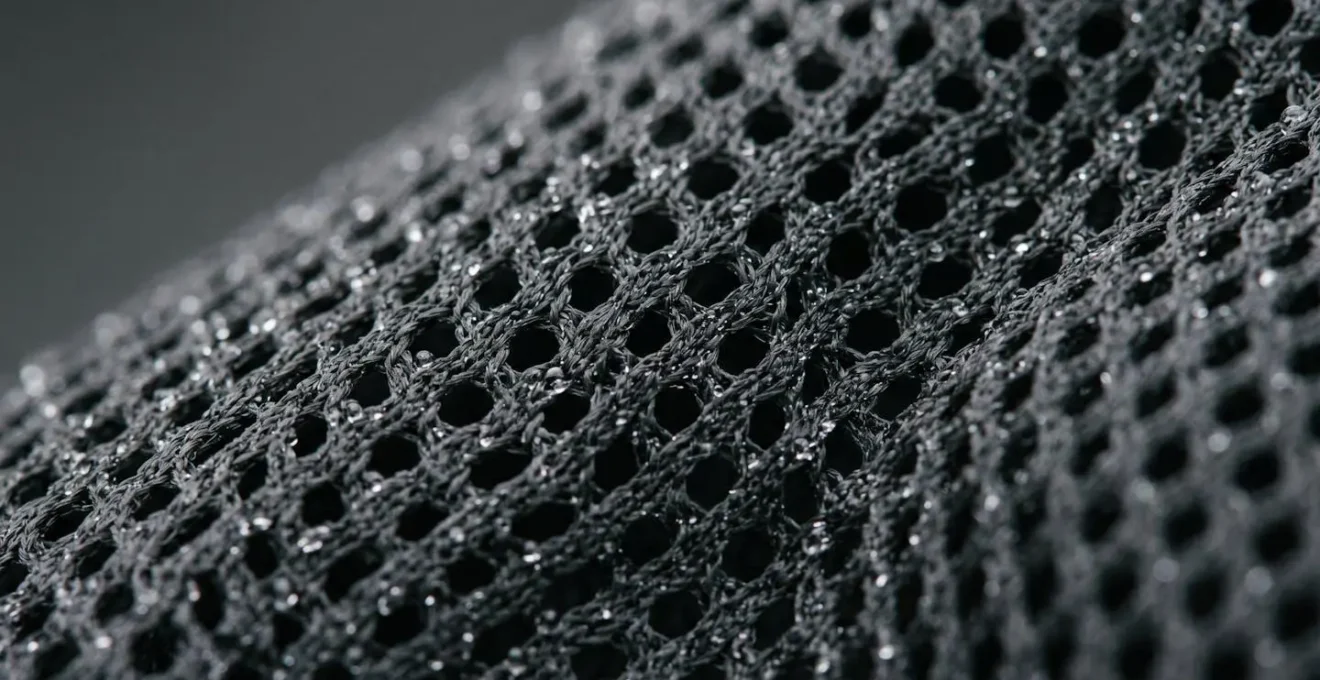
The genius of a great gilet lies in its dual function: it must block wind on the front while simultaneously expelling heat and moisture from the back. A gilet with a solid, windproof back panel is a design flaw, as it traps sweat and creates the dreaded “greenhouse effect” against your back, leaving you damp and prone to chilling on descents. The solution is a mesh back panel. This feature is non-negotiable for any high-intensity riding.
The mesh acts as a chimney, allowing the vast amount of heat and water vapour generated by your body to escape freely, while the solid front panel does the crucial work of protecting your core from wind chill. The effectiveness of this is measured by a fabric’s Moisture Vapour Transmission Rate (MVTR). For active cycling, a rating of 10,000-20,000 g/m²/24h is considered suitable, indicating how much moisture can pass through the fabric. As experts note, this is critical for high-effort apparel.
This focus on breathability is paramount. As noted by the specialists at Proviz Sports in their guide to performance fabrics:
A 15k rating comfortably handles sustained aerobic effort in mixed weather. Gilets especially benefit from strong breathability since your core works hardest.
– Proviz Sports, Breathability Guide to Sports Jackets and Gilets
Essentially, when choosing a gilet, you should consider the back panel as important as the front. A full mesh back ensures you get wind protection where you need it and maximum ventilation where you don’t, keeping you dry, comfortable, and thermally balanced.
This design philosophy is the key to creating a garment that works with your body’s physiology, not against it.
Reflective Piping: Is It Enough for Dusk Riding or Do You Need High-Vis?
Visibility is not a feature; it’s a survival necessity. In the UK, where low light, overcast skies, and dusk are common riding conditions, being seen is paramount. The sobering reality is that, per mile travelled, 30 cyclists die per billion miles vs 2 car drivers, a statistic that underscores the vulnerability of riders. While a gilet’s primary function is thermal, its secondary role as a visibility aid is critically important. Many gilets incorporate small strips of reflective piping or logos. But is this enough?
The answer is nuanced and depends on the conditions. The official UK Highway Code provides clear guidance, distinguishing between two types of visibility. As stated in their rules for cyclists:
Light-coloured or fluorescent clothing can help other road users to see you in daylight and poor light, while reflective clothing and/or accessories can increase your visibility in the dark.
– UK Highway Code, Highway Code Rule 59 – Cyclist Clothing Recommendations
This means there are two distinct scenarios. For daytime, overcast, or dusk riding, a brightly coloured or fluorescent gilet (high-vis yellow, orange, or pink) is most effective. It stands out against the natural background. Reflective piping, on the other hand, is largely ineffective in daylight. Its purpose is to shine brilliantly when hit by vehicle headlights in true darkness. Therefore, a gilet with only small reflective details is insufficient for ensuring you are seen during twilight hours. For maximum safety, a rider should ideally use a bright, fluorescent gilet for daytime and dusk, and ensure it also has substantial reflective panels for night riding.
A minimalist black gilet might look stylish at the cafe stop, but it offers zero visibility benefits. A gilet is a prime piece of high-torso real estate; using it to enhance your presence on the road is a strategic choice.
Two-Way Zips: Why Being Able to Unzip from the Bottom Matters?
On the surface, a zipper seems like a simple component. But on a performance gilet, the difference between a standard one-way zip and a two-way zip is profound. A two-way zip, which can be opened from the bottom as well as the top, is one of those “one-percenter” features that elevates a good piece of kit to an essential one. Its utility is twofold: ventilation and access.
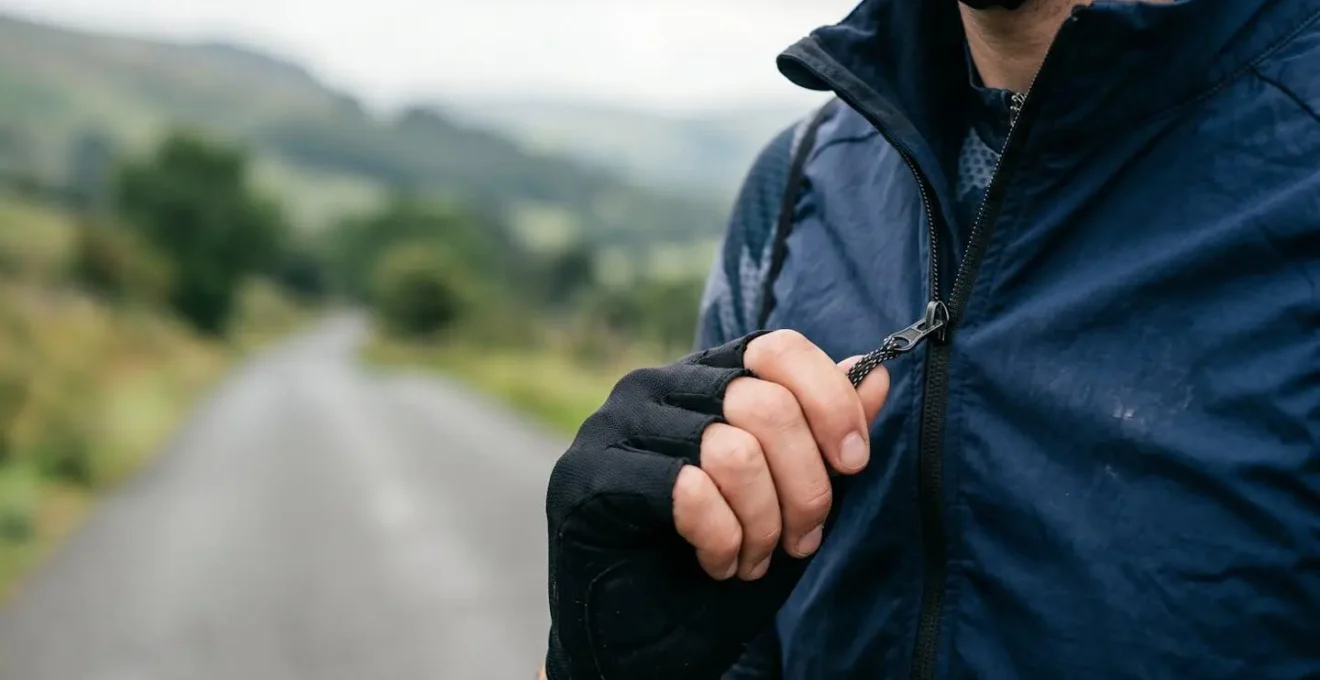
Firstly, it offers unparalleled temperature regulation. On a long climb, you can unzip the gilet from the bottom by a few inches. This small opening creates a significant channel for air to flow in and cool your core, without having the top of the gilet flapping in the wind or exposing your neck and chest to a full blast of cold air. It’s a subtle, precise way to dump excess heat. Secondly, it provides easy access to your jersey pockets. There’s no need to unzip the gilet entirely from the top, letting in a rush of cold air, just to grab an energy gel. You simply pull the bottom zip up, retrieve what you need, and zip it back down. It’s a small convenience that makes a huge difference to comfort and efficiency on a long ride.
Case Study: The Cafe du Cycliste Maya Gilet
The Cafe du Cycliste Maya gilet demonstrates the practical value of two-way zippers in real-world conditions. During testing on long-distance UK rides, the two-way zip allowed riders to fine-tune ventilation while climbing by unzipping from the bottom for core cooling while keeping the collar zipped to protect against neck windchill. The feature proved particularly valuable during cafe stops, preventing the gilet from bunching uncomfortably when seated, maintaining rider comfort during the quintessential British cycling tradition of the mid-ride coffee break.
It’s a feature that, once experienced, you’ll never want to be without, proving that the smallest design elements often have the biggest impact on performance.
Insulated Gilets: When Is It Too Warm to Wear One?
While the classic gilet is a thin, windproof shell, its insulated counterpart is a formidable tool for cold-weather riding. An insulated gilet uses a lightweight synthetic fill (like Primaloft) or hydrophobic down to trap a layer of warm air around your core, providing significant warmth without the bulk and restricted movement of a full winter jacket. This is particularly effective in the UK, where wind chill can make a cold day feel brutal; a temperature of 5°C can feel like -18°C with moderate wind. The insulated gilet directly combats this, keeping your vital organs warm, which allows your body to send warm blood to your extremities.
The critical question is, when does it become *too* warm for one? An insulated gilet is a furnace. Worn in the wrong conditions, it will quickly lead to overheating. The ideal window for an insulated gilet is typically when the ambient temperature is in the low single digits or below. However, this is heavily dependent on rider intensity and regional climate, as UK weather varies dramatically. A low-intensity recovery ride in the Scottish Highlands in October might be perfect for an insulated gilet, while the same garment would be stifling on a high-tempo ride in the South of England.
The following table provides a general guide for using an insulated gilet, demonstrating how region and effort level are the determining factors. Always consider the “feels like” temperature, factoring in wind chill, not just the number on the thermometer.
| UK Region | Zone 2 Recovery Ride | Hill Repeats/High Intensity | Seasonal Window |
|---|---|---|---|
| Scotland & North England | Below 10°C | Below 5°C | September – May (9 months) |
| Midlands & Wales | Below 8°C | Below 3°C | October – April (7 months) |
| South England & London | Below 6°C | Below 1°C | November – March (5 months) |
| Wind Chill Factor (20mph headwind) | Subtract 8-10°C from ambient | Subtract 6-8°C (self-generated wind offset) | Critical on exposed routes |
Ultimately, if there’s any doubt, it’s better to stick with a standard packable gilet and a warmer base layer, as this provides far more versatility to adapt as you and the day warm up.
The “Boil in the Bag” Effect: How to Avoid Overheating in Rain Jackets?
The “boil in the bag” effect is the cyclist’s nemesis. It’s the clammy, sweaty feeling that occurs when your waterproof jacket traps more moisture inside than it keeps out. Many waterproof fabrics, while excellent at repelling rain, have poor breathability. This means that as your body works hard and produces sweat, the moisture has nowhere to go. It condenses on the inside of the jacket, leaving you wet from your own perspiration. Ironically, you can end up just as soaked as if you’d worn no jacket at all.
As the experts at Cycling Weekly aptly describe, this is a common failure in protective gear:
The boil-in-the-bag effect is not something we want to see from a vest at any price-point. This can be a particular issue with vests which attempt to offer higher levels of protection, with windproof and waterproof fabrics doing a good job of keeping the elements out, but also, unfortunately, keeping body moisture in.
– Cycling Weekly, Best cycling vests and gilets buying guide
So how does this relate to gilets? By making a smarter choice. For the majority of UK riding conditions, you don’t need a fully waterproof, seam-sealed jacket. Light drizzle, road spray, and short showers are far more common than torrential downpours. In these scenarios, a standard windproof gilet with a Durable Water Repellent (DWR) coating is a far superior choice. The DWR treatment causes water to bead up and roll off the fabric, providing enough protection to get you through a light shower while the mesh back ensures maximum breathability. It’s estimated that for many UK riders, up to 80% of wet rides are manageable with a DWR gilet instead of a full jacket. This strategy allows you to avoid the boil-in-the-bag trap entirely by prioritising breathability over absolute waterproofness.
Save the full waterproof for genuinely atrocious weather; for everything else, a DWR gilet is the smarter, more comfortable option.
Jersey Pockets vs Saddlebag: Which Is Better for Centre of Gravity?
The debate between using jersey pockets and a saddlebag is about more than just aesthetics; it’s about physics and accessibility. A saddlebag places weight low and centrally on the bike, below the rider’s centre of gravity. This is generally better for bike handling, as it doesn’t raise the centre of gravity or create a pendulum effect during out-of-the-saddle efforts. Jersey pockets, conversely, place weight high and on the rider.
From a pure physics standpoint, the saddlebag is superior for carrying dense, heavy items like a multi-tool, spare inner tubes, and a CO2 inflator. However, this ignores the most important factor in UK riding: accessibility. Weather can change in minutes, and the ability to add or remove a layer quickly is crucial. A gilet, arm warmers, and food are not static items; they are part of your dynamic thermal regulation and fuelling strategy. Storing them in a saddlebag makes them difficult to access on the move. You would have to stop, get off the bike, and unpack the bag, by which time the conditions may have changed again.
Strategy in Practice: Audax UK Randonneurs
For Audax UK events ranging from 200km to 600km rides, experienced randonneurs have developed specific kit carrying strategies. On a typical 200km brevet with a 13.5-hour time limit, riders must carry essentials including spare clothing, tools, food, and the all-important gilet for temperature fluctuations. The consensus approach places frequently-accessed items (gilet, food, arm warmers) in jersey pockets for immediate deployment, while static items (spare tubes, multi-tool, pump) go in the saddlebag. This accessibility-first approach acknowledges that gilets may be donned and removed 3-5 times during a single ride as riders pass through valleys, climb exposed hills, and navigate the unpredictable British weather that characterizes these endurance events.
This long-distance logic applies to all riding. The best strategy is a hybrid one: place heavy, static, “emergency” items in the saddlebag, and place light, dynamic, “in-play” items like your gilet and nutrition in your jersey pockets. The minimal impact of a sub-100g gilet on your centre of gravity is a tiny price to pay for the immense benefit of instant accessibility.
The gilet belongs in your pocket, ready for action, not buried in a bag.
Key Takeaways
- The gilet is a thermal regulation tool, not just a wind-blocker; its value is in managing temperature swings.
- Prioritise features that aid dynamic ventilation: a mesh back is essential, and a two-way zip is a game-changer.
- For UK conditions, a DWR-treated gilet offers a better balance of protection and breathability than a full rain jacket on most days.
Merino vs Synthetic: Which Base Layer Handles 10°C Temperature Swings Best?
The gilet is the star, but it doesn’t act alone. It is part of a “kit ecosystem,” and its performance is directly influenced by the base layer worn beneath it. The base layer’s job is to wick moisture away from your skin, and the gilet’s job is to protect your core from wind while letting that moisture escape. The choice between a merino wool and a synthetic base layer is critical in determining how well this system functions, especially when dealing with the 10°C temperature swings common on a single UK ride.
Synthetic base layers (e.g., polyester, polypropylene) are exceptional at wicking moisture and dry extremely quickly. They act like a conduit, pulling sweat away from the skin and moving it to the outer surface to evaporate. This is ideal for high-intensity efforts where you produce a lot of sweat. Merino wool, on the other hand, can absorb a significant amount of moisture before it feels wet, and it has the unique property of retaining its insulating properties even when damp. It’s also naturally odour-resistant. However, it dries much more slowly than synthetics.
The optimal combination of base layer and gilet depends on the specific conditions and effort level of your ride. There is no single “best” answer, only the best system for the day’s challenge. The following table breaks down how different systems perform in typical UK scenarios.
| System Combination | Start Temperature (5°C) | Peak Temperature (15°C) | Moisture Management | Best UK Scenario |
|---|---|---|---|---|
| Merino Base + Packable Gilet | Warm and comfortable | Remove gilet, merino breathes well | Stays warm when damp, slower drying | Welsh valleys, Lake District – humid climbs with sudden weather changes |
| Synthetic Base + Packable Gilet | Adequate with gilet on | Remove gilet, synthetic dries fast | Quick moisture wicking and drying | Scottish Highlands – dramatic temperature drops on descents after hard climbs |
| Merino Base + Insulated Gilet | Very warm, ideal starting point | Too warm – must remove gilet early | Gilet blocks wind, prevents evaporative cooling | Early morning winter rides in South England – cold start, rapid warming |
| Synthetic Base + Mesh-Back Gilet | Cool initially, warms with effort | Optimal – maximum ventilation maintained | Excellent breathability, minimal sweat buildup | Peak District – repetitive climbing with variable effort levels |
By thinking of your gilet and base layer as a cohesive system, you can build the perfect combination to conquer the specific challenges of your ride, ensuring your core remains perfectly regulated from the first pedal stroke to the last.