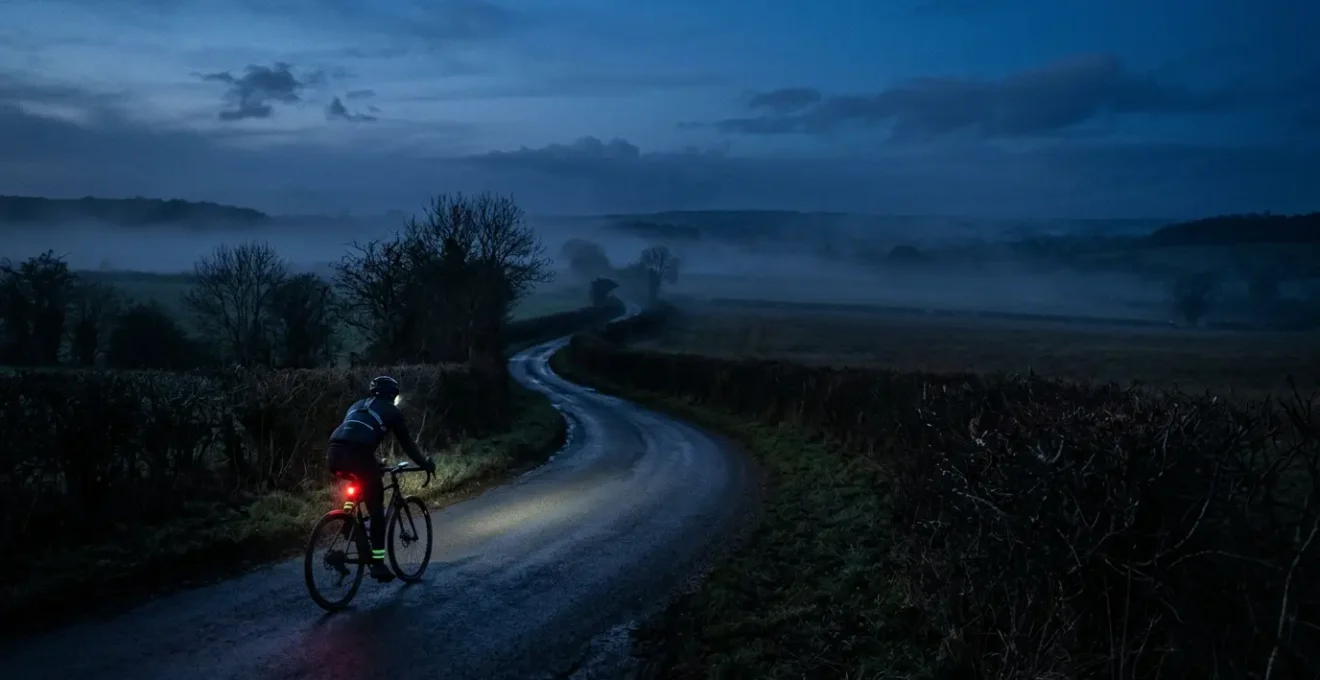
The common wisdom about cycling visibility—wear bright colours and use lights—is dangerously incomplete. True safety comes not from being bright, but from being psychologically recognisable to a driver’s brain.
- Your brain can spot the “biological motion” of reflective ankles and knees twice as fast as a static reflective jacket.
- A driver’s brain is wired to look for cars and can suffer “inattentional blindness,” literally not seeing a cyclist right in front of them.
Recommendation: Stop thinking about just being visible. Start building a 360-degree ‘recognition system’ using strategic lights and biomotion reflectors that makes you impossible for a driver’s brain to ignore.
The primal fear for any cyclist commuting on an unlit country lane or a busy city street after dusk is the same: “Can they see me?” The default solution for decades has been a simple arms race of brightness. We’ve been told to clad ourselves in the most fluorescent yellow imaginable and equip our bikes with lights that could rival an aircraft’s landing beam. While well-intentioned, this approach is based on a flawed premise. It assumes that visibility is simply a matter of luminosity. It isn’t.
The brutal reality is that a driver’s brain is a powerful, but flawed, filter. It’s constantly scanning for threats it expects, primarily other cars. A cyclist, even a brightly lit one, can be an unexpected shape that fails to register. This is the heart of the “Sorry Mate, I Didn’t See You” (SMIDSY) problem. It’s not that the driver’s eyes didn’t see you; it’s that their brain didn’t process what it saw. Your visibility strategy, therefore, must be less about shouting with light and more about speaking the brain’s native language.
This guide moves beyond the platitudes of hi-vis. We will deconstruct the psychology of being seen. We’ll explore the science of why a flashing light can be superior in one environment and a liability in another, why reflective strips on your ankles are more powerful than a reflective torso, and how your position on the road can make you either invisible or unavoidable. It’s time to shift from passive visibility to active recognition.
To help you build a comprehensive safety system, this article breaks down the core principles of psychological visibility. Each section addresses a critical question, moving you from basic equipment choices to advanced roadcraft strategies.
Summary: A Strategic Guide to Cyclist Recognition
- Flashing or Steady Lights: Which Mode Actually Gets a Driver’s Attention?
- Ankles or Back: Where Should You Place Reflective Strips for Maximum Effect?
- Are Your Super-Bright lights Actually Illegal on UK Roads?
- Do Daytime Lights Really Reduce Accident Risk in Overcast Weather?
- The “SMIDSY” Phenomenon: Why Drivers Look but Don’t See Cyclists?
- Side Cut-Outs: How Important Is Being Seen from a Junction?
- Primary Position: Why Riding in the Middle of the Lane Is Safer?
- Does Wearing Neon Actually Reduce Close Passes on UK Roads?
Flashing or Steady Lights: Which Mode Actually Gets a Driver’s Attention?
The debate between flashing and steady lights is more than a matter of preference; it’s a question of cognitive science. The primary goal of a light is to first be detected, and second, to allow the observer to judge distance and speed. Flashing lights excel at the first task, while steady lights are superior for the second. A flashing pattern cuts through visual clutter, making it highly effective at grabbing a driver’s attention, especially in a busy urban environment filled with other static lights like streetlamps and shop signs.
The data on detection is compelling. Research investigating bicycle taillight conspicuity found that a flashing light was first detected at an average distance of 123 meters, while a steady light was only spotted at 41 meters. This is a threefold increase in detection distance, a critical margin of safety. However, a flashing light alone makes it difficult for a driver’s brain to track your trajectory and speed, a phenomenon known as the “phantom array effect.”
As human factors expert Marc Green notes in an interview on collision analysis, the environment is key: “steady or flashing makes no difference in rural areas… but flashing is better in urban areas where there are a lot of steady background lights.” This suggests a hybrid approach is often the optimal strategy for all-around safety, combining the attention-grabbing power of a flash with the spatial clarity of a steady beam.
Case Study: The Hybrid Lighting Strategy
Cycling safety authorities like The Bike Light Database advocate for a compromise strategy to get the best of both worlds. They recommend using two taillights: one set to a flashing mode to maximize detection and a second in a steady burn mode. This combination ensures a driver’s attention is captured from afar by the flash, while the constant light from the second unit provides the crucial reference point needed to accurately judge your distance and speed of travel, preventing misjudgements during an overtake.
Ankles or Back: Where Should You Place Reflective Strips for Maximum Effect?
The traditional approach to reflective gear has been to cover the largest, most stable part of the body: the torso. A reflective jacket or vest seems like the logical choice. However, this logic ignores a powerful shortcut in the human brain’s visual processing system: biomotion. Our brains are exceptionally good at recognizing the unique, cyclical motion of a human walking or pedalling, even with minimal information.
This is where placing reflective material on your moving joints—specifically your ankles and knees—becomes a game-changing strategy. A static reflective panel on your back simply appears as a stationary, unidentified bright spot to a distant driver. But reflective bands on your ankles create an unmistakable up-and-down circular pattern. The brain instantly processes this pattern and identifies you as a cyclist, not just an inanimate object. This recognition is subconscious and incredibly fast.
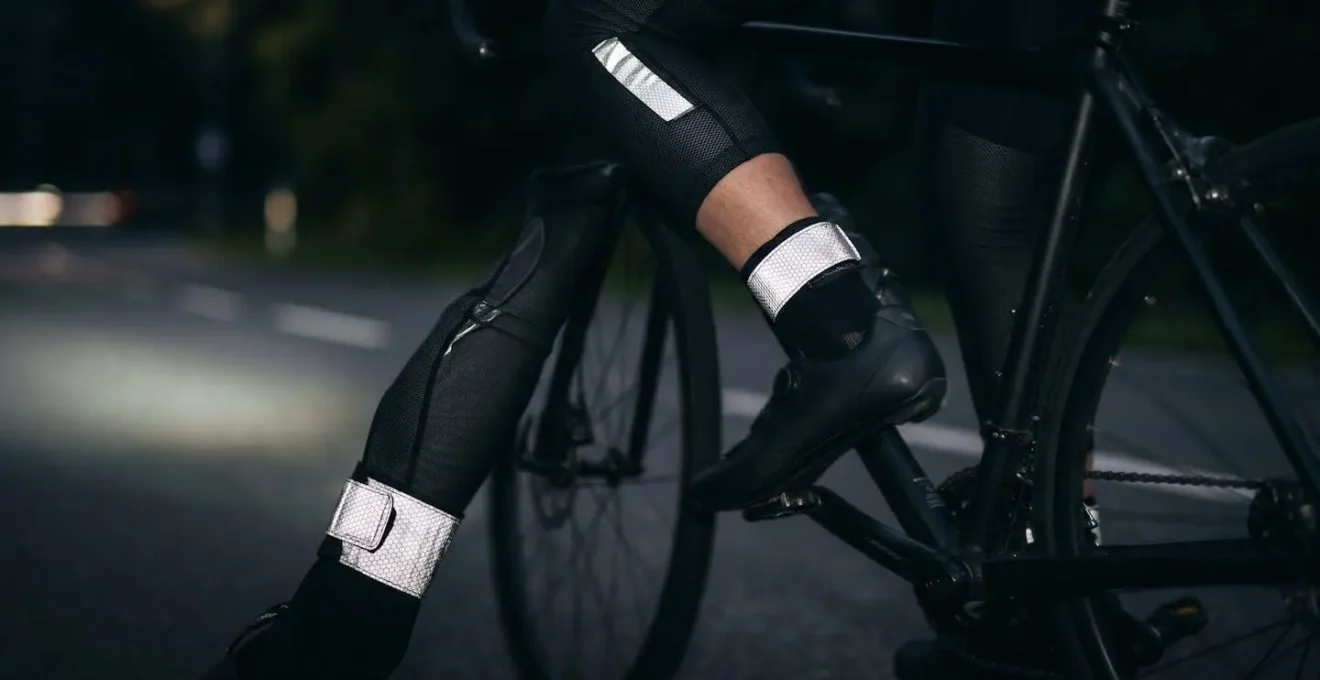
As the image demonstrates, the motion of the reflective elements creates a kinetic signature that is uniquely human. This principle is backed by significant research. In fact, studies in the Human Factors journal demonstrate that placing reflectors on key joints can make a cyclist recognizable up to twice as fast as one wearing a reflective vest alone. This time saving can be the difference between a safe pass and a collision.
Are Your Super-Bright lights Actually Illegal on UK Roads?
In the arms race for brightness, many cyclists assume that more lumens automatically equal more safety. This has led to the proliferation of “super-bright” lights capable of casting a beam over 1000 lumens. While these are invaluable for off-road trail riding in total darkness, using them at full power on public roads can be both dangerous and illegal. The key issue isn’t brightness itself, but dazzle.
Surprisingly, according to UK Road Vehicles Lighting Regulations, there is no specified legal maximum brightness for a bicycle light. However, the law is very clear about causing “undue dazzle or discomfort to other road users.” Temporarily blinding an oncoming driver or a pedestrian is a serious hazard that could cause the very accident you’re trying to prevent. It’s a classic case where a perceived safety measure can have the opposite effect.
The cycling advocacy group Cycling UK provides clear guidance on this matter, stating with authority the legal ramifications of misuse:
If your lights cause undue dazzle or discomfort to other road users, then you’re breaking the law and the police are within their rights to fine you
– Cycling UK, Official UK cycling safety guidance on lighting regulations
This means that while your 1200-lumen light isn’t illegal to own, using it on its highest setting in a well-lit urban area or on a narrow path with other users is likely an offence. Responsible use involves angling the beam downwards towards the road surface and using lower power settings when full brightness is not necessary. Many modern lights also feature beam patterns with a sharp cut-off, similar to a car’s dipped headlights, which are designed to illuminate the road without dazzling others.
Do Daytime Lights Really Reduce Accident Risk in Overcast Weather?
The concept of using lights during the day, known as Daytime Running Lights (DRLs), has become standard in the automotive world for a clear reason: it increases conspicuity. For cyclists, this principle is just as, if not more, important, especially in the flat, low-contrast light of an overcast day or the dappled light of a tree-lined road. In these conditions, a cyclist can easily blend into the background.
During daylight hours, the challenge isn’t just about illumination but about breaking through the visual noise and capturing a driver’s attention. This is where a specific type of light mode becomes particularly effective: a daytime-specific flashing pattern. These modes use an irregular or “disruptive” flash pattern and high intensity to stand out against the brightest ambient light. As one safety analysis from Revolights points out, “During the time of day when the sun is brightest, it can be more difficult to get a driver’s attention than after dark. In this case, a flashing pattern might do the better job.”
The effectiveness of this approach is not just theoretical. Studies have shown that using a flashing light in the daytime can increase a cyclist’s visibility by a significant margin, in some cases making them more noticeable from a greater distance. This added buffer of recognition time gives drivers more opportunity to react appropriately, reducing the risk of close passes and junction-related incidents. Using a DRL isn’t about lighting up the road ahead; it’s about making your presence known to everyone else on it.
The “SMIDSY” Phenomenon: Why Drivers Look but Don’t See Cyclists?
It’s one of the most frustrating and terrifying phrases a cyclist can hear after a collision: “Sorry Mate, I Didn’t See You.” This “SMIDSY” phenomenon is not usually a lie; it’s a symptom of a cognitive glitch known as inattentional blindness. The driver’s eyes may have pointed directly at the cyclist, but their brain, burdened with processing a complex road environment, failed to register their presence. This happens because the brain uses mental shortcuts and filters to manage cognitive load.
A driver is actively, and subconsciously, scanning for specific threats and patterns they expect to see—namely, other cars, lorries, and buses. A cyclist is a smaller, slower, and less common shape. If the driver’s brain isn’t specifically primed to look for a cyclist at that moment, it can literally filter you out of their conscious perception. You become part of the background noise.
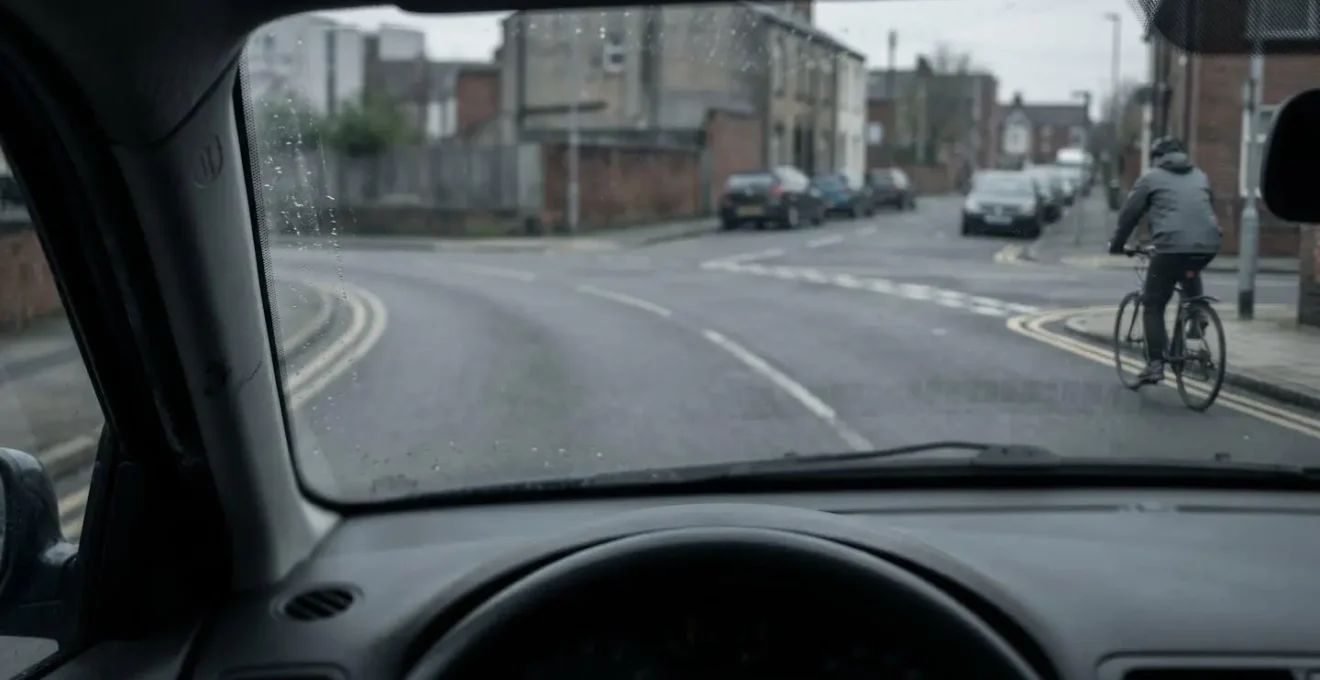
This psychological blind spot is the single greatest argument for moving beyond simple brightness in your visibility strategy. Your goal must be to present a signal that is so distinct and recognizable that it forces its way through the driver’s mental filter. This is why biomotion is so effective; the brain is hardwired to notice human movement. As collision analyst Marc Green explains the core of the problem:
Drivers are often mentally filtering for other cars and large threats. A cyclist, being smaller and unexpected, can be literally invisible to a brain that isn’t specifically looking for one.
– Marc Green, Expert analysis on collision factors in BikeRadar feature
Overcoming SMIDSY means making yourself an undeniable signal. It requires using every tool available—biomotion, disruptive light patterns, and assertive road positioning—to ensure you are not just visible, but cognitively *seen*.
Side Cut-Outs: How Important Is Being Seen from a Junction?
A cyclist’s front and rear lights create a strong signal for traffic ahead and behind. However, they create a dangerous blind spot from the side. This becomes a critical vulnerability at junctions, roundabouts, and driveways, where vehicles are most likely to pull out into a cyclist’s path. The statistics on this are sobering; The National Highway Traffic Safety Administration found that side-impact collisions are a major threat, accounting for a significant portion of all bicycle accidents.
To be safe, a cyclist needs a 360-degree visibility strategy. This is where features like side cut-outs on modern lights and, more importantly, reflectors on moving parts, become essential. While a static light on the frame provides some lateral visibility, it doesn’t create the kind of unmistakable signal that prevents a driver from making a split-second error of judgement at a T-junction.
Case Study: The Power of Moving Reflectors at Junctions
Research powerfully demonstrates that incorporating biomotion is the most effective way to improve side visibility. Adding reflectors to pedals or wheels can slash collision rates by creating a pattern that drivers instantly recognize as a cyclist. This moving signal is far more effective at capturing attention at a perpendicular angle than a static light alone. It allows a driver’s brain to process the movement pattern and identify the threat much faster, providing crucial reaction time at high-risk locations like junctions where traditional front/rear lights offer no lateral protection.
A comprehensive approach involves layering multiple forms of side visibility. This ensures that from any angle, you are presenting a signal that is difficult to miss. Below is a checklist for building a robust system for junction safety.
Action Plan: 360-Degree Visibility for Junctions
- Install spoke reflectors at 90-degree intervals on your wheels to create a continuous circle of visibility as they rotate.
- Wear reflective ankle bands to maximize the biomotion effect, which is highly visible from perpendicular angles.
- Consider a helmet-mounted light, as your head movements when checking traffic naturally create dynamic side visibility.
- Apply high-quality reflective tape to frame tubes like the seat stays and fork blades for passive side illumination from headlights.
- For ultimate protection, add active wheel lights or clip-on side marker lights for constant lateral visibility.
Primary Position: Why Riding in the Middle of the Lane Is Safer?
Visibility isn’t just about lights and reflectors; it’s about roadcraft. One of the most important, yet often misunderstood, techniques is “taking the lane,” also known as riding in the primary position. This means positioning yourself in the centre of the lane, rather than hugging the curb in the secondary position. While it may feel counter-intuitive to place yourself directly in the path of traffic, it is often the safest and most visible place to be.
The UK’s national cycle training standard, Cyclecraft, formally defines it as “The primary riding position, where the cyclist will be more visible and predictable to motor vehicle traffic, as being in the center of the traffic lane.” By riding in the primary position, you place yourself directly in the driver’s central field of vision, where they expect to see other vehicles. This makes you a more predictable and noticeable part of the traffic flow, helping to avoid the “inattentional blindness” that can occur when you’re tucked away at the edge of their peripheral vision.
Furthermore, taking the lane actively discourages unsafe overtakes. When you are in the middle of a narrow lane, a driver is forced to slow down, wait for a safe gap, and perform a proper overtake by moving into the adjacent lane. If you ride in the gutter, you invite drivers to attempt a dangerous “squeeze past” within the same lane, dramatically reducing your safety margin. This assertive positioning is a form of defensive cycling that communicates your right to be on the road. Knowing when to use it is a key skill:
- On narrow roads where a car cannot safely overtake within the lane.
- When approaching junctions, roundabouts, or left turns to prevent vehicles from cutting you off.
- At pinch points like traffic islands or parked cars.
- When the road surface near the curb is poor, covered in potholes or debris.
- When filtering to the front of a queue at traffic lights to ensure you are seen.
Key Takeaways
- Effective visibility is about being psychologically recognizable, not just bright.
- Biomotion (reflectors on ankles/knees) triggers faster driver recognition than static vests.
- A hybrid light strategy (one flashing, one steady) maximizes both detection and distance judgement.
Does Wearing Neon Actually Reduce Close Passes on UK Roads?
For decades, fluorescent or “neon” clothing has been the go-to advice for daytime visibility. Its ability to convert invisible UV light into visible light makes it appear exceptionally bright in overcast conditions. However, its effectiveness is misunderstood and, crucially, it is almost completely useless at night. Fluorescent colours require a source of UV light—the sun—to work. Once the sun goes down, a neon yellow jacket appears as just a dull, dark colour to a driver’s headlights.
This is where the critical distinction between fluorescent and retroreflective materials comes in. Retroreflective materials work by bouncing light directly back to its source with minimal scattering. This means a driver’s headlight beam is reflected back at the driver, making the material appear intensely bright. This technology is designed specifically for low-light and night-time conditions.
The common mistake is relying on one type of material for all conditions. As a study on cyclist conspicuity found, many cyclists dangerously overestimate their own visibility at night. The solution is to understand the different roles these two materials play, as this comparison clearly shows.
This table, based on an analysis of conspicuity materials, highlights the specific strengths and weaknesses of each type.
| Material Type | Daytime Performance | Night Performance | Working Principle | Best Use Case |
|---|---|---|---|---|
| Fluorescent (Neon) | Excellent – converts UV light to visible light, appears exceptionally bright | Ineffective – requires UV light from sun, appears dark at night | Absorbs invisible UV and re-emits as visible light | Daytime and overcast conditions only |
| Retroreflective | Moderate – appears similar to regular fabric | Excellent – bounces light directly back to source (headlights) | Microprisms or glass beads reflect light to its source | Night and low-light conditions |
| Combined (Fluorescent + Retroreflective) | Excellent – bright color visibility | Excellent – retroreflective properties activate | Dual-function material | All-day cycling with day-to-night transitions |
So, does neon reduce close passes? During the day, yes, it increases your conspicuity. At night, it has virtually no effect. To reduce close passes at night, your strategy must be built around retroreflective materials, ideally placed on your moving joints to leverage the powerful effect of biomotion and make you an unmistakable human figure in a driver’s headlights.
To truly own the road, your final step is to audit your current setup. Go beyond a simple check for brightness and instead analyze your entire visibility system through the lens of driver psychology. Ensure you are not just visible, but unmistakable.
Frequently Asked Questions on UK Cycling Visibility
What are StVZO-compliant bike lights?
StVZO refers to stringent German lighting regulations that mandate a shaped beam with a sharp horizontal cut-off, much like a car’s dipped headlights. This design illuminates the road ahead very effectively without shining into the eyes of oncoming drivers and causing dazzle. While finding lights certified to the UK’s BS6102/3 standard can be difficult, StVZO-compliant lights are widely available and accepted under UK law as a compliant EC equivalent.
Do I need BS6102/3 certified lights to be legal in the UK?
Technically, the law requires steady-mode lights to conform to the BS6102/3 standard or an equivalent EC standard. However, this specific certification is rarely enforced by police. As long as you have a functioning white front light and a red rear light that are clean and visible, you are unlikely to face issues, even if your lights are not officially certified to this older standard.
Can I use super-bright lights on urban roads?
While there is no legal maximum lumen limit in the UK, it is an offence to cause “undue dazzle or discomfort” to other road users. Using an extremely bright light (e.g., over 400-500 lumens) on full power in a well-lit urban environment is considered poor etiquette and could be illegal if it blinds others. Experts recommend using lower power settings in town to be considerate, which also has the benefit of significantly extending your light’s battery life.