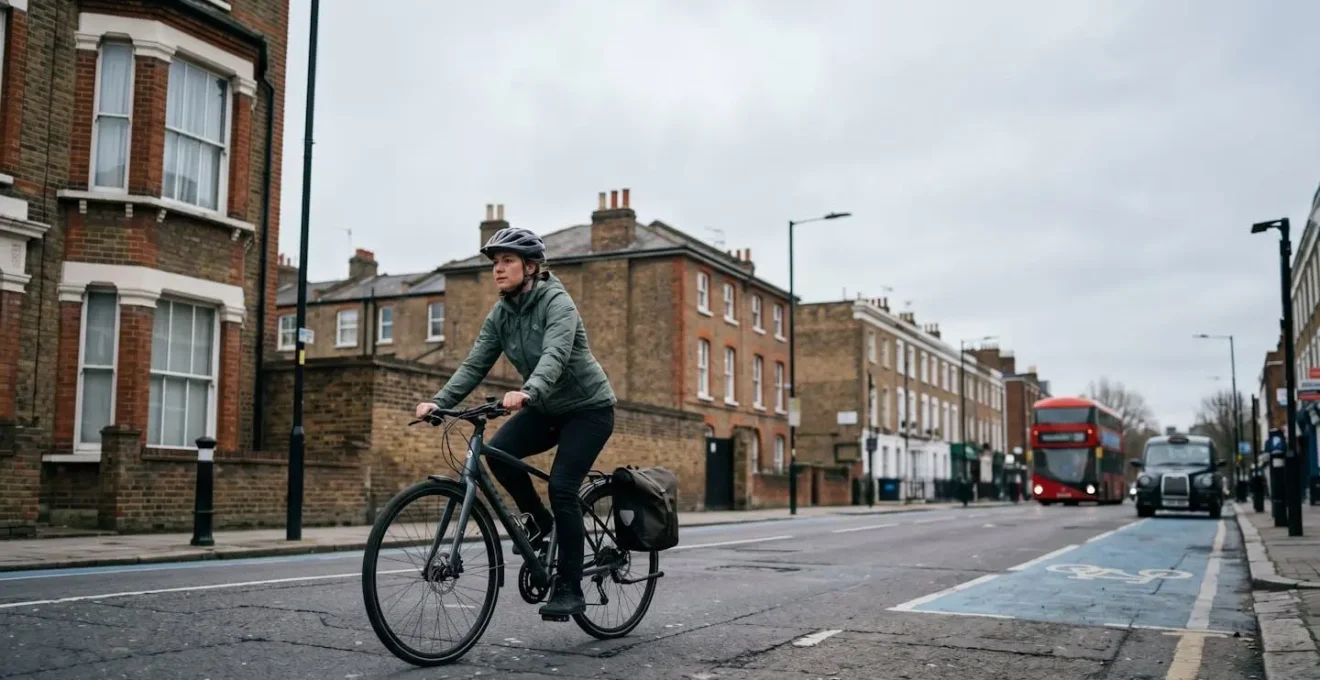
The best London commuter bike isn’t a pre-defined category like ‘hybrid’ or ‘road’—it’s a purpose-built system designed to defeat the city’s specific challenges.
- Your choice should be dictated by a practical assessment of your route’s terrain, component durability, and theft risk.
- Prioritising features like wider tyres, sealed gears, and powerful brakes over raw speed creates a more reliable and enjoyable ride.
Recommendation: Think less about the bike’s label and more about building ‘commuter armour’ tailored for real-world London conditions.
The daily London commute is a unique test of endurance for both rider and machine. Navigating a ten-mile journey can feel like an urban triathlon: dodging taxis, swerving around crater-sized potholes, and bracing against sudden downpours. When choosing a bike for this daily gauntlet, the debate often simplifies to a single question: hybrid or road bike? This binary choice, however, misses the point entirely.
Most advice centres on the obvious: road bikes are faster and more aggressive, while hybrids are more upright and comfortable. But this doesn’t help you when you’re fixing a puncture in the rain or wondering if your expensive-looking bike will still be there after your coffee stop. The real challenge isn’t about pure speed or absolute comfort; it’s about reliability, safety, and practicality in an environment that is actively hostile to delicate engineering.
But what if the key wasn’t the bike’s label, but a series of deliberate component choices designed to conquer London’s three main adversaries: punishing road surfaces, relentless weather, and opportunistic thieves? This guide reframes the decision. We will treat your future bike not as an off-the-shelf product, but as a system of ‘commuter armour’ you can specify to survive and thrive on the city’s streets. We’ll analyse the ‘why’ behind each critical choice, from tyres that absorb impact to gears that shrug off winter grit.
This approach will equip you with the knowledge to select or build a machine that delivers ‘practical velocity’—the ability to make consistent, reliable progress every single day, no matter what the city throws at you.
Summary: Your Guide to a London-Proof Commuter Bike
- Hybrid or Road Bike: Which Choice Suits a 10-Mile Potholed Commute Best?
- Why 35mm Tyres Are the Sweet Spot for Urban Pothole Protection?
- Hub Gears vs Derailleurs: Which Requires Less Maintenance in Winter?
- Rim vs Disc Brakes: Is the Extra Cost Worth It for Wet City Stopping?
- Backpack vs Rack: Which Caused Less Back Sweat on a 30-Minute Ride?
- The Shakedry Revolution: Is It Too Fragile for Daily Commuting?
- Beyond Hi-Vis: How to Stay Seen on Dark Country Lanes at Night?
- The “Ugly Bike” Theory: Why a Beater Bike Is Safer to Lock Outside?
Hybrid or Road Bike: Which Choice Suits a 10-Mile Potholed Commute Best?
For a typical 10-mile London commute, which might take you from the fractured tarmac of Stratford to the smoother cycleways near Victoria, the classic hybrid vs. road bike debate is a false dichotomy. A pure road bike with skinny 25mm tyres will feel fast on a perfect surface but will transmit every jarring shock from potholes and drain covers, leading to discomfort and potential punctures. A traditional, heavy hybrid might be comfortable but can feel sluggish and unresponsive when you need to accelerate away from traffic lights. With official counts in October 2024 revealing that 139,000 people were cycling daily across the City of London, efficiency matters.
The smartest answer often lies in a third category: the modern gravel or “all-road” bike. These machines offer the efficient riding position and drop handlebars of a road bike, which provide multiple hand positions and better aerodynamics, but with the clearance for wider, more comfortable tyres (35mm or more). This blend offers the ‘practical velocity’ needed for London—fast enough on the good bits, but resilient enough for the bad.
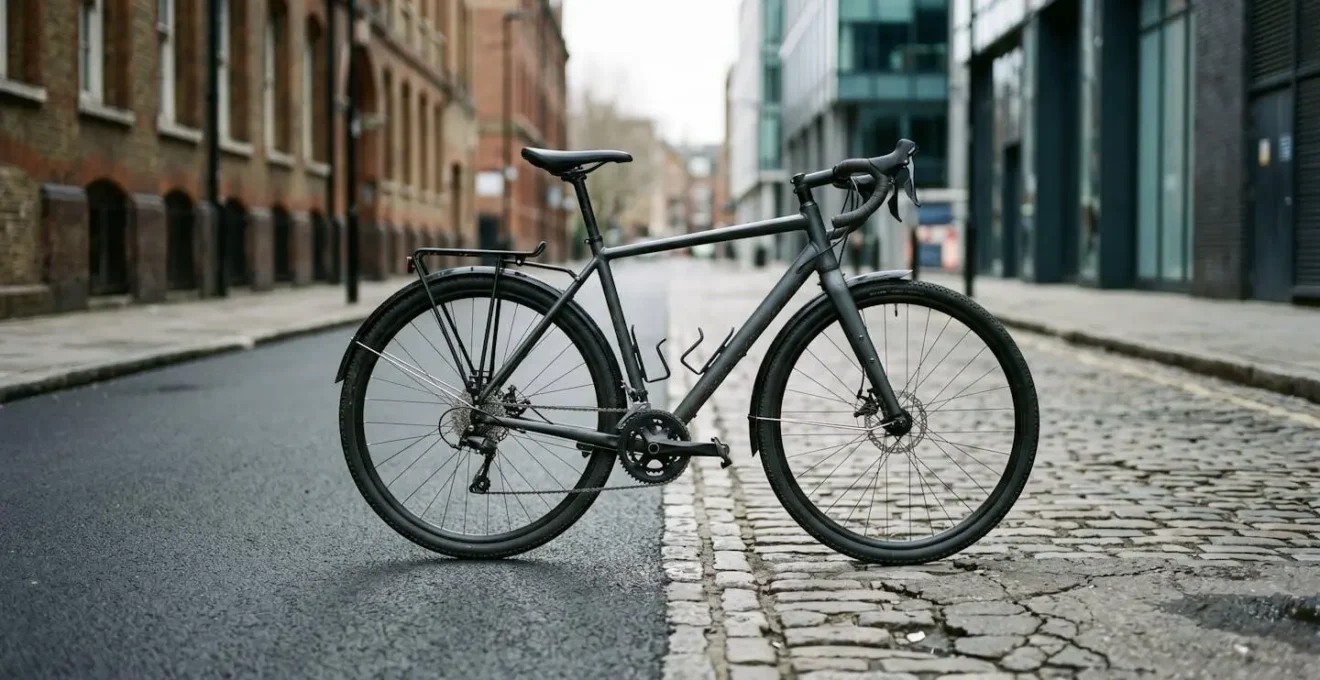
As the image suggests, a bike capable of handling mixed surfaces is the ideal tool. It provides the versatility to navigate everything from pristine cycle superhighways to cobbled side streets and poorly maintained park paths. It’s not about being the fastest, but about having the most capable and reliable machine for the diverse and often unpredictable reality of a London commute. This philosophy of blending speed with resilience should be the foundation of your choice.
Why 35mm Tyres Are the Sweet Spot for Urban Pothole Protection?
If there’s one component that defines a bike’s ability to handle London’s streets, it’s the tyres. The city’s road surfaces are notoriously poor; a recent Freedom of Information analysis revealed that 952,064 pothole reports were filed in the UK between January and November 2024, a five-year high. For a cyclist, this translates to a constant barrage of impacts that can lead to “pinch flat” punctures, where the inner tube is snake-bitten against the wheel rim. Skinny road bike tyres (25-28mm) run at high pressure are particularly vulnerable.
This is where “pothole-proofing” your ride becomes crucial. Moving up to a 35mm tyre width is the single most effective upgrade for urban survival. This volume of air acts as a natural suspension system, absorbing shocks from broken tarmac and drain covers that would otherwise be transferred directly to your hands and body. They can be run at a lower pressure without risking pinch flats, dramatically improving both comfort and grip, especially on wet or greasy roads.
While mountain bike tyres (50mm+) offer even more cushion, they introduce significant rolling resistance, making a 10-mile commute feel like a slog. The 35mm width is the perfect compromise—the sweet spot that balances cushioning and puncture resistance with efficient rolling speed. High-quality, puncture-resistant models in this size, like the Schwalbe Marathon, have a proven track record, with some commuters reporting tens of thousands of kilometres through urban debris with virtually no flats. This level of reliability transforms the daily commute from a game of chance into a predictable journey.
Hub Gears vs Derailleurs: Which Requires Less Maintenance in Winter?
London’s winter is a relentless assault on a bicycle’s drivetrain. A mixture of rain, road salt, and grit forms an abrasive paste that quickly wears out exposed components like chains, cassettes, and derailleurs. For the daily commuter, this means frequent cleaning, lubricating, and adjusting to keep gears shifting smoothly. An external derailleur system, while lightweight and efficient, is a high-maintenance liability in these conditions. This is where the concept of a weather-sealed drivetrain becomes a game-changer.
The alternative is an internal gear hub. This system seals all the complex gear-changing mechanisms inside the rear wheel’s hub, protecting them completely from the elements. While slightly heavier and fractionally less efficient in power transfer, the reliability benefits are immense for a commuter. There is no fragile derailleur to get bent in a crowded bike rack or clogged with grime.
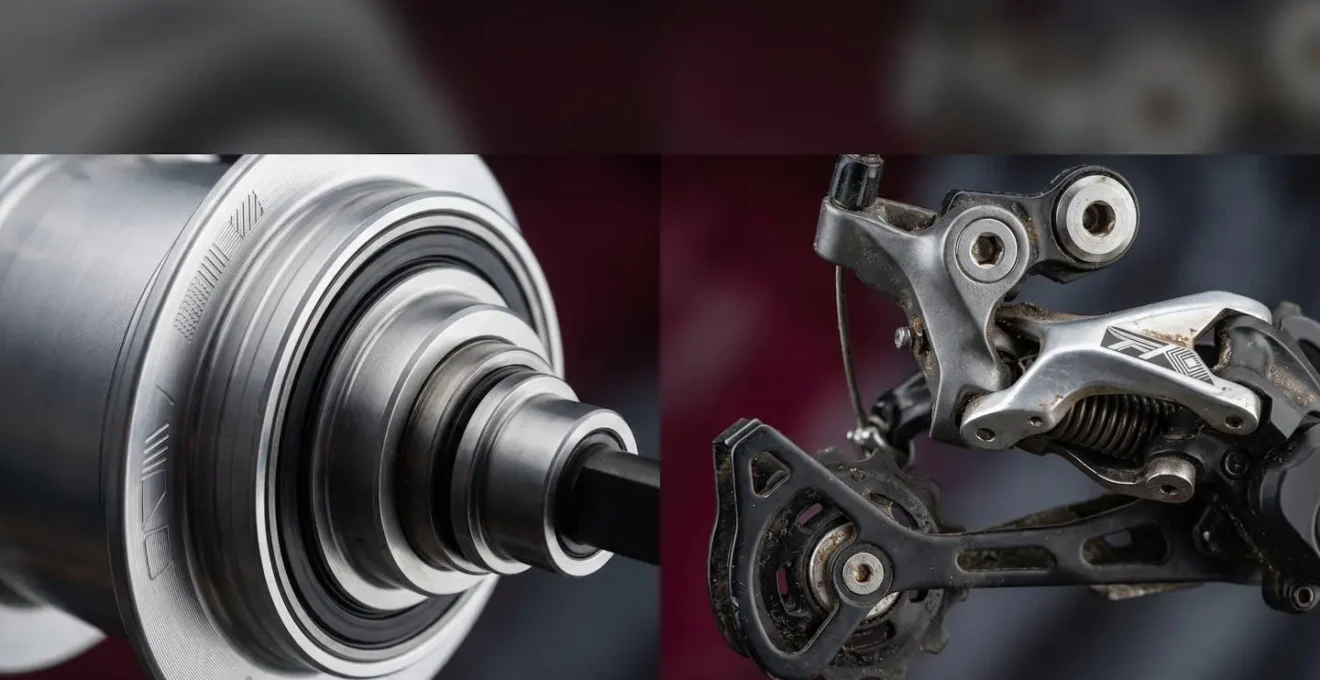
The visual contrast is stark: a clean, protected hub versus an exposed, vulnerable mechanism. For a bike that has to perform day-in, day-out, the choice is clear. While a derailleur needs constant attention, manufacturer specifications for many hub gears recommend servicing only every couple of years. This ‘fit and forget’ nature is the essence of practical commuting. You can also change gears while stationary—a huge advantage when you have to stop unexpectedly at a traffic light while in a high gear. For a London commuter, choosing a hub gear is choosing reliability over marginal performance gains.
Rim vs Disc Brakes: Is the Extra Cost Worth It for Wet City Stopping?
In a city that sees an average of 109 rainy days per year, your bike’s ability to stop reliably is not a luxury; it’s a critical safety feature. The debate between traditional rim brakes and modern disc brakes comes down to performance in the wet. Rim brakes, which squeeze pads against the wheel’s rim, suffer a noticeable drop in performance when rain, dirt, and road grime lubricate the braking surface. That heart-stopping moment of delay before the brakes bite is a feeling many London cyclists know all too well.
Disc brakes, which use a rotor at the center of the wheel, are largely unaffected by wet conditions. Their stopping power is consistent, predictable, and significantly stronger, providing a crucial margin of safety when a pedestrian steps out or a car stops suddenly. While the initial cost is higher, the long-term value proposition for a daily commuter becomes clearer when you analyse the total cost of ownership.
The following table, based on typical costs and wear, breaks down the financial and performance trade-offs for a London commuter. It reveals that while the upfront cost for disc brakes is higher, the reduced wear on wheel rims (a costly component to replace) can balance out the expense over the bike’s lifetime.
| Factor | Disc Brakes (Hydraulic) | Rim Brakes |
|---|---|---|
| Initial Cost | £150-300 premium | Baseline |
| Wet Weather Performance | Consistent, powerful stopping | Reduced performance when wet |
| Consumable Replacement | Brake pads: £15-25 per set | Pads: £8-15 + Wheel rim wear |
| Long-term Cost (3 years heavy use) | £50-80 (pads only) | £40-60 (pads) + £100-200 (wheel replacement) |
| Maintenance Complexity | Moderate (bleeding required) | Simple (cable adjustment) |
| Theft Risk Factor | Higher (desirable components) | Lower |
For a rider prioritising safety and all-weather performance, the extra initial investment for disc brakes is a price worth paying for the confidence they provide. The consistent stopping power is a key piece of ‘commuter armour’ for navigating the unpredictable urban environment.
Backpack vs Rack: Which Caused Less Back Sweat on a 30-Minute Ride?
Your choice of bike is only half the battle; how you carry your gear is just as important for a comfortable and practical commute. The default for many is a backpack, but anyone who has cycled for more than ten minutes in London—even on a cool day—knows the inevitable result: the dreaded sweaty back. A backpack traps heat and moisture, meaning you arrive at the office feeling damp and uncomfortable, which is far from ideal if you don’t have access to showers.
The solution is to let the bike carry the load. Installing a rear pannier rack and using pannier bags completely liberates your back, allowing air to circulate freely. This simple change can be transformative, turning a sweaty ordeal into a pleasant ride. Beyond comfort, it also improves safety and stability. A heavy backpack raises your centre of gravity, making the bike feel less stable, especially when filtering through traffic or making sharp turns. Panniers keep the weight low and centred over the rear wheel, leading to superior handling and stability.
Of course, there is a trade-off. Panniers need to be removed and carried or securely locked at your destination, which adds a minute or two to your routine. A backpack is simply on-and-off. However, many modern panniers come with quick-release systems and shoulder straps, offering a hybrid solution. For the London commuter, arriving dry and with a more stable bike far outweighs the minor inconvenience. The pannier rack is an essential upgrade for anyone serious about daily cycling.
The Shakedry Revolution: Is It Too Fragile for Daily Commuting?
Staying dry is a primary concern for any London cyclist, but it comes with a compromise: breathability. Traditional waterproof jackets can feel like wearing a plastic bag during exertion, leaving you soaked from the inside out. The invention of Gore-Tex Shakedry fabric was a revolution—a jacket that was not only completely waterproof but also incredibly breathable, allowing sweat to escape. For performance cyclists, it was the holy grail. However, for the daily commuter, its biggest strength is also its greatest weakness: its fragility.
Shakedry’s magic comes from its exposed waterproof membrane; there is no outer “face fabric.” This makes it unbelievably light and breathable, but also highly susceptible to abrasion and snagging. The simple act of wearing a backpack can rub away the membrane, destroying its waterproof properties. A brush against a brick wall or getting it caught on a Tube turnstile can easily cause a tear. This makes it a high-risk, high-cost choice for the rough and tumble of a daily commute.
A more robust, three-layer waterproof jacket from a commuter-focused brand like Altura or Endura offers a much more practical balance. While slightly less breathable, these jackets are built to withstand the daily abuse of backpacks, crowded trains, and being stuffed into a bag. A cost-per-wear analysis makes the choice clear.
| Factor | Shakedry Jacket | Robust Alternative (Altura/Endura) |
|---|---|---|
| Initial Cost | £200-250 | £100-140 |
| Typical Lifespan (Daily Commute) | 1-1.5 years | 3-4 years |
| Cost Per Year | £140-200 | £30-45 |
| Backpack Compatibility | Not recommended (abrasion damage) | Fully compatible |
| Breathability | Exceptional | Good to Very Good |
| Durability Against Turnstiles | Poor (snag risk) | Excellent |
| Brick Wall Abrasion Resistance | Poor | Good |
| Best For | Pannier users, careful handling | Backpack commuters, daily abuse |
Unless you never wear a backpack and handle your gear with extreme care, a Shakedry jacket is an expensive and fragile luxury for commuting. A durable, workhorse jacket provides better long-term value and peace of mind.
Beyond Hi-Vis: How to Stay Seen on Dark Country Lanes at Night?
While the title mentions “country lanes,” the principles of visibility are even more critical on London’s poorly lit park paths, side streets, and during the gloomy twilight of winter mornings. The common wisdom is to wear a hi-vis yellow jacket, but this is a flawed strategy. Hi-vis is only effective during the day; at night, without a light source to illuminate it, it’s just a dark jacket. For night riding, reflectivity and active lighting are far more important.
The most effective way to be seen is to use “biomotion.” As UK Road Safety Research highlights, placing reflective materials on moving parts makes you instantly identifiable as a cyclist. The up-and-down motion of reflective ankle bands or pedals creates a powerful visual cue that a driver’s brain registers much faster than a static reflective torso.
Reflective details or lights on moving parts like ankles, pedals, and wheels are more effective at identifying you as a cyclist than a static hi-vis jacket.
– UK Road Safety Research, Biomotion Visibility Studies
Beyond personal reflectivity, your bike’s lighting should be strategic. This is where London-specific innovations have emerged to tackle urban dangers.
London Case Study: The Beryl Laserlight
To combat one of the capital’s most dangerous scenarios—vehicles turning left across a cyclist’s path—the Beryl Laserlight was trialled on Santander Cycles. This device projects a green symbol of a bicycle onto the road 5-6 metres ahead of the rider. This alerts drivers and pedestrians to the presence of a cyclist before the bike itself has entered a blind spot, providing a vital early warning at junctions.
A smart visibility strategy combines a powerful front light to see potholes, a bright rear light, side-facing reflectives for junctions, and, most importantly, biomotion. This multi-layered approach ensures you are seen and identified from all angles, a crucial element of your ‘commuter armour’.
Key Takeaways
- The best commuter bike is a system of compromises balancing resilience, comfort, and practicality over raw speed.
- Invest in ‘commuter armour’: wider tyres for potholes, sealed gears for winter, and disc brakes for wet-weather safety.
- True urban speed, or ‘practical velocity’, is about consistent, reliable daily performance, not top-end race pace.
The “Ugly Bike” Theory: Why a Beater Bike Is Safer to Lock Outside?
You can have the perfect commuter bike, but it’s worthless if it gets stolen. Bike theft is rampant in London. Metropolitan Police data for the year ending April 2025 found that 1,363 bike thefts were reported in Hackney alone. Worse still, with a charge rate of only around 1% for such cases, recovery is highly unlikely. This reality leads to the final, and perhaps most crucial, part of the London commuter’s strategy: the “Theft Calculus.” This is the cold-hearted equation that weighs your bike’s performance and cost against the constant risk of losing it.
This is the logic behind the “Ugly Bike” or “Beater Bike” theory. The idea is that the best bike for locking up outside is one that is mechanically sound but visually undesirable. Thieves are opportunistic; they target bikes that look valuable and are easy to sell. A flashy brand name, shiny new components, and a pristine paint job are all signals of high value. An older, scuffed, or nondescript bike, even if it has high-quality components underneath, is less likely to be the first choice for a thief scanning a row of locked bikes.
Making a bike ‘ugly’ is a conscious act of camouflage. It’s about reducing its perceived value to a potential thief without sacrificing its mechanical function. This is the ultimate expression of street-smart cycling in a high-theft environment.
Action Plan: How to Uglify Your London Commuter Bike
- De-brand It: Cover prominent brand logos on the frame with black electrical tape, stickers, or even a layer of paint to make it generic.
- Downgrade Visually: Swap out a fancy saddle for a basic, worn-looking one. Avoid shiny new accessories that signal a high-value, well-maintained machine.
- Secure Components: Use locking skewers or non-standard security bolts for wheels and the seatpost. Component stripping is common even on less attractive bikes.
- Embrace the Wear: Use weathered bar tape or grips. Don’t be too quick to clean off every bit of grime—a bit of ‘patina’ can be a deterrent.
- Mark and Register: Register your bike with a service like BikeRegister and apply the visible security marking. This shows the bike is traceable and less appealing to professional thieves.
Of course, this strategy must be paired with two high-quality locks (a D-lock and a chain). But by reducing your bike’s visual appeal, you actively shift the thief’s attention to an easier, more profitable target next to yours.
Choosing the right bike for London is an exercise in practical, defensive engineering. By applying this street-smart mindset—prioritising durability, all-weather safety, and low theft appeal—you can build a machine that not only survives the city but makes your daily journey a reliable and enjoyable part of your day.