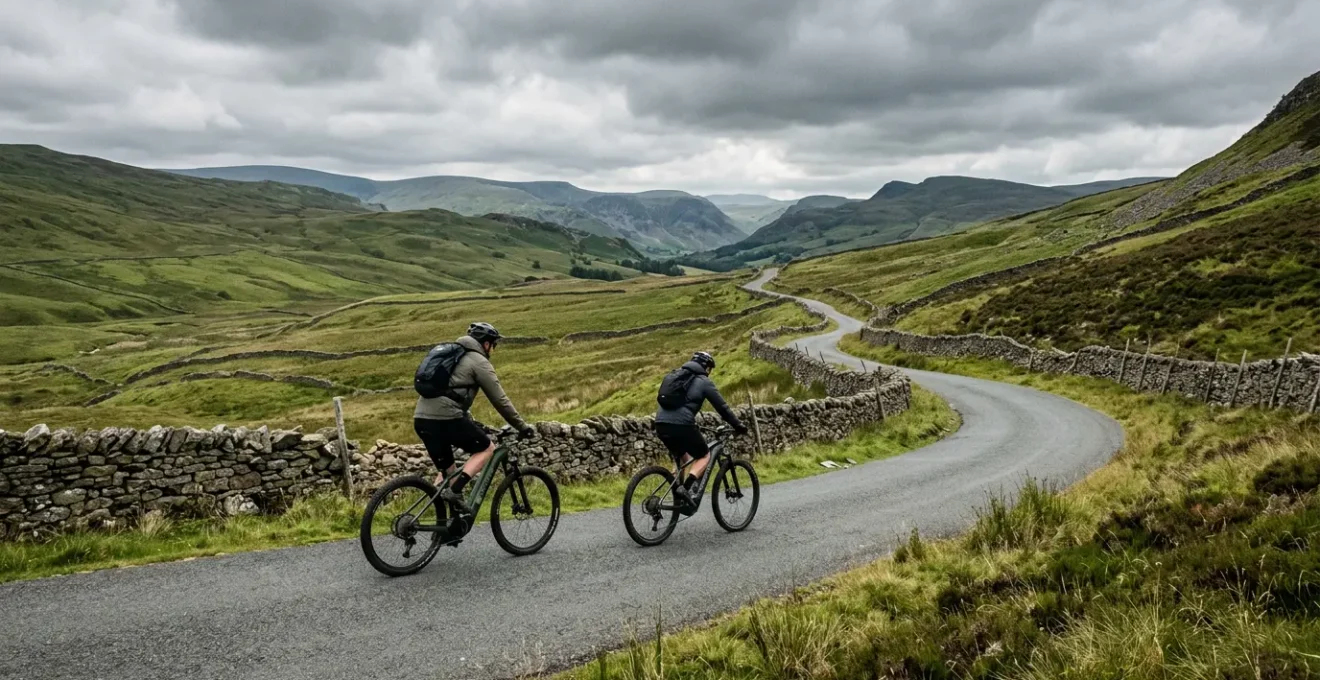
For conquering severe UK gradients, a mid-drive motor with a high-quality torque sensor is non-negotiable; the debate is less about hub vs. mid-drive and more about mastering system dynamics.
- High torque (85Nm+) provides the necessary climbing force, but a responsive torque sensor is critical for applying that power smoothly and maintaining traction on wet, loose surfaces.
- Aggressive use of high torque without correct, pre-emptive shifting will rapidly destroy an e-bike’s drivetrain, leading to chain snaps and costly repairs within 500 miles.
Recommendation: Prioritise test-riding a system with a sensitive torque sensor on a challenging local hill. Focus on the quality of power delivery, not just the peak number, to ensure performance, control, and component longevity.
There’s a unique type of dread familiar to any e-bike rider in a city like Bristol, Sheffield, or Bath. It’s the moment on a relentless, rain-slicked 15% gradient when your pedalling becomes a desperate churn, and the motor’s supportive hum strains, falters, and threatens to give up completely. The fear of grinding to a halt, or worse, the rear wheel spinning out on greasy tarmac, is a very real concern on Britain’s challenging hills. Conventional wisdom offers simple advice: “get a mid-drive motor” or “make sure you have high torque.”
While not wrong, this advice is dangerously incomplete. Raw power is a blunt instrument. On the unforgiving inclines of the Peak District or the sharp kickers of the Surrey Hills, the real battle is for traction, efficiency, and mechanical sympathy. The choice is not merely between a hub or a mid-drive motor; it’s an exercise in understanding and mastering powertrain dynamics. The secret to conquering the UK’s toughest climbs lies in how the entire system—motor, sensors, drivetrain, and rider—works in harmony to translate power into controlled forward momentum.
This engineering-focused analysis will move beyond the marketing specifications. We will dissect the critical role of torque (Nm) and why it’s only half the story. We’ll explore the profound difference between sensor types on ride feel and safety, compare the real-world trail experience of major brands, and quantify the brutal cost of misusing high-torque systems. Ultimately, this guide provides the technical understanding needed to choose a bike that won’t just get you up the hill, but will do so with control, confidence, and mechanical integrity.
Summary: A Powertrain Engineer’s Guide to E-Bike Hill Climbing
- Nm Explained: Why 85Nm Is Essential for Heavy Riders on Steep Climbs?
- Torque vs Cadence Sensors: Which Feels More Natural to Ride?
- Bosch vs Shimano: Which Motor System Is Quieter on the Trail?
- How to Stop a High-Torque Motor from Snapping Your Chain in 500 Miles?
- Turbo Mode Trap: How Fast Does Climbing Drain Your Battery?
- Wh vs Range: How to Calculate Real Mileage for a Hilly Commute?
- Seated vs Standing: Which Is More Efficient for 30-Second Climbs?
- UK E-Bike Laws: How to Avoid Illegal Modifications and £1000 Fines?
Nm Explained: Why 85Nm Is Essential for Heavy Riders on Steep Climbs?
In the world of e-bike motors, torque, measured in Newton-metres (Nm), is the fundamental metric for climbing ability. It represents the rotational force the motor can apply to the crank, directly translating into your power to overcome gravity and inertia. While a 50-60Nm motor is adequate for moderate urban hills, for the severe gradients found across the UK and for riders carrying more weight, a higher torque figure becomes a necessity, not a luxury. A system with at least 85Nm of torque provides the grunt needed to maintain momentum on sustained climbs of 15% or more without forcing the rider into an unsustainable physical effort.
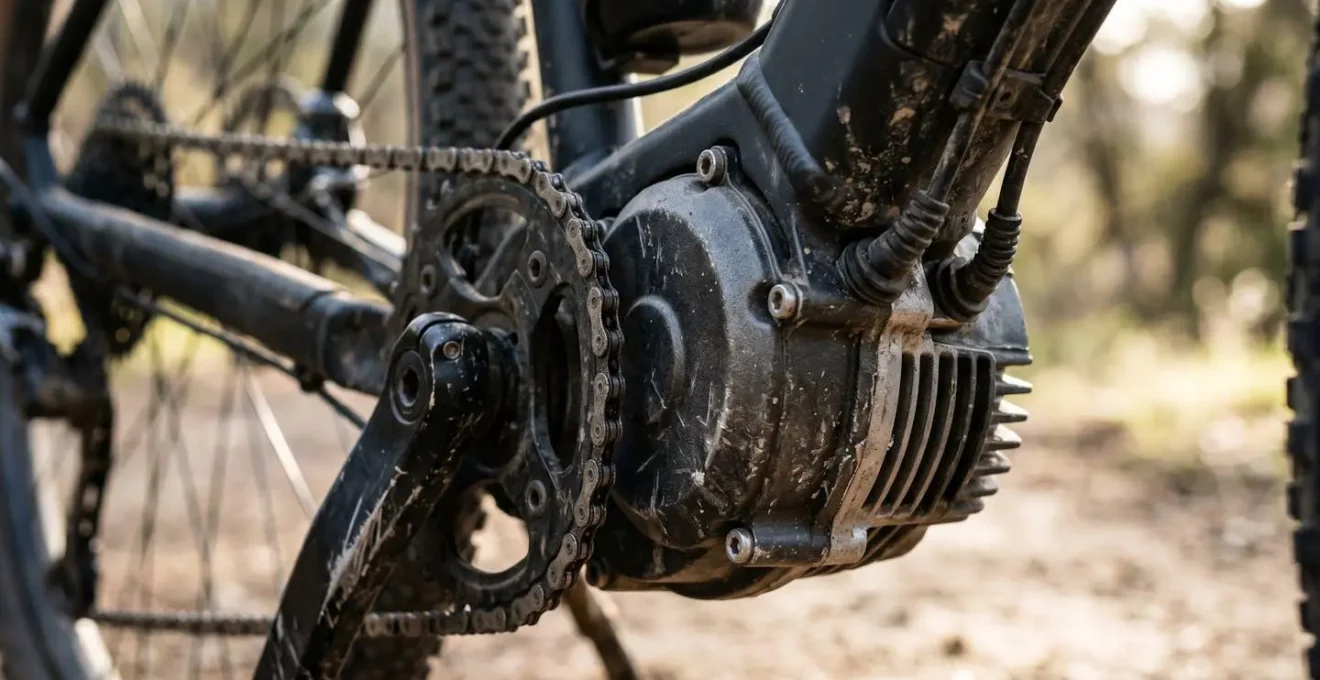
As the image above illustrates, the motor acts as the heart of the powertrain, and its ability to deliver high force under load is paramount. This is especially true from a standing start on a hill—a common scenario at a Bristol or Bath traffic light. Lower torque motors can struggle to initiate movement, forcing the rider to strain or roll backwards. In contrast, a high-torque motor provides the immediate impulse required to get going and settle into a steady climbing cadence. For inclines of 20% or more, e-bikes with 80 Nm or higher provide the most efficient and enjoyable experience.
However, torque requirements are not one-size-fits-all; they are a direct function of the total load (rider + bike + cargo) and the steepness of the gradient. The following data provides a clear framework for matching motor power to real-world British cycling challenges.
| Gradient | Rider Type | Minimum Torque (Nm) | Recommended Use Case |
|---|---|---|---|
| 10% hills | Average rider (70-85kg) | 60 Nm | Urban commuting with moderate hills |
| 15-20% hills | Heavier rider (85-100kg) | 70-85 Nm | Hilly touring, Peak District routes |
| 20%+ hills | Touring with 15-20kg load | 85+ Nm | NC500, Scottish Highlands, loaded panniers |
| Extreme (Hardknott Pass 30%) | Any rider + cargo | 85+ Nm | Legendary British climbs, sustained steep gradients |
Ultimately, selecting a motor with sufficient torque is the first step in building a capable climbing machine. It provides the raw potential, but how that potential is controlled and delivered is what truly separates a great hill climber from a merely powerful one.
Torque vs Cadence Sensors: Which Feels More Natural to Ride?
If torque is the motor’s muscle, the sensor is its brain. This component dictates how and when power is delivered, and it has the single biggest impact on ride feel. The two dominant technologies, cadence and torque sensors, offer fundamentally different experiences. A cadence sensor is a simple on/off switch; as soon as it detects the cranks are turning, it delivers a pre-set level of assistance. This can feel jerky and unnatural, especially on technical climbs where you need to modulate power precisely. It’s a crude system that often delivers too much power when you don’t need it, and not enough when you do.
In stark contrast, a torque sensor measures how hard you are pressing on the pedals. It’s a sophisticated system that amplifies your effort proportionally. Push gently, and you get a little help; stomp on the pedals for a steep ramp, and the motor delivers maximum power. This creates an intuitive, symbiotic feel that’s like having “super-legs.” For conquering steep British hills, particularly in wet and unpredictable conditions, a torque sensor is not just a preference—it’s a critical safety and performance feature.
Case Study: Traction Control on Wet British Surfaces
Analysis shows that in typical UK conditions, such as on wet leaves or loose gravel, torque sensors provide superior control. They deliver proportional power that prevents the sudden surges which can cause rear-wheel spin-out. A cadence sensor’s “all-or-nothing” power delivery, however, can be dangerous on the damp, tight hairpin turns common in Devon lanes or during Surrey Hills climbs, often inducing a loss of traction precisely when control is most needed.
This need for control directly impacts how you interact with the bike’s drivetrain. A high-torque motor paired with a simple cadence sensor is a recipe for immense drivetrain stress. However, even with a sophisticated torque sensor, proper technique is essential to protect your components from the massive forces at play. Learning to manage the motor’s power output through smart shifting is key to both performance and longevity.
Action Plan: Pre-emptive Shifting for High-Torque Motors
- Anticipate: Identify gradient changes ahead, such as the notoriously steep ramps encountered during hill starts in Bath or Bristol.
- Release: Ease off your pedal pressure for a split second before the gradient increases, not while you are already straining.
- Shift: Change to a lower (easier) gear during that moment of reduced torque load on the drivetrain.
- Resume: Reapply pedal pressure smoothly as the new gear engages, allowing the torque sensor to ramp up assistance proportionally to your effort.
- Maintain: Keep a steady cadence of 60-80 RPM to keep the motor in its most efficient torque delivery range and prevent the shock loads that can snap a chain.
The intuitive control of a torque sensor makes it the unequivocal choice for any serious hill climber. It provides the responsive, natural-feeling power needed to maintain traction and momentum when the gradient bites hard.
Bosch vs Shimano: Which Motor System Is Quieter on the Trail?
Once you’ve settled on a mid-drive motor with a torque sensor, the conversation inevitably turns to the two giants of the industry: Bosch and Shimano. On paper, their flagship trail motors, like the Bosch Performance Line CX and the Shimano EP8/EP801, are remarkably similar. Both deliver a punchy 85Nm of torque, feature sophisticated software, and are trusted by hundreds of bike brands. For a powertrain engineer, the differentiation lies not in the peak numbers, but in the nuanced characteristics of their real-world performance, particularly acoustics.
The noise a motor produces is a critical, yet often overlooked, part of the riding experience. When you’re climbing a quiet lane in the Yorkshire Dales or navigating a peaceful forest trail, a loud, high-pitched motor whine can be incredibly intrusive, spoiling the natural ambiance. Here, the brands begin to diverge. Bosch has invested heavily in optimising the internal gearing and housing of its motors for quiet operation. The Performance Line CX, while not silent, is renowned for its relatively low-volume, low-frequency hum, even under heavy load.
Shimano’s systems, while mechanically excellent and often praised for their compact size and “Q-factor” (the width between pedals), have a more mixed reputation for noise. Their lower-power systems are whisper-quiet, but their high-performance units can be more audible. This subjective point is frequently raised by long-term riders and experts in community discussions, as noted by the Electric Bike Forums community.
Shimano 5000 and 6000 series are very quiet, I would say the more powerful 7000 and 8000 series are not known for being the quietest when compared to similar Bosch and Brose options
– Electric Bike Forums Community, Comparing Bosch to Shimano
For a rider prioritising the experience of being in nature, the quieter operation of the Bosch system might be a deciding factor. For others, the specific ride feel or integration of the Shimano system may take precedence. Neither is definitively “better,” but they are different in ways that spec sheets fail to capture.
How to Stop a High-Torque Motor from Snapping Your Chain in 500 Miles?
The immense force generated by an 85Nm motor is a double-edged sword. While it flattens hills, it also places unprecedented stress on your bike’s drivetrain—the chain, cassette, and chainring. An e-bike motor doesn’t just assist you; it adds its full power on top of your own. This combined force, especially when applied poorly, can stretch, wear, and ultimately snap components designed for human-only power output. A snapped chain isn’t just an inconvenience; on a steep, remote climb, it’s a serious safety issue.
The number one cause of premature drivetrain failure on a high-torque e-bike is poor shifting technique. Shifting gears while the motor and rider are applying maximum force is like dropping the clutch in a car at 6,000 RPM. The resulting shock load slams the chain across the cassette teeth, causing micro-fractures and rapid wear. Repeat this a few hundred times, and failure is inevitable. This is why the “pre-emptive shifting” technique—easing off power for the split-second it takes to shift—is not just a suggestion, it’s a mandatory practice for any high-torque e-bike owner.
The financial consequences of neglecting this are stark. A standard bike chain might last thousands of miles; on a poorly ridden e-MTB in the Peak District, you could be replacing it every 300-500 miles. As the chain wears, it damages the more expensive cassette, leading to a cascade of replacement costs. Using e-bike specific components, such as chains with reinforced pins (e.g., KMC e-bike series) and more durable cassettes (e.g., Shimano’s Linkglide technology), can significantly extend lifespan. Some advanced systems, like those from Bosch, even incorporate “shift detection” technology that momentarily cuts motor power during a gear change to protect the drivetrain. The cost difference between good and bad habits is significant.
This table, based on real-world usage for a rider in the hilly Peak District, quantifies the annual financial impact of different maintenance and riding approaches. As shown in the drivetrain cost analysis, proper technique is the most effective way to save money.
| Maintenance Approach | Chain Lifespan | Cassette Lifespan | Annual Cost (£) | Notes |
|---|---|---|---|---|
| Poor technique + neglect | 300-500 miles | 600-1000 miles | £180-£250 | 2-3 chain replacements, 1 cassette per year |
| Correct shifting + basic maintenance | 1000-1500 miles | 2000-3000 miles | £60-£90 | 1 chain, cassette every 2 years |
| E-bike specific components + preventive care | 1500-2500 miles | 3000-5000 miles | £40-£60 | KMC e-bike chain, Shimano Linkglide cassette |
| Shift detection technology (Bosch) | 2000-3000 miles | 4000-6000 miles | £35-£50 | Motor cuts power during shifts, maximum protection |
Treating your drivetrain with mechanical sympathy is not optional. It is the key to ensuring your bike remains reliable, safe, and cost-effective to run over the long term. The power is there to be used, but it must be used intelligently.
Turbo Mode Trap: How Fast Does Climbing Drain Your Battery?
Every high-performance e-bike has it: a “Turbo” or “Boost” mode that unleashes the motor’s full 85Nm of torque. It’s tempting to see it as the ultimate solution for any climb. However, from an engineering perspective, relying on sustained Turbo mode is a trap. It is a highly inefficient, brute-force approach that comes with two significant penalties: catastrophic battery drain and the risk of thermal throttling.
An e-bike motor generates heat under load, and sustained, high-power climbing is the most demanding task you can ask of it. To protect themselves from overheating and permanent damage, motors will automatically reduce their power output when they reach a certain temperature. On a long, steep climb on a warm day, you can find your “Turbo” mode suddenly feeling more like “Eco” mode precisely when you need the power most. This thermal management is a crucial design feature, but it means sustained Turbo is not a reliable strategy for long ascents.
The more immediate consequence is the dramatic impact on your battery’s range. The relationship between power output and energy consumption is not linear; it’s exponential. Doubling the assistance level more than doubles the rate of battery drain. A ride that might yield 50 miles in Eco mode could be over in 20 miles if ridden aggressively in Turbo. This effect is magnified enormously by climbing. For example, real-world data from the ascent of Bealach na Bà in Scotland—one of the UK’s most formidable road climbs—shows that a 625Wh battery’s range can be more than halved by relying on Turbo instead of a smarter assist strategy.

A more intelligent approach involves using lower assist modes (like Tour+ or Trail) for the bulk of a climb and reserving Turbo for short, 30-second “punches” to get over the steepest sections or past an obstacle. This strategy drastically improves efficiency, manages heat, and conserves precious battery life, ensuring you have the power you need for the entire ride, not just the first half.
Wh vs Range: How to Calculate Real Mileage for a Hilly Commute?
The battery capacity, measured in Watt-hours (Wh), is one of the most prominent numbers advertised on an e-bike. A bigger number, like 625Wh or 750Wh, seems to promise a longer range. However, the manufacturer’s claimed range is a theoretical maximum achieved under perfect, flat conditions. For a rider planning a hilly commute in the UK, this figure is, at best, a vague guideline and, at worst, dangerously misleading. Calculating your real-world range requires a more robust, engineering-led approach that accounts for the harsh realities of British terrain and weather.
The single biggest factor affecting range is elevation gain. Climbing is a battle against gravity, and it consumes an enormous amount of energy. A simple rule of thumb, the “British hill penalty,” is to deduct 1-1.5 miles from your flat-terrain range for every 100 metres of climbing. A 20-mile commute with 400m of ascent is therefore equivalent to a 24-26 mile ride on the flat before any other factors are considered.
Other uniquely British factors compound this. The infamous coastal headwinds in Wales or East Anglia can easily slash range by another 15-20%. The quality of the road surface also plays a surprisingly large role; analysis shows that 15-20% more energy is used on poorly maintained B-roads with rough chipseal compared to smooth new tarmac, due to increased rolling resistance. Finally, battery chemistry is less efficient in the cold, meaning you should expect a further 20-30% reduction during the winter months from November to February. A holistic calculation is required:
- Establish Battery Capacity: First, confirm your battery’s energy in Wh (e.g., a 48V, 13Ah battery has 624Wh).
- Map Your Route’s Elevation: Use a tool like Strava, Komoot, or OS Maps to find the total elevation gain for your specific commute.
- Apply Penalties: Start with the manufacturer’s ‘ideal’ range and begin deducting for hills, likely headwinds, and cold temperatures.
- Calculate Your Consumption Rate: A more precise method is to track your usage. A hilly Edinburgh commute might consume 20-25 Wh/mile, while a flat Cambridge one might only use 12-15 Wh/mile. Your final estimated range is simply your battery’s Wh divided by your specific consumption rate.
By abandoning the advertised range and adopting this more pragmatic calculation, you can accurately predict your bike’s capabilities on your specific route. This removes “range anxiety” and replaces it with the confidence that comes from understanding the real-world performance of your powertrain system.
Seated vs Standing: Which Is More Efficient for 30-Second Climbs?
When faced with a short, brutally steep “kicker” climb—a common feature on British roads and trails—the instinct for many cyclists is to get out of the saddle and stand on the pedals. On a traditional bike, this technique allows the rider to use their body weight to generate more force. On an e-bike, the effectiveness of this technique is entirely dependent on the type of motor system you are using. The interaction between rider technique and motor type is a perfect example of powertrain dynamics in action.
For a bike equipped with a mid-drive motor and a torque sensor, standing up is a highly efficient strategy. When you stand, you naturally push harder on the pedals, leveraging your full body weight. The torque sensor reads this massive increase in force and instructs the motor to deliver its maximum power. The synergy is perfect: the motor’s power output precisely mirrors the rider’s explosive effort, creating a powerful surge to conquer the climb. It feels natural and is the optimal way to tackle short, sharp ramps like those found in the Surrey Hills.
However, the same technique on a bike with a hub-drive motor can be inefficient and even dangerous. When you stand, you unweight the rear wheel, which is where a hub motor delivers its power. On loose or wet surfaces, this reduction in weight can be just enough for the motor’s power to overcome the tyre’s grip, resulting in a complete loss of traction and wheel spin. You have power, but it’s not translating into forward motion. On a hub-drive bike, especially on typical UK trail centre surfaces, remaining seated is often the safer and more effective technique to maintain pressure on the rear wheel and preserve grip.
Case Study: Motor Type and Climbing Technique Efficiency
Tests show that for mid-drive motors with torque sensors, a standing sprint is the most effective way to tackle short, steep climbs, as it maximizes the signal to the torque sensor. Conversely, for hub-drive motors on loose or damp terrain, a seated climbing technique is far more effective. It keeps the rider’s weight firmly over the driven wheel, ensuring the motor’s power is transferred to the ground without inducing wheel spin, a critical factor for maintaining control and momentum.
This highlights a crucial principle: the most efficient climbing technique is not universal. It must be adapted to the specific powertrain system you are using. Understanding this relationship allows you to extract the maximum performance from your machine safely.
Key Takeaways
- A mid-drive motor with a torque sensor is superior for traction control on steep, wet UK hills.
- 85Nm of torque is the target for heavy riders and steep gradients, but it must be managed with proper shifting technique to avoid costly drivetrain damage.
- Real-world range depends more on elevation, weather, and road surface than the battery’s Wh rating alone; calculate accordingly.
UK E-Bike Laws: How to Avoid Illegal Modifications and £1000 Fines?
Understanding the technical capabilities of your e-bike is only part of the equation; you must also operate it within the strict legal framework of the UK. The regulations for “Electrically Assisted Pedal Cycles” (EAPCs) are clear and designed to ensure safety. Ignoring them by using an illegally modified or “de-restricted” bike on public roads can lead to severe penalties, including fines up to £1000, points on your driving licence, and seizure of the bike.
The two most critical legal parameters concern motor power and speed assistance. Firstly, the motor’s continuous rated power output must not exceed 250 watts. This is a key point of confusion. Many legal motors, such as the Bosch and Shimano units discussed, can produce a peak power of 500-600W for short bursts during acceleration or climbing. This is perfectly legal. The regulation refers to the *continuous* rating, not the peak output, as confirmed by UK EAPC regulations.
Secondly, the electric assistance must cut off when the bike reaches 15.5mph (25kph). You are free to pedal the bike faster than this using your own leg power, but the motor cannot provide any help beyond this speed limit. “De-restricting” kits that bypass this limiter are widely available online, but using one on a public road instantly turns your e-bike into an unregistered, uninsured motor vehicle in the eyes of the law. In the event of an accident, any insurance you hold would likely be voided, leaving you personally liable for damages. Given the increasing police crackdowns in cities like London and Manchester, the risk of being caught is no longer trivial.
Therefore, the final step in choosing the perfect hill-climbing e-bike is to ensure it is fully compliant with UK law. A powerful, capable, and legal machine provides not only performance but also peace of mind, allowing you to focus on the ride.
Frequently Asked Questions about UK E-Bike Laws
What is the maximum legal speed for motor assistance on UK e-bikes?
Electric assistance can only be provided to a maximum of 25kph (15.5mph). You can pedal faster using your own power, but the motor must cut off at this speed.
Do I need insurance for a legal UK e-bike (EAPC)?
No, if your e-bike meets EAPC standards (250W motor, 15.5mph assist limit), no licence, tax, or insurance is legally required. However, in an accident, any insurance is likely voided if the bike has been illegally modified or de-restricted, leaving the rider personally liable for damages.
What is an S-Pedelec and is it legal in the UK?
S-Pedelecs are faster e-bikes (up to 45kph/28mph assistance) that fall under the L1e-B moped category. They are legal but require DVLA registration, tax, insurance, and a moped-style helmet—a different vehicle class from standard EAPCs.
What are the penalties for riding a de-restricted e-bike on UK roads?
If caught riding an illegally modified e-bike (exceeding 250W or 15.5mph assistance), you could face fines up to £1000, points on your driving licence for riding an uninsured motor vehicle, and potential bike seizure. The risk of enforcement is increasing with recent police crackdowns in cities like London and Manchester.