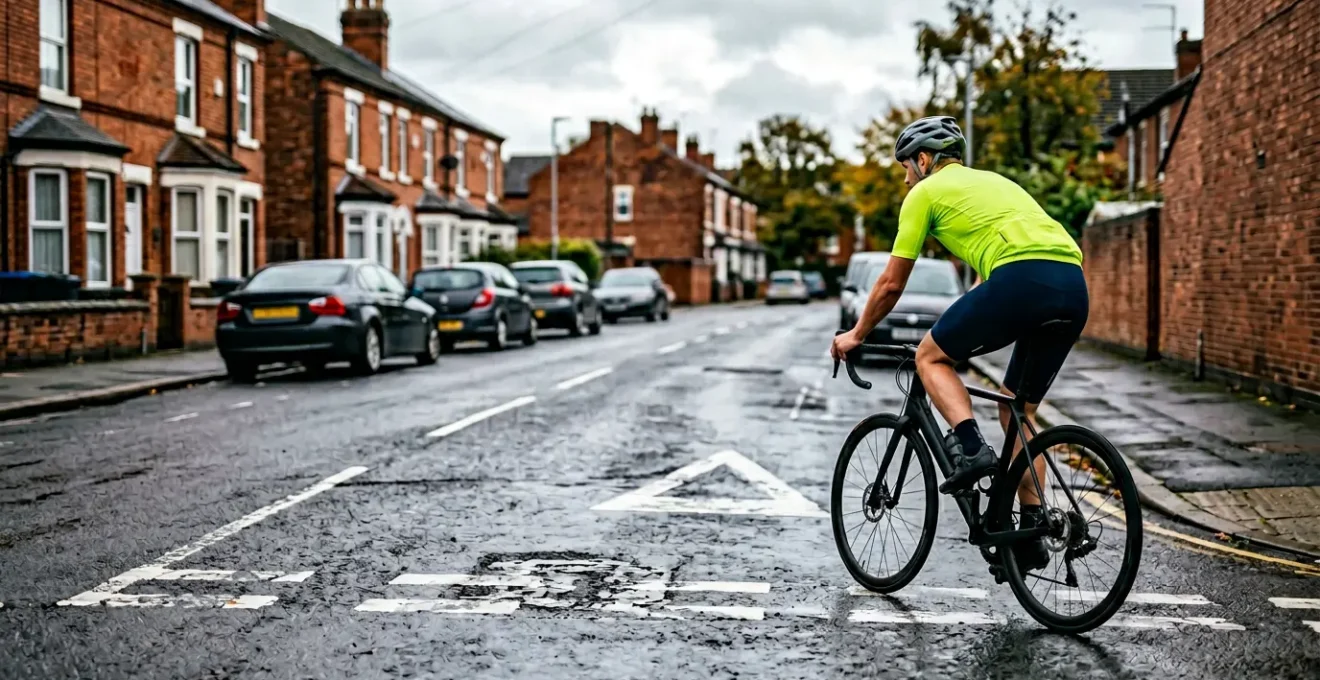
High-visibility clothing is not a silver bullet; being seen by drivers is a battle for cognitive attention, not just a matter of brightness.
- Drivers suffer from ‘inattentional blindness’, meaning their brains can filter out cyclists they aren’t actively looking for, regardless of colour.
- Pattern-breaking designs and biological motion (‘biomotion’) are more effective than solid neon blocks for capturing a driver’s attention, especially in complex environments and at night.
Recommendation: Stop searching for one magic jacket. Instead, build a ‘conspicuity system’ using different strategies for day, night, and various road environments.
Every cyclist who has ridden on UK roads knows the feeling: the sudden rush of wind and roar of an engine as a vehicle passes uncomfortably close. The default advice has always been a simple, almost paternalistic mantra: “wear bright colours.” We’ve dutifully kitted ourselves out in screaming neon yellows and fluorescent pinks, hoping to transform ourselves from vulnerable road users into unmissable beacons of safety. We’ve accepted the trade-off, sacrificing style for the promise of being seen.
But what if the fundamental premise is flawed? What if the problem isn’t that drivers can’t see us, but that their brains don’t register us? This isn’t about blaming the victim; it’s about upgrading our understanding of the problem. The debate between looking like a construction worker or wearing stylish, dark-coloured kit is often framed as a simple choice between safety and aesthetics. The reality, however, is far more nuanced and scientifically complex.
This analysis moves beyond the platitude of “be bright, be seen.” We will deconstruct the cognitive phenomena that lead to “looked-but-failed-to-see” crashes, examine the surprising science of what actually makes a cyclist stand out against a complex background, and explore the legal ramifications of your clothing choices. By the end, you’ll understand that true safety isn’t found in a single neon jersey, but in a systematic approach to conspicuity.
This article delves into the evidence-based realities of cyclist visibility. We will explore the science of driver perception, the effectiveness of different visual strategies, and the practical steps you can take to build a genuine safety system, not just a bright wardrobe.
Summary: The Science of Being Seen: A Cyclist’s Guide to UK Road Safety
- The “SMIDSY” Phenomenon: Why Drivers Look but Don’t See Cyclists?
- Solid Colour vs Pattern breaking: What Makes You Stand Out Against a Hedge?
- Contributory Negligence: Can Wearing Dark Clothes Reduce Your Insurance Claim?
- White vs Black Helmets: Does Head Visibility Matter Above Traffic?
- Flags and Spacers: Do Physical Width Indicators Force Drivers to Pass Wider?
- Flashing or Steady Lights: Which Mode Actually Gets a Driver’s Attention?
- The “White Van” Effect: Does Radar Make You Complacent on Shoulder Checks?
- Beyond Hi-Vis: How to Stay Seen on Dark Country Lanes at Night?
The “SMIDSY” Phenomenon: Why Drivers Look but Don’t See Cyclists?
The most frustrating and dangerous encounters on the road often begin with the infamous phrase, “Sorry mate, I didn’t see you” (SMIDSY). This isn’t always an excuse; it’s a terrifyingly common cognitive failure. The root cause is not necessarily poor eyesight, but a phenomenon known as inattentional blindness. This is the brain’s highly efficient—and sometimes fatal—filtering system. When a driver is focused on looking for cars, their brain may literally edit out other, less expected objects from their conscious perception, even if they are looking directly at them.
Motorcyclists, who share a similarly narrow profile with cyclists, are frequent victims of this. As Dr. Kristen Pammer’s research into this area concludes, “Motorcycles appear to be very low on the priority list for the brain when it is filtering information.” This mental blind spot is compounded by physical perception challenges. The narrow profile of a cyclist creates insufficient ‘looming’—the visual cue of an object rapidly growing in size that triggers our brain’s danger-detection circuits. Our eyes are poor at detecting objects moving directly towards us (Z-motion) compared to those moving across our field of vision.
This means a driver can look directly at an approaching cyclist and their brain fails to correctly interpret the closing speed or even register the cyclist as a threat. In fact, research into inattentional blindness revealed that participants in a simulator were twice as likely to miss a motorcycle compared to a taxi. Understanding this core cognitive issue is the first step: the problem isn’t just being visible, it’s about being cognitively conspicuous enough to break through the driver’s mental filter.
Solid Colour vs Pattern breaking: What Makes You Stand Out Against a Hedge?
The classic solution to the visibility problem is a solid block of fluorescent colour. In the right conditions, it’s remarkably effective. Studies have shown that in daylight, fluorescent materials can dramatically increase detection distances. They work by absorbing invisible UV light and re-emitting it as visible light, making them appear to glow, especially in overcast or low-light daytime conditions. The effect is potent: some findings suggest fluorescent yellow can increase a driver’s detection distance from 400 feet to as much as 2,200 feet.
However, the real world is not a sterile laboratory. A solid block of colour, even a bright one, can still be camouflaged against a complex and “noisy” visual background like a dappled country lane or a busy city street. This is where the concept of pattern-breaking becomes critical. The military has understood this principle for decades, but in reverse. Camouflage works by using patterns to break up the recognisable human silhouette, helping it blend into the background. For cyclists, we can use this principle for safety.

A jacket with bold, high-contrast geometric shapes or panels does something a solid colour cannot: it creates distinct edges and forms that the human brain can latch onto. It disrupts the brain’s tendency to smooth over and ignore objects that blend with their surroundings. Against a natural, leafy green hedge, a solid yellow jersey might still be perceived as a patch of sunlight or flowers. A jersey with sharp, unnatural black-and-yellow blocks is unmistakably artificial and man-made, triggering a different level of cognitive processing in an observer. The goal isn’t just to be a colour, but to be a recognisable shape that doesn’t belong in the natural environment.
Contributory Negligence: Can Wearing Dark Clothes Reduce Your Insurance Claim?
While the scientific debate on visibility is fascinating, there is a harsh legal reality that every UK cyclist should be aware of: your clothing choice can have significant financial consequences in the event of a crash. The legal concept of contributory negligence means that if you are found to be partially at fault for your own injuries, any compensation you receive can be reduced by a corresponding percentage. And in the eyes of some UK courts, wearing dark clothing, especially at night, can be deemed a contributing factor.
The case law is clear. In the prominent case of Carpenter v Lunnon [2004], a pedestrian wearing dark clothing on a dark country lane was hit from behind. The court determined that his dark clothing reduced the driver’s opportunity to see him and reduced his compensation by 20%. While this was a pedestrian, the principle is regularly applied to cyclists. Depending on the specific circumstances—such as time of day, weather, and road type— UK judges have assessed contributory negligence at rates of 35-40% or more in cycling cases where visibility was a key issue.
It’s crucial to distinguish between recommendations and legal requirements. The UK Highway Code states in Rule 60 that at night, a bicycle MUST have a white front and red rear light lit. This is a legal mandate under The Road Vehicles Lighting Regulations 1989. Failing to have lights at night is an almost guaranteed way to be found significantly negligent. While the code only *recommends* light-coloured or fluorescent clothing in daylight and reflective clothing at night, failing to follow this advice can and will be used by an opposing insurer’s legal team to argue that you did not take reasonable care for your own safety. This transforms your jacket choice from a simple preference into a decision with potential five-figure financial implications.
White vs Black Helmets: Does Head Visibility Matter Above Traffic?
The helmet is often the highest point on a cyclist, putting it above the roofline of many cars and making it potentially visible from a greater distance. This raises the question: does helmet colour actually make a difference? The evidence suggests a resounding yes. While a brightly coloured jersey can be obscured by other vehicles, a helmet often remains in a driver’s line of sight for longer.
A landmark case-control study conducted in New Zealand provided some of the most compelling data on this topic. The researchers meticulously analysed real-world crash data and found that riders wearing white helmets had a significantly lower risk of being involved in a crash compared to those wearing darker colours. The conclusion was stark: the study found a 24% lower crash risk for white helmets vs. black helmets. This is a substantial difference that cannot be attributed to chance.
Further research into detection distances provides the rationale behind this finding. A white or silver helmet simply reflects more ambient light, making it more visible in a wider range of conditions, especially during the crucial dawn and dusk periods. In contrast, a black or dark blue helmet absorbs light and can blend in with background shadows, trees, or tarmac. The difference in conspicuity is dramatic. While fluorescent helmets perform best in daylight, even a simple white helmet provides a significant safety advantage over a dark one, making it a simple, evidence-based choice for any rider concerned with their safety. It’s a passive safety feature that is always working.
Flags and Spacers: Do Physical Width Indicators Force Drivers to Pass Wider?
Faced with the feeling of powerlessness against close-passing drivers, some cyclists turn to physical deterrents. These range from high-vis flags on long poles, common on recumbent bikes, to more aggressive-looking plastic “spacers” that stick out from the side of the bike, designed to physically demarcate the rider’s space. The logic seems sound: if a driver is afraid of hitting an object attached to your bike, they will surely give you more room. But does the evidence support this?
The research in this area, much of it pioneered by Dr. Ian Walker at the University of Bath, paints a more complex picture. Dr. Walker’s studies involved rigging a bicycle with an ultrasonic sensor to precisely measure passing distances under various conditions. His findings have challenged many common assumptions about visibility. In one famous part of his study, he donned different outfits, including a vest with the word ‘POLICE’ printed on the back. The result? As he noted, even the authority of the police only increased passing distance by a mere 2 inches on average.
This suggests that drivers’ passing distances are often dictated by habit, road positioning, and subconscious factors rather than a conscious evaluation of the cyclist’s kit. While a physical spacer might prevent the most egregious passes by forcing a driver to swerve, it doesn’t necessarily teach them to perform a safe overtake consistently. Furthermore, there’s a risk that such devices could be perceived as aggressive by drivers, potentially escalating tension. They may offer a psychological comfort blanket for the rider, but the science suggests they are not a substitute for assertive road positioning and a broader understanding of conspicuity.
Flashing or Steady Lights: Which Mode Actually Gets a Driver’s Attention?
Bicycle lights have evolved from dim, bulb-based units to incredibly powerful LEDs capable of casting a beam for hundreds of metres. This has brought a new debate to the forefront: for daytime visibility and nighttime safety, is it better to use a flashing or a steady light? The choice has significant implications for how a driver’s brain processes your presence.
A flashing light is exceptionally good at one thing: capturing initial attention. The blinking pattern is a powerful signal that breaks through the visual noise of the environment, making it excellent for being noticed in the first place. This is why many advocates support a flashing light for daytime use. A large-scale Danish experiment involving nearly 4,000 cyclists found that using permanent front and rear daytime running lights led to a significant drop in accidents causing injury, demonstrating their effectiveness in getting cyclists noticed.
However, a flashing light has a major drawback: it makes it very difficult for the human eye to judge distance and speed. Because the light source is not constant, the brain struggles to process its location in 3D space. At night, this can be dangerous. A driver might see a blinking light but be unable to tell if it’s 50 metres away and stationary or 200 metres away and approaching rapidly. This is where a steady light excels. A constant, bright light allows other road users to accurately triangulate your position, speed, and direction of travel. For this reason, many experts and regulations (in countries like Germany) advocate for steady lights at night. A popular and effective compromise is to use two lights: a primary steady light to allow for distance judgment, and a secondary flashing light to act as an attention-grabbing signal.
The “White Van” Effect: Does Radar Make You Complacent on Shoulder Checks?
Modern cycling technology offers a new layer of protection: rear-facing radar units that alert the rider to approaching vehicles. These devices can be a game-changer, providing an early warning system that reduces the stress of riding on busy roads. They effectively give you eyes in the back of your head. However, this powerful tool comes with a potential psychological trap: automation complacency.
Automation complacency is the learned tendency to over-trust an automated system, leading to a reduction in manual checks and vigilance. When the radar has been silent for 10 minutes on a quiet road, do you still perform a full, decisive shoulder check before moving out to avoid a pothole? Or do you begin to rely solely on the beep from your head unit? This is the danger. Technology is a fantastic aid, but it is not a replacement for fundamental roadcraft and situational awareness. It can fail, its battery can die, or it may not detect a fast-approaching vehicle until the last second.
The “White Van Effect” isn’t about a specific type of vehicle, but the scenario of a vehicle pulling out from a side road or performing a manoeuvre that the radar, focused on the rear, cannot predict. A huge proportion of crashes happen at intersections. The landmark Hurt Report on motorcycle safety found that in two out of three multi-vehicle crashes, the driver of the other vehicle violated the rider’s right of way. This often happens at junctions—the exact place where rear-facing radar offers no benefit. Relying on it can subtly degrade the vital habit of scanning all around, leaving you vulnerable to the most common types of collisions.
Key Takeaways
- Inattentional blindness is the real enemy, not just poor light; drivers’ brains filter out what they don’t expect to see.
- Fluorescent colours are effective in daylight only as they require UV light to work; retro-reflective materials are essential for night-time conspicuity.
- Highlighting human movement (biomotion) with reflective strips on ankles and knees is scientifically proven to be more effective for night recognition than a static reflective vest.
Beyond Hi-Vis: How to Stay Seen on Dark Country Lanes at Night?
As dusk settles, a fluorescent yellow jacket loses its power. Fluorescent materials work by converting UV light from the sun into visible light, but as expert Dr. Philippe Lacherez points out, they “don’t work at night.” At this point, safety depends entirely on two other factors: active lighting (your bike lights) and passive reflectivity (retro-reflective materials). A common mistake is to rely on a jacket with a few small reflective patches. While better than nothing, this approach fails to leverage the most powerful recognition tool we have: biomotion.
Biological motion, or biomotion, refers to the unique, recognisable patterns of movement created by human joints. Our brains are hard-wired over millennia to detect this specific motion. A study by the Queensland University of Technology highlighted this powerfully. Drivers were able to recognise a cyclist wearing reflective strips on their ankles and knees in just 1.5 seconds. The same cyclist wearing only a reflective vest took over 6 seconds to be identified. The recognition rate was astonishing: research highlights showed that drivers recognized cyclists 90% of the time with ankle and knee markers, versus only 15% for a fluorescent vest alone at night.
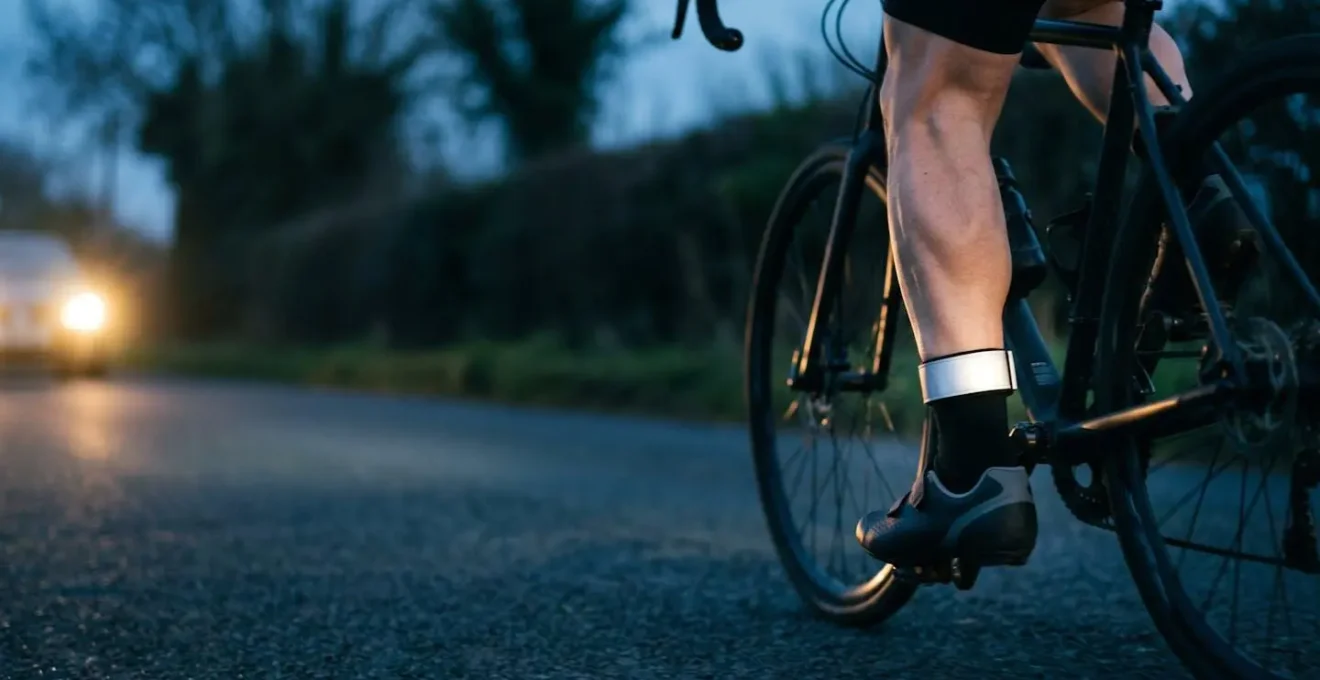
This means the most effective thing you can do to be seen on a dark road is to highlight your moving parts. Reflective ankle bands, shoe covers, or over-trousers with reflective details on the lower leg are far more effective than a static, reflective torso panel. The up-and-down, circular motion of your pedalling feet creates an unmistakable signal that screams “human on a bicycle” to an approaching driver’s brain, cutting through the darkness and visual clutter in a way a simple bright block of colour never could.
Your 5-Point Conspicuity System Audit
- Lighting Inventory: List your front and rear lights. Do you have both steady (for night-time depth perception) and flashing (for daytime attention) modes available and in use?
- Daylight Gear Check: Collect your main jerseys/jackets. Are they solid fluorescent, or do they incorporate high-contrast, pattern-breaking designs to stand out against complex backgrounds?
- Night-time Gear Check: Examine your kit for retro-reflective material. Is it only on the torso, or does it highlight your key biological motion points: ankles, knees, and feet?
- Helmet Assessment: Look at your helmet. Is it a dark colour that absorbs light, or a light/white/silver colour that reflects ambient light, making you more visible above the traffic line?
- Integration Plan: Based on the audit, identify the biggest gap. Is it a lack of biomotion markers for night riding, or reliance on a dark helmet? Plan one specific gear upgrade to create a more complete day/night system.
Ultimately, the choice to wear neon or not is a false dichotomy. True road safety is not achieved with a single garment but through a thoughtful, evidence-based ‘conspicuity system’. It involves understanding the cognitive limitations of drivers and using a combination of strategies—daytime fluorescence, pattern-breaking designs, night-time biomotion, and effective lighting—to ensure you are not just visible, but unmissable. Re-evaluate your kit not on the basis of a single colour, but on how effectively it helps a distracted driver’s brain answer the question: “What is that, and what is it doing?”