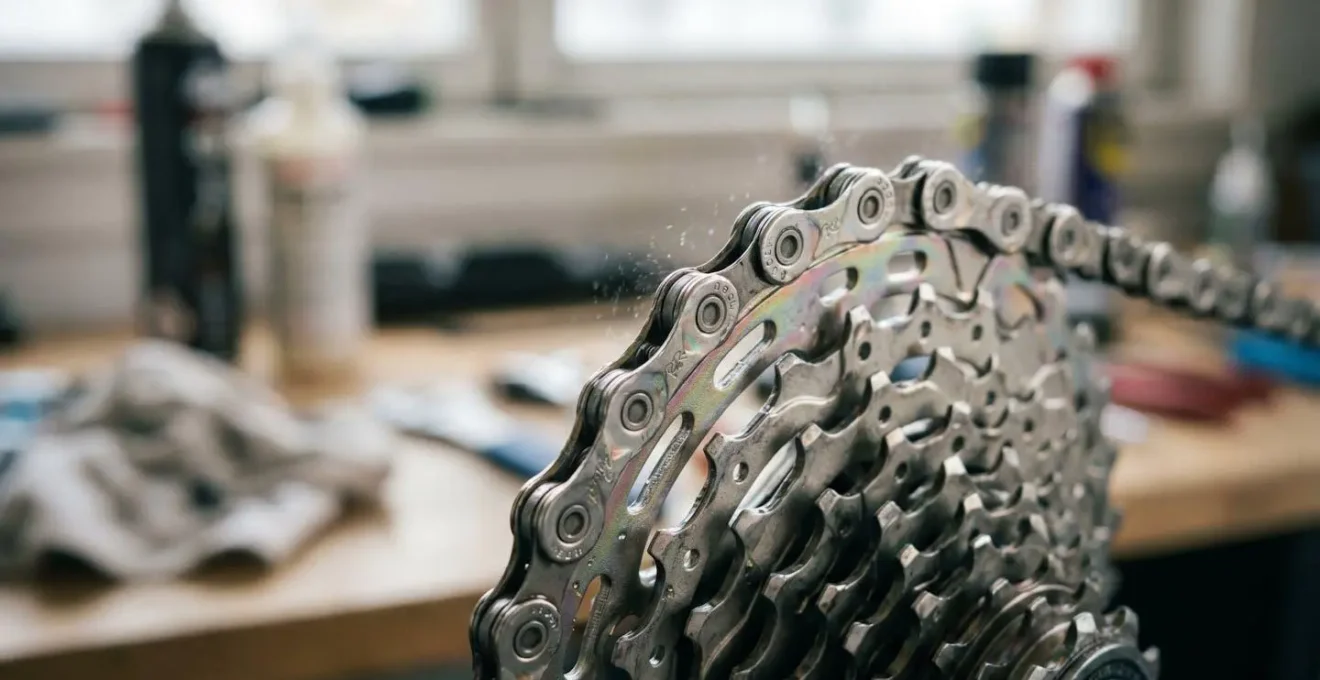
The single greatest performance and financial return in cycling comes from a clean drivetrain, not expensive upgrades.
- Regular, correct cleaning offers a 30-60x better Return on Investment (ROI) per watt gained than ceramic bearings or aero wheels.
- Neglecting your chain doesn’t just reduce performance; it actively depreciates your bike’s most expensive components, multiplying replacement costs by up to 3x.
Recommendation: Treat your drivetrain not as a part to be used, but as a financial asset to be managed. A disciplined 10-minute cleaning routine is your best investment.
That sharp, grinding noise from your drivetrain isn’t just an annoyance; it’s the sound of money turning into metal dust. You’ve likely just been handed a garage bill for a new cassette and chain, perhaps upwards of £200, and felt the shock. The mechanic probably mumbled something about “wear and tear.” This is a lie of omission. What they should have said is that this was an almost entirely preventable expense, caused by a failure in asset management.
The common wisdom is simple: “clean your chain.” But this advice is dangerously incomplete. It fails to convey the sheer financial gravity of the situation. We’re told to use a degreaser, a brush, and some lube. This is like telling a stockbroker to “buy low, sell high” – it ignores the strategy, the methodology, and the crucial “why.” Cyclists obsess over marginal gains from ceramic bearings, aero frames, and lightweight components, yet they completely ignore the massive, quantifiable losses happening in their own drivetrain.
This article reframes the entire discussion. We will not talk about cleaning as a chore. We will discuss drivetrain hygiene as a strict financial protocol. The fundamental truth is this: the battle for performance and financial efficiency is won or lost not in the wind tunnel, but in a bucket of degreaser. A clean chain is not about feeling good; it’s about stopping the catastrophic depreciation of your most critical components.
We will dissect the cost-benefit of different lubricants, evaluate the ROI of cleaning tools, establish non-negotiable procedures for waste disposal and high-torque motors, and prove, with hard numbers, that 10 minutes of your time yields a greater performance-per-pound return than any upgrade you can buy. This is not a guide; it is a financial strategy for your bicycle.
This guide provides a structured, evidence-based approach to drivetrain maintenance, treating it as a critical investment. The following sections break down the financial and performance implications of each choice you make.
Summary: The Financial Case for Drivetrain Hygiene
- Wet vs Dry Lube: Which Stops Your Chain Turning Black in Summer?
- Chain Scrubbers vs Toothbrush: Is the Gadget Worth the Faff?
- Eco-Friendly Disposal: Where to Pour Dirty Degreaser Legally?
- The “Wipe Down” Rule: How to Delay Deep Cleans with Post-Ride Habits?
- Pressure Washers: Why Spraying Your Chain Ruins Freehub Bearings?
- £300 for 2 Watts: Is a Clean Chain a Better Investment?
- How to Stop a High-Torque Motor from Snapping Your Chain in 500 Miles?
- Ceramic Bearings: Are They Worth the High Maintenance in Wet Climates?
Wet vs Dry Lube: Which Stops Your Chain Turning Black in Summer?
The choice between wet and dry lubricant is not about preference; it’s a financial calculation based on your riding environment. The black gunk that coats your chain in summer is not just unsightly. It is a grinding paste, a mixture of excess lubricant and abrasive road grit, that is actively sand-papering your expensive cassette and chainrings into oblivion. A dry or wax-based lubricant is the correct choice for dry, dusty summer conditions because it creates a hard, non-tacky surface that repels contaminants. Wet lube, by its nature, is an oil-based adhesive that attracts and holds onto this grit, accelerating asset depreciation.
The financial impact is not trivial. Using a dry or wax-based lube and applying it correctly (thinly and wiping off excess) can result in a 1.5 to 2x slower wear rate compared to a poorly managed wet lube. This directly translates to doubling the lifespan of your drivetrain components. The black chain is a visual indicator of poor financial choices. Your goal is a chain that looks clean and runs quietly, not one that is visibly “wet” with oil. A wet look means you have over-applied the product, creating the very grinding paste you are trying to avoid.
The numbers below do not lie. An over-applied wet lube that attracts dirt can triple or quadruple your drivetrain running costs over 5000km. This is a direct consequence of choosing the wrong tool for the conditions or applying it incorrectly.
| Lubricant Type | Chains Worn (5000km) | Cassettes Replaced | Chainrings Replaced | Total Cost (USD) |
|---|---|---|---|---|
| Optimal Dry/Wax Lube | 0.3-0.5 | 0.1 | 0.05 | $25-$35 |
| Standard Wet Lube (Properly Applied) | 0.6-0.8 | 0.2 | 0.08 | $50-$65 |
| Over-Applied Wet Lube (Attracts Dirt) | 1.2-1.5 | 0.4-0.5 | 0.12-0.15 | $95-$125 |
| Cost assumptions: Chain $35, Cassette $65, Chainrings $85. Data extrapolated from Zero Friction Cycling wear testing. | ||||
Chain Scrubbers vs Toothbrush: Is the Gadget Worth the Faff?
The debate between a dedicated chain scrubber and an old toothbrush is a classic example of false economy. A toothbrush is a surface-level tool. It scrapes visible grime from the outer plates of the chain but fails to address the root cause of wear: grit that has penetrated the rollers and pins. This internal contamination is responsible for over 90% of chain elongation and subsequent component damage. A chain scrubber is not a luxury; it is a precision instrument designed to solve this specific problem.
Its rotating brushes, submerged in degreaser, force cleaning fluid into the internal mechanics of each link, flushing out the abrasive particles a toothbrush can never reach. The financial return on investment (ROI) is clear. A £15 chain scrubber saves approximately seven minutes per clean compared to the toothbrush method. If you clean your chain weekly, this amounts to over six hours saved per year. If you value your time at a mere £2.50/hour, the tool pays for itself in less than a year on time savings alone. This calculation, however, ignores the far greater saving: the drastic reduction in wear on your £200 cassette and chainrings.
Thinking the toothbrush is “good enough” is a costly mistake. You are performing a cosmetic clean while the core of your asset continues to degrade. The scrubber is a non-negotiable tool for anyone serious about preserving their drivetrain. It is the difference between polishing a car with a rotten chassis and performing critical engine maintenance.
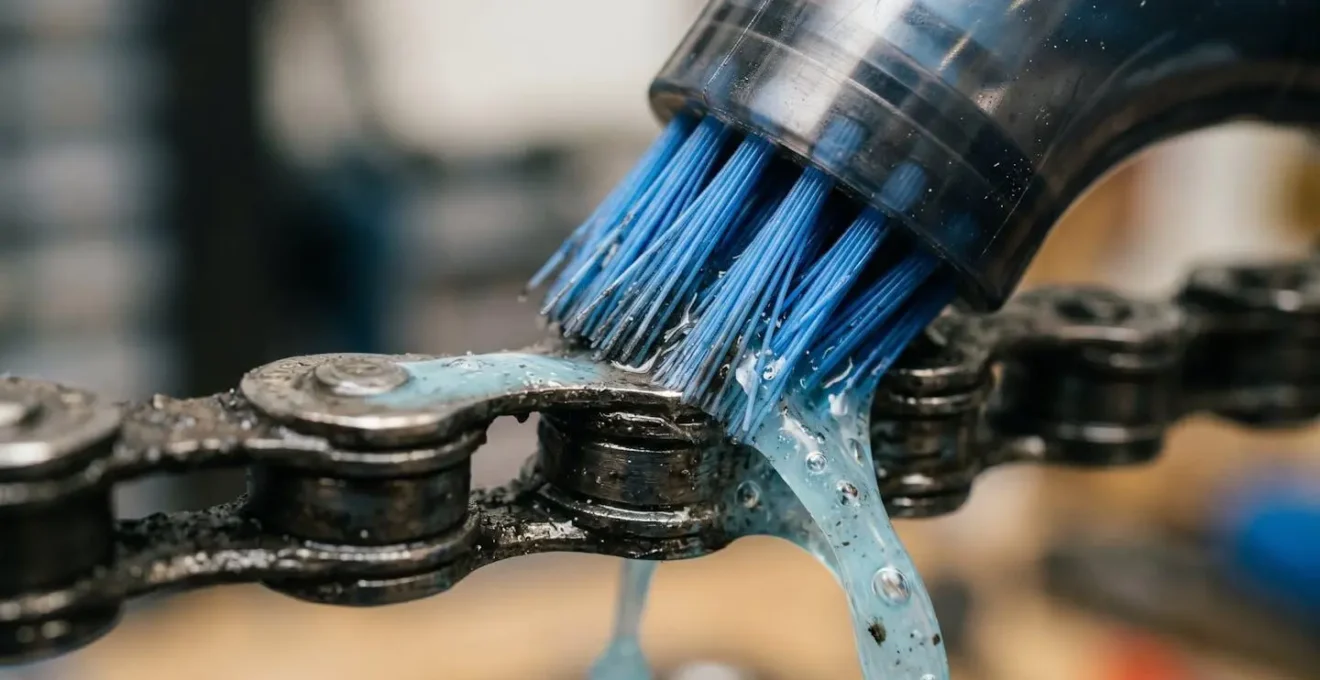
As the image demonstrates, the mechanical action of a scrubber is designed to penetrate the most critical areas of the chain. This is not cleaning; it’s a deep-seated decontamination process that a simple brush cannot replicate. The “faff” of using the gadget is insignificant compared to the faff and expense of replacing your entire drivetrain prematurely.
Eco-Friendly Disposal: Where to Pour Dirty Degreaser Legally?
The black liquid you’re left with after cleaning your chain is not just “dirty degreaser.” It is a toxic cocktail of degreasing solvents, petroleum residues, and heavy metal particles (nickel, chromium, steel) worn from your drivetrain. Pouring this down the drain or onto the ground is irresponsible, often illegal, and contaminates soil and water systems. Even biodegradable, citrus-based degreasers are not exempt from this rule. As maintenance experts emphasize:
even ‘eco’ degreaser becomes hazardous waste once it’s contaminated with heavy metals and petroleum from the chain
– Cycling maintenance experts consensus, Triathlete Magazine – Chain Cleaning Environmental Impact
A professional approach involves not only proper disposal but also maximizing the life of your degreaser, treating it as a consumable asset. The “Two-Jar System” is a simple, effective method for this. It reduces degreaser consumption by up to 70% and drastically minimizes the volume of hazardous waste you need to dispose of. This isn’t just about being “green”; it’s about efficient, cost-effective workshop practice.
Action Plan: The Two-Jar Degreaser Recycling System
- Collection: After each cleaning, pour all used, black degreaser into a sealed glass container labelled “Jar 1: Sedimentation.”
- Settling: Allow Jar 1 to sit completely undisturbed for 5-7 days. The heavy metal filings and solid grit will settle to the bottom, forming a thick sludge.
- Decanting: Carefully pour the now-cleaner, translucent top layer of liquid from Jar 1 into a second container, “Jar 2: Re-use.” Be careful not to disturb the sludge at the bottom.
- Re-use: Use the recycled degreaser in Jar 2 for the initial, heavy-duty cleaning stages. This liquid is still highly effective for breaking down grime. Use fresh, new degreaser only for the final, clean rinse.
- Disposal: When the sludge in Jar 1 accumulates to about one-third of the jar’s volume, seal it securely. Take it to your local council’s hazardous waste disposal facility or a household chemical collection point. Do not put it in your regular bin.
The ‘Wipe Down’ Rule: How to Delay Deep Cleans with Post-Ride Habits?
The most effective maintenance is preventative. A deep clean with degreaser is a corrective action, necessary only when contamination has become significant. The single most powerful habit for extending the life of your drivetrain and delaying the need for deep cleans is the post-ride wipe-down. This is a non-negotiable 30-second ritual for any serious cyclist.
Immediately after every single ride, take a clean, dry microfibre cloth and run the chain backwards through it. This simple action removes the surface layer of dust, water, and road grit before it has a chance to be pulled into the chain’s rollers by the next application of lube. This prevents the formation of the abrasive “grinding paste” that destroys components. Implementing this rule can easily double the interval between necessary deep cleans. Indeed, data from professional cycling maintenance protocols shows an increase from 50-100 km to 100-200 km between deep cleans with a consistent wipe-down habit.
This isn’t just about saving time; it’s a critical diagnostic process. A daily wipe-down allows you to feel and hear the condition of your chain. You will notice stiff links or the gritty sound of internal contamination long before it becomes a major problem, allowing for targeted intervention instead of costly component failure.
Case Study: Professional Team Maintenance Protocol
EF Pro Cycling mechanics follow a strict post-ride protocol: chains are wiped down thoroughly after each training day using a dry microfiber cloth, removing surface dust and grit before they can work into the rollers. For stage races, this 30-second habit doubles the interval between deep degreaser cleans from every 3 days to every 6 days, halving maintenance time over a 21-day Grand Tour while maintaining optimal drivetrain efficiency. The wipe-down serves as a diagnostic check – mechanics listen for gritty sounds and feel for stiff links that signal the need for deeper intervention.
Pressure Washers: Why Spraying Your Chain Ruins Freehub Bearings?
Using a pressure washer on a bicycle is the definition of a high-risk, low-reward financial decision. The allure is saving a few minutes, but the potential cost is catastrophic. The high-pressure jet of water, especially when aimed at the cassette area, does not simply “clean” the bike. It forces water and embedded grit past the delicate rubber seals that protect the bearings inside your freehub body and bottom bracket.
Once these seals are compromised, water displaces the grease packed inside the bearing races. This leads to rapid corrosion and failure. The result is a crunchy, inefficient, and ultimately destroyed freehub or bottom bracket, requiring a replacement that can cost anywhere from £80 to £200 in parts and labour. The perceived “time saving” of 8 minutes by using a pressure washer can therefore have an effective cost of £600 to £1,500 per hour ‘saved’ when component failure occurs.
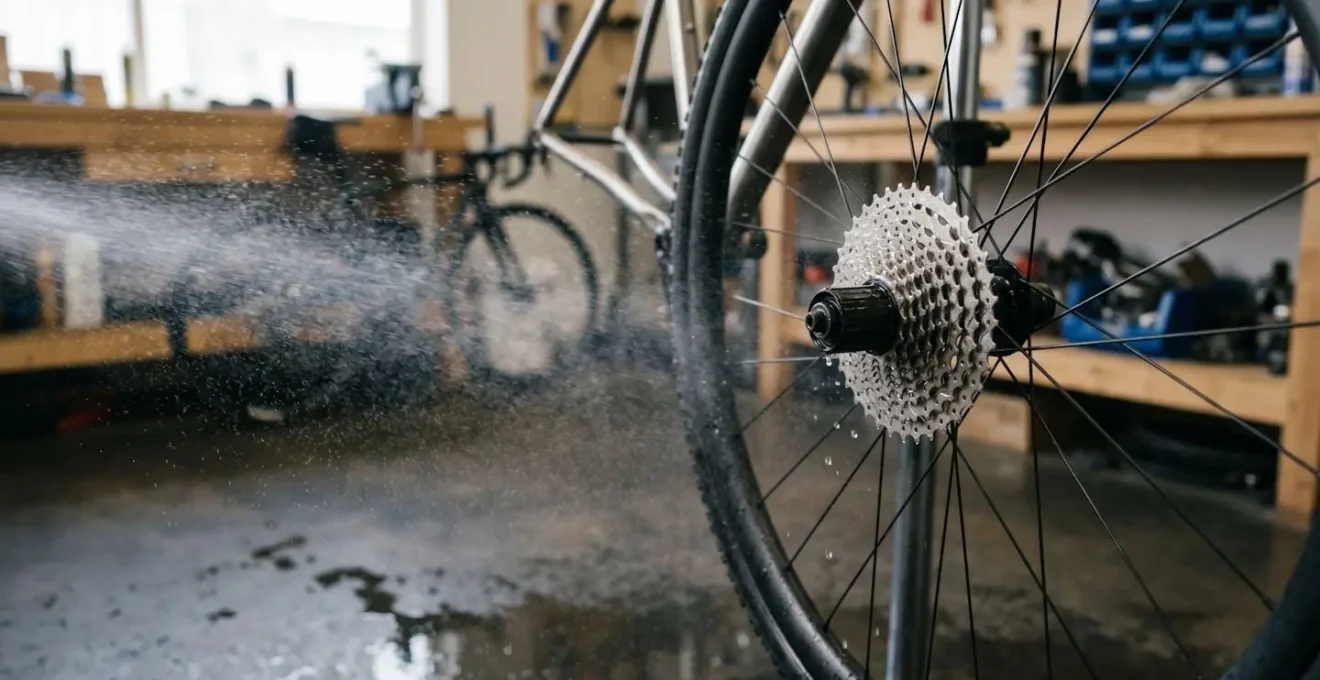
There is no “safe” way to use a high-pressure jet near any bearing on a bicycle. A low-pressure garden hose with a “shower” nozzle, used from a distance and never aimed directly at bearing seals, is an acceptable way to rinse the bike. But for the drivetrain itself, manual cleaning with brushes and degreaser is the only professionally sanctioned method that carries zero risk of collateral damage.
The table below starkly illustrates the financial foolishness of using a pressure washer. It’s a gamble you will eventually lose.
| Method | Time Required | Materials Cost | Risk of Damage | Repair Cost if Damaged |
|---|---|---|---|---|
| Proper Manual Clean (Degreaser + Brush) | 10 minutes | £2 degreaser per clean | 0% – No risk | £0 |
| Pressure Washer (Direct spray at cassette/freehub) | 2 minutes | £0 (water only) | High – Forces water past seals | £50-£150 freehub body + bearings replacement + £30-£50 labor |
| Low-Pressure Garden Hose (Side spray, shower nozzle) | 5 minutes | £0 (water only) | Low – Safer alternative | £0-£20 (minimal risk) |
| The 8-minute time saving from pressure washing can result in £80-£200 in damage costs – an effective cost of £600-£1,500 per hour ‘saved’ | ||||
£300 for 2 Watts: Is a Clean Chain a Better Investment?
The cycling industry thrives on the pursuit of marginal gains, selling expensive components with promises of saved watts. A £300 ceramic pulley wheel system might save you 2 watts. A £1,500 aero wheelset might save you 8 watts at high speed. These are considered significant investments in performance. Yet, the single largest and most cost-effective watt-saving available to any cyclist is systematically ignored: a clean chain.
The science is unequivocal. Friction Facts laboratory testing demonstrates a dirty, gritty chain can rob you of 5-10 watts of power at a typical 250W output compared to a clean, properly lubricated one. In real-world muddy conditions, this loss can skyrocket. The cost to reclaim these watts is not hundreds or thousands of pounds. It is the price of a bottle of degreaser and 10 minutes of your time.
Let’s analyze this from a pure ROI perspective. The “Cost per Watt Saved” is the ultimate metric for any performance upgrade. As the data below proves, nothing comes close to the value of basic drivetrain hygiene. Investing in expensive hardware before you have mastered chain cleaning is financially illogical. You are spending £150 to gain a single watt from a pulley wheel while simultaneously throwing away 10 watts due to dirt.
A disciplined cleaning routine offers a return on investment that is 30 to 60 times better than buying premium components. It is the lowest-hanging fruit in the entire orchard of performance upgrades.
| Upgrade Type | Investment Cost | Watts Saved (at 250W) | Cost per Watt Saved | Maintenance Required |
|---|---|---|---|---|
| Ceramic Pulley Wheel System | £300 | 2 watts | £150/watt | Low (but fragile in wet conditions) |
| Premium Aero Wheelset | £1,500 | 5-8 watts (at 40 km/h) | £188-£300/watt | Low |
| Regular Chain Cleaning + Optimal Lube | £10 degreaser + £12 lube = £22 | 5-10 watts (vs dirty chain) | £2.20-£4.40/watt | High (10 mins every 200km) |
| Wax-Based Chain Treatment (paraffin) | £15 for supplies | 3-6 watts (vs standard lube) | £2.50-£5/watt | Very High (strip and re-wax every 300-650km) |
| Source: VeloNews & Friction Facts data analysis. Chain cleaning delivers 30-60x better ROI per watt saved than premium components. | ||||
How to Stop a High-Torque Motor from Snapping Your Chain in 500 Miles?
An e-bike motor, particularly a mid-drive unit with high torque (60Nm+), is a financial consequence multiplier. It applies forces to your drivetrain that are far beyond human capacity, and it does so relentlessly. This means that every mistake in maintenance is amplified, and the cost of neglect escalates dramatically. While e-bike drivetrain research suggests an e-bike chain might last 2,000-3,000 km compared to 3,000-5,000 km on a traditional bike, this is only true under an optimal maintenance schedule.
With poor hygiene, the story is far worse. The motor’s torque forces abrasive grit deep into the chain rollers with incredible pressure, accelerating wear exponentially. A chain that might have lasted 1,000 miles on an acoustic bike can be stretched to its breaking point in under 500 miles on a high-torque e-bike. This “chain stretch” (elongation) then acts like a faulty tool, re-shaping and destroying the teeth on your much more expensive cassette and chainring.
For an e-bike owner, meticulous drivetrain cleaning is not an optional task; it is a mandatory protocol to prevent rapid, catastrophic financial loss. Using an e-bike-specific chain, which features stronger pins and plates, is the first step. The second, and more critical step, is a cleaning frequency that is double that of a non-assisted bike. Poor shifting technique, such as changing gear under full motor power, further compounds the stress on the chain. You must learn to momentarily ease off the pedals as you shift to allow the chain to move smoothly.
Case Study: The Multiplied Cost of E-Bike Neglect
A workshop study tracked two identical e-bikes with 85Nm mid-drive motors over 1,000 miles. Bike A used a standard chain with minimal cleaning (every 300 miles). Bike B used an e-bike-specific chain with regular cleaning (every 100 miles) and proper shifting technique. The results were stark: Bike A’s chain reached the dangerous 0.75% wear limit at just 800 miles and had completely destroyed the cassette by 1,000 miles, necessitating a £200 full drivetrain replacement. Bike B’s chain measured only 0.3% wear at the same 1,000-mile mark, with no measurable damage to the cassette. The study concluded that high motor torque multiplies the financial consequences of poor maintenance by 2-3x, making it a non-negotiable expense.
Key Takeaways
- The return on investment for chain cleaning is 30-60 times better than buying premium components, making it the best performance upgrade available.
- A pressure washer is a high-risk tool that can cause £80-£200 in bearing damage for an 8-minute time saving.
- The black gunk on a chain is a “grinding paste” that triples or quadruples drivetrain running costs; a clean look is a sign of financial health.
Ceramic Bearings: Are They Worth the High Maintenance in Wet Climates?
In the final analysis, all discussions about performance must return to the reality of the riding environment. Ceramic bearings and other high-end upgrades are “fair weather” soldiers. Their marginal gains, measured in a clean lab, are often the first casualty in a battle against real-world conditions like rain, mud, and road grime. In wet and gritty climates, the entire performance equation is dominated by one factor: drivetrain contamination.
The miniscule 1-2 watt saving from a ceramic bearing is rendered utterly meaningless when your drivetrain is labouring under a heavy coating of mud. In truly filthy conditions, lab testing by Friction Facts suggests power loss from a contaminated chain can reach an astronomical 20-30 watts at a 250W output. In this context, obsessing over ceramic bearings is like worrying about the aerodynamics of your valve caps while dragging an anchor.
The priority must always be the fundamentals. In a wet climate, this means switching to a high-quality wet lubricant, applying it correctly, and being even more disciplined with your post-ride wipe-down and cleaning schedule. The lubricant acts as a protective barrier against water, but it will also attract more grit, making frequent cleaning an absolute necessity. The financial choice is clear: spend your money and time on a robust cleaning protocol that works in all conditions, not on fragile, expensive components that offer a benefit only when it’s clean and dry.
A clean, well-maintained standard steel drivetrain will outperform a filthy, neglected one with ceramic upgrades every single time. Cleanliness is not an upgrade; it is the foundation upon which all performance is built. Without it, you are simply throwing money into the mud.
Now that you understand the stark financial realities, the next logical step is to implement a strict, non-negotiable maintenance schedule. Treat it not as a chore, but as the most profitable 10 minutes you can invest in your cycling.