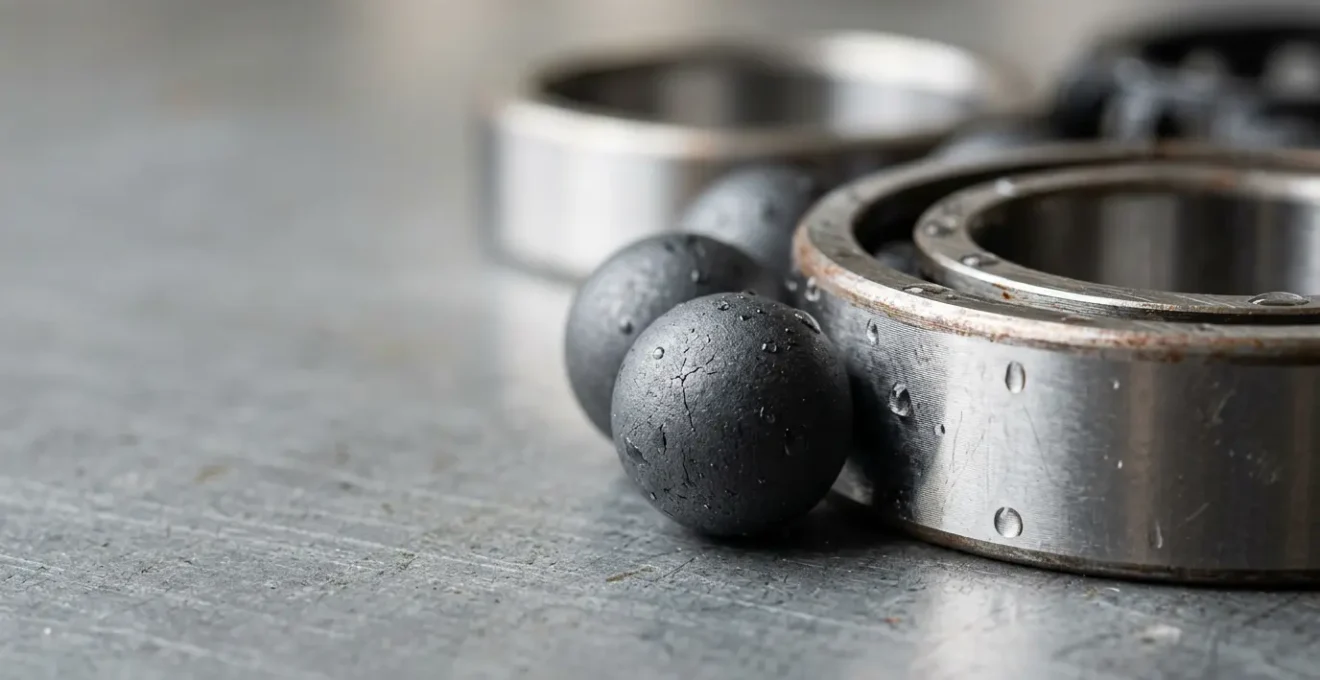
For cyclists in wet climates, ceramic bearings are a fundamentally flawed investment, offering marginal gains in a lab that evaporate or even become a liability on gritty, wet roads.
- The required low-friction grease offers virtually no water protection, leading to rapid contamination and increased friction.
- The steel races, not the ceramic balls, are the weak point; they corrode and are susceptible to permanent damage (brinelling) from the harder ceramic balls, especially in misaligned frames.
Recommendation: Invest your £300 budget in a professional bike fit and a premium chain waxing system. You will gain 10-20 times more real-world speed for your money and reduce long-term maintenance costs.
The allure of ceramic bearings is potent. Videos of cranksets spinning endlessly on a workstand plant a powerful seed: this is free speed, an upgrade that works tirelessly while you pedal. For the discerning amateur cyclist, already invested in a high-performance machine, the jump to ceramic seems like the next logical step in marginal gains. The marketing promises lower friction, greater durability, and a handful of saved watts that could be the difference on a long climb or a final sprint. This promise can be compelling enough to overlook a price tag that often runs into the hundreds of pounds.
However, for a rider whose reality involves the damp tarmac, persistent drizzle, and gritty spray of a UK winter, a critical question must be asked: does the lab-tested promise of ceramic bearings survive first contact with the real world? The answer is far from simple. The very properties that make ceramic bearings shine in a sterile environment can become their greatest weaknesses when exposed to water, dirt, and the microscopic imperfections of a real-world bicycle frame. This isn’t a simple question of cost versus benefit; it’s a complex analysis of risk, maintenance liability, and return on investment (ROI).
Instead of blindly chasing marginal gains, a more rational, ROI-focused approach is required. What if the key to unlocking more speed isn’t a high-cost, high-maintenance component, but a series of lower-cost, higher-impact optimisations? This article will dissect the claims made about ceramic bearings through the lens of a performance consultant. We will analyse the trade-offs in grease and seals, the realities of material corrosion, the catastrophic risk of frame misalignment, and ultimately, compare the cost-per-watt of this upgrade against more pragmatic, effective alternatives.
This guide breaks down the true cost and benefit of ceramic bearings in challenging conditions. By examining each aspect from an investment perspective, you’ll be equipped to make a rational decision that maximises your performance on the road, not just in theory.
Summary: A Rational Analysis of Ceramic Bearings for Wet Climates
- Speed vs Longevity: Why Factory Grease Is Too Slow for Time Triallists?
- Contact Seals: Why “Spinning Forever” on the Stand Means Nothing on the Road?
- Stainless vs Ceramic Hybrid: Which Races Rust Slower?
- Pressing Issues: Why Ceramic Bearings Die Fast in Misaligned Frames?
- £300 for 2 Watts: Is a Clean Chain a Better Investment?
- Index 12 vs 6:Is Buying a Cheap Carbon Frame Worth the Risk on UK Roads?
- Derailleur Prices: What Happens When You Drop an Electronic Bike?
- Chain Cleaning: How a £10 Degreaser Saves You £200 on Cassettes?
Speed vs Longevity: Why Factory Grease Is Too Slow for Time Triallists?
The core conflict of any bearing, ceramic or steel, lies in its lubrication. The grease inside a bottom bracket or wheel hub serves two opposing purposes: it must be fluid enough to allow free rotation with minimal drag, yet thick and tenacious enough to prevent water and contaminants from entering and destroying the bearing surfaces. For a time triallist competing in dry conditions, every fraction of a watt counts, making an ultra-low viscosity oil or grease the logical choice. The minimal drag is worth the trade-off of near-zero protection against the elements.
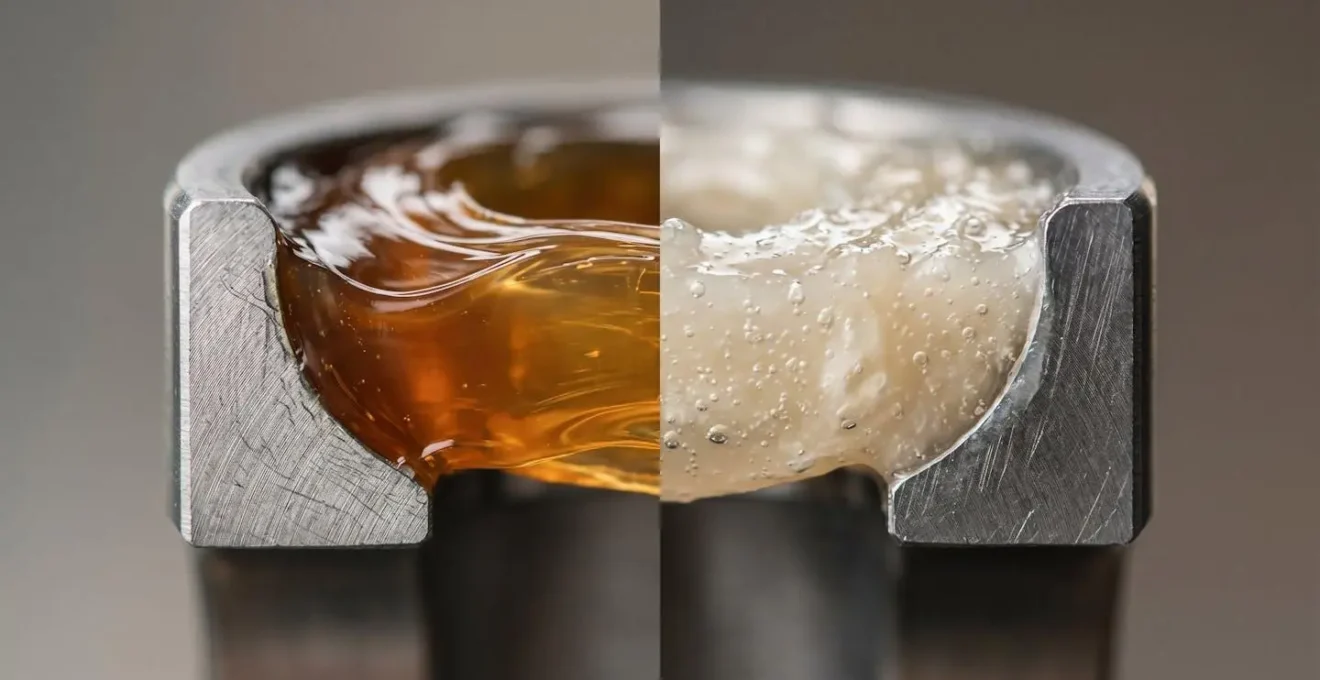
However, for a rider in a wet climate, this approach is disastrous. A light, low-friction grease is quickly purged by water ingress, leading to a milky, emulsified substance with poor lubricating properties. This not only increases friction but accelerates wear. In fact, some independent testing reveals that using a heavy, waterproof grease to protect a “fast” ceramic bearing can result in a complete negation of any theoretical watt gains. You are left with a high-cost component performing no better, or even worse, than a standard sealed bearing. The table below illustrates this fundamental compromise between speed and durability.
| Grease Type | Friction (watts/pair BB) | Water Resistance | Service Interval | Best Use Case |
|---|---|---|---|---|
| Ultra-Low Viscosity Oil (Avid Slip R/C) | 0.02W (lowest) | Very Poor | Weekly in wet conditions | Race day only, dry conditions |
| Light Factory Grease | 0.39-0.46W | Moderate | 500-1000km | All-purpose road cycling |
| Heavy Marine Grease | 0.79W+ (highest drag) | Excellent | 2000-3000km wet weather | Year-round wet climate training |
The image below provides a stark visualisation of this process. On one side, clean, effective grease; on the other, the same grease contaminated with water, its structure and protective qualities compromised. This is the reality that a low-viscosity, race-day lubricant faces after a single wet ride.
Ultimately, a ceramic bearing’s performance is only as good as its lubrication. In a wet climate, you are forced to choose between low friction and effective protection. You cannot have both. Opting for protection means using a heavier grease that makes the ceramic upgrade’s primary benefit—low friction—entirely redundant. It’s an investment that cancels itself out.
Contact Seals: Why “Spinning Forever” on the Stand Means Nothing on the Road?
The “endless spin” test is perhaps the most deceptive piece of marketing in the cycling world. A crankset or wheel that spins for minutes in a workstand seems impressive, but from a practical engineering perspective, it’s a significant red flag. That effortless spin is often a sign of minimal or non-contact seals. While this creates exceptionally low drag in a clean, static environment, it means the bearing is wide open to the grit and water of the real world. A bearing with poor sealing is not a high-performance component; it’s a short-term liability on wet roads.
True all-weather performance requires robust contact seals. These are seals that make physical contact with the rotating part of the bearing race to create a physical barrier against contaminants. This contact, by its very nature, adds a small amount of drag. A well-sealed, brand-new bearing will feel noticeably “slower” or more resistive when spun by hand compared to a poorly sealed one. This isn’t a flaw; it’s the sign of a component built for longevity in the real world, not for workstand demonstrations.
The engineering team at Kogel, a company that specializes in performance bearings, puts it best when discussing the balance between friction and protection. As they state in their technical blog on bike bearing friction testing:
Cross seals add around 0.5W of friction to a bottom bracket. Our cross seal bearings will work exactly the same at the start and after 90 minutes of watery mud treatment. A lesser sealed bearing would be faster on the opening lap, but would fill up with dirt.
– Kogel Bearings Engineering Team, Kogel
This is the crux of the issue for a wet-climate cyclist. The tiny friction penalty of a good seal is a constant, predictable “cost” that you pay for vastly superior protection. In contrast, the “free” speed of a non-contact seal is quickly erased and reversed as soon as grit and water enter the bearing, creating a high-friction, grinding paste that rapidly destroys the precise internal surfaces. From an ROI perspective, the smart investment is in the component that maintains consistent performance over time, not the one that offers a fleeting moment of low friction before catastrophic failure.
Stainless vs Ceramic Hybrid: Which Races Rust Slower?
A common sales pitch for hybrid ceramic bearings—which feature ceramic balls running on steel races—is their superior corrosion resistance. After all, the ceramic balls themselves are virtually immune to rust. However, this argument conveniently overlooks the most vulnerable part of the system: the steel races. The bearing is only as corrosion-resistant as its weakest component, and in a hybrid bearing, that component is invariably the inner and outer steel rings that the balls roll on.
Even when these races are made of “stainless steel,” they are not entirely immune to corrosion, especially in the presence of road salt and grime. The term “stainless” simply means the steel has a higher chromium content, which helps it resist rust better than standard chrome steel, but it doesn’t make it rust-proof. As a leading bearing engineering analysis demonstrates, the overall corrosion resistance is fundamentally reduced in hybrid bearings because they still rely on metal rings. The ceramic balls can be perfectly pristine, but if the track they run on becomes pitted with rust, the bearing’s performance is compromised and its lifespan is drastically shortened.
The choice of steel for the race involves a critical trade-off between hardness and corrosion resistance. Harder steel is needed to prevent the ultra-hard ceramic balls from damaging the race, but harder steels typically have lower corrosion resistance. The following table, adapted from data on bearing materials, highlights this dilemma.
| Race Material | Hardness (HRC) | Corrosion Resistance | Ceramic Ball Compatibility | Best Application |
|---|---|---|---|---|
| 52100 Chrome Steel | 60-65 (hardest) | Poor (1.5% chromium) | Risk of brinelling damage | Dry indoor racing only |
| 440C Stainless | 58-60 | Good (16-18% chromium) | Adequate with proper hardening | Mixed weather road cycling |
| 316 Stainless | 35-40 (softest) | Excellent (marine-grade) | Softer race reduces ball advantage | Year-round wet climate commuting |
As the table shows, the hardest steel (52100) offers poor rust resistance. The most rust-resistant steel (316) is too soft to be a good partner for hard ceramic balls, negating their performance advantage. This leaves 440C stainless as the common compromise, but its resistance is merely “good,” not “invincible.” In a wet, gritty environment, micro-pitting from corrosion on the 440C race is a significant risk, leading to noisy, rough-feeling bearings. The investment in ceramic balls is rendered moot once the path they travel on has been damaged by rust.
Pressing Issues: Why Ceramic Bearings Die Fast in Misaligned Frames?
Perhaps the single greatest risk to your ceramic bearing investment has nothing to do with the bearing itself, but with the frame it’s installed in. The extreme hardness of ceramic balls, often touted as a benefit for durability, becomes a catastrophic liability when paired with even the slightest frame misalignment. This is due to a failure mode called brinelling. When a bearing is overloaded or subjected to a sharp impact, the balls can press tiny, permanent dents into the steel race they run on.
With traditional steel bearings, both the ball and the race are of similar hardness, so they may deform slightly together under extreme load. With a hybrid ceramic bearing, the silicon nitride ball is 3-4 times harder than the steel race. It does not deform. Instead, it acts like a tiny hammer, concentrating all the force onto a microscopic point and punching a permanent dent into the softer steel race. As the TFL Bearing Engineering team explains:
Brinelling is permanent plastic deformation of the bearing raceway. Because ceramic balls are 3-4 times harder than steel races, any misalignment doesn’t deform the ball; it causes the ball to permanently press a microscopic dent into the race.
– TFL Bearing Engineering Team, True vs. False Brinelling: Diagnosis & Prevention Guide
This is especially critical in modern press-fit bottom brackets. If the two bearing bores in the carbon frame are not perfectly parallel and co-axial (a common manufacturing tolerance issue), the bearing is installed under a constant side-load. This continuous, uneven pressure forces the ultra-hard ceramic balls into the steel races, creating a rhythmic “clicking” or “grinding” as the balls roll in and out of the dents they have created. Your expensive, “fast” bearing is now a noisy, inefficient mess.
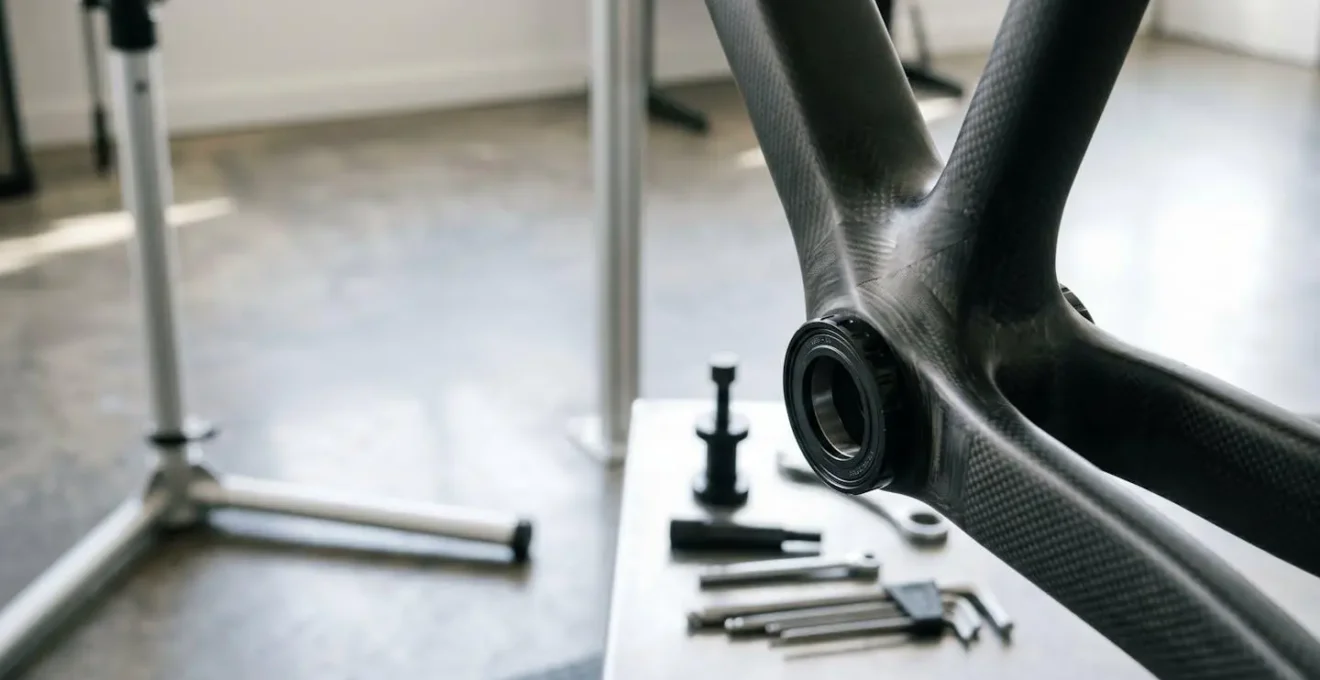
Before even considering an investment in ceramic bearings, you must have absolute confidence in your frame’s alignment. For a press-fit system, this means tolerances measured in hundredths of a millimeter. Without access to precision measurement tools, this is almost impossible for the average user to verify. The following checklist provides a basic method for assessing potential alignment issues that could doom a ceramic bearing upgrade.
Checklist: Bearing Health Assessment for Frame Alignment
- Remove crankset and spin bearing by hand, feeling for distinct ‘clicking’ or uneven resistance at specific rotation points (indicates brinell marks at ball spacing intervals).
- Check for fretting corrosion by inspecting the outside of the bearing shell for red-brown dust or discoloration where the bearing contacts the frame (a sign of micro-movement from misalignment).
- Measure the bearing bore with a dial bore gauge if available, or check for visual gaps when the bearing is seated (press-fit should be a uniform interference, not loose in one direction).
- Test for false brinelling by noting if noise disappears after 10-15 minutes of riding (true brinelling produces rhythmic noise that persists and worsens).
- Monitor temperature after a 30-minute ride; excessive heat at the bearing location compared to the opposite side indicates misalignment causing uneven load and accelerated wear.
£300 for 2 Watts: Is a Clean Chain a Better Investment?
After navigating the complexities of grease, seals, and materials, the final investment decision comes down to a simple question: what is the actual, measurable return in watts, and how does it compare to other available upgrades? This is where the case for ceramic bearings as a sound investment completely falls apart. While manufacturers often claim savings of “1 to 9 watts,” these numbers are typically generated under idealized, unloaded lab conditions with no seals.
Independent, third-party testing tells a much different story. When put under real-world loads, the measurable gains are often vanishingly small. In a landmark study, Friction Facts laboratory data showed that the difference between the *single best* tested steel bottom bracket and the *single best* ceramic one was a mere 0.03 watts. That’s three-hundredths of a watt, a quantity so small it’s deep within the margin of error of any power meter. As one analysis of independent testing concludes, the real-world gain is often undetectable by the rider.
This number is often derived from unloaded, lab-condition tests by manufacturers. Under real-world rider load and in contaminated conditions, the actual, measurable gain is often less than 0.5 watts, well within the margin of error and undetectable by the rider.
– Independent Bearing Testing Analysis, Ceramic Cycling Bearings: Worth the Money or Overblown Hype?
To put a £300 investment for a potential 0.5-watt gain into perspective, let’s compare the cost-per-watt against other common performance upgrades. The following table provides a stark reality check on where your money is best spent to go faster.
| Upgrade Option | Initial Cost (£) | Watts Saved (@40kph) | Cost per Watt (£) | Maintenance Factor |
|---|---|---|---|---|
| Ceramic Bearings (full system) | 300 | 1.5W (claimed, 0.5W realistic) | £200-600 | High (frequent service, contamination risk) |
| Chain Immersion Waxing (setup + 3 chains) | 150 | 5-7W vs standard lube | £25-30 | Moderate (re-wax every 200-300km) |
| Aero Helmet (mid-range) | 120 | 8-12W vs standard helmet | £10-15 | None (no consumables) |
| Premium Tyres (pair, low rolling resistance) | 100 | 10-15W vs budget tyres | £7-10 | Low (normal replacement cycle) |
| Professional Bike Fit | 200 | 15-30W (position optimization) | £7-13 | None (one-time investment) |
The numbers are unequivocal. The ROI on ceramic bearings is astronomically poor compared to almost any other performance-oriented purchase. For the same £300, you could get a professional bike fit and a pair of premium low-rolling-resistance tyres, and save upwards of 30 watts—a 60-fold better return on your investment. A clean, waxed chain offers at least 10 times the watt savings for half the cost. From a purely rational, ROI-focused perspective, ceramic bearings are one of the worst value-for-money upgrades in cycling.
Index 12 vs 6:Is Buying a Cheap Carbon Frame Worth the Risk on UK Roads?
The discussion about bearing alignment naturally leads to a broader, more fundamental question of investment: the frame itself. The performance and longevity of any high-end component, be it a bottom bracket or a headset, is contingent on the quality of the platform it’s mounted on. If a £3,000 “Index 12” frame from a top-tier manufacturer guarantees near-perfect bearing bore alignment, what is the risk associated with a £1,000 “Index 6” frame from a less-established brand?
On the rough and often poorly maintained roads of the UK, this question carries significant weight. A frame must not only be light and stiff but also dimensionally accurate and durable. Cheaper carbon manufacturing processes can sometimes lead to greater variability in tolerances. A bottom bracket shell that is a few hundredths of a millimeter out of true might be unnoticeable with a forgiving, standard steel bearing. However, as established in the section on brinelling, this same minor imperfection can be a death sentence for a £300 ceramic bearing set.
Therefore, the decision to buy a cheaper carbon frame introduces a hidden variable into your total cost of ownership. You might save money upfront on the frameset, but you may be inadvertently buying into a future of creaking, premature component wear, and frustration. The risk isn’t just that the frame might have a cosmetic blemish; the risk is that its critical interfaces are not manufactured to the precise tolerances required by the high-performance components you intend to install. From an ROI perspective, a “cheap” carbon frame can become very expensive if it requires you to replace high-end bearings every few thousand miles.
Your frame should be considered the foundational investment. Before even contemplating an expensive “marginal gain” upgrade like ceramic bearings, a rational investor must be confident that the foundation is sound. On UK roads, a robust, well-manufactured frame that can withstand the rigours of the environment and whose tolerances are guaranteed is a far smarter long-term investment than a budget frame paired with exotic, fragile components.
Derailleur Prices: What Happens When You Drop an Electronic Bike?
Expanding our ROI-focused lens, we must consider the entire bicycle as a system of investments and risks. You are considering a £300 upgrade for a largely invisible, questionable performance gain. Now, consider another component: a modern electronic rear derailleur, which can easily cost £500-£700. Unlike the bottom bracket, it is highly exposed and vulnerable to damage in even a minor crash or a simple tip-over.
This introduces the concept of a “risk budget.” If your total budget for performance and maintenance is not infinite, where do you allocate your funds and accept risk? Investing in fragile, high-maintenance bearings for a wet climate is one form of risk—the risk of a poor return and rapid failure. Investing in an expensive electronic derailleur is another—the risk of a high-cost, single-incident failure. A rational performance consultant would advise minimising both. The key is to build a robust system that delivers reliable performance day-in, day-out.
A standard, high-quality steel bearing from a reputable brand like Shimano or NTN costs around £20-£30 for a set. It is built to withstand contamination, offers excellent longevity, and has a negligible friction penalty in real-world conditions. The £270 saved by forgoing the ceramic “upgrade” could be put towards the cost of a future replacement derailleur, a professional bike fit, several pairs of top-tier tyres, or a power meter to enable more effective training. All of these represent a more tangible and reliable return on investment.
The cyclist obsessed with marginal gains often loses sight of the bigger picture. They chase hundredths of a watt in their bottom bracket while ignoring the 10 watts lost to a dirty chain or the 20 watts lost to a poor aerodynamic position. The question isn’t just “what happens when you drop an electronic bike?” but “what is the most intelligent allocation of capital to build a fast, reliable, and resilient cycling system?” In this analysis, expensive bearings for wet-weather riding consistently fall to the bottom of the priority list.
Key takeaways
- Real-world watt savings from ceramic bearings are often less than 0.5W under rider load, a value dwarfed by aerodynamic and drivetrain friction losses.
- The engineering requirements for wet-weather riding (robust seals, waterproof grease) directly contradict and negate the low-friction design principles of race-day ceramic bearings.
- The true ROI for speed lies in proven, high-impact areas: a professional bike fit, quality tyres, an aero helmet, and meticulous drivetrain hygiene.
Chain Cleaning: How a £10 Degreaser Saves You £200 on Cassettes?
We arrive at the most logical conclusion of this entire analysis. If the goal is to maximise performance and get the best return on investment, the focus must shift away from high-cost, low-yield upgrades and toward low-cost, high-impact maintenance. Nothing exemplifies this principle better than drivetrain hygiene. A dirty, poorly lubricated chain can easily waste 5 to 10 watts of your power—a loss that is 10 to 20 times greater than the most optimistic, real-world gains from a ceramic bearing upgrade.
The investment required to solve this problem is laughably small in comparison. A £10 bottle of degreaser and £20 for a block of paraffin wax and a slow cooker (the “immersion waxing” method) constitutes a complete system that will not only claw back those lost watts but also dramatically extend the life of your expensive drivetrain components. A clean, waxed chain runs with incredible efficiency and does not attract grit. This lack of a “grinding paste” means your chain, cassette, and chainrings will last two to three times longer. A £200 cassette can be saved from premature death by a £10 maintenance routine.
This is the ultimate expression of a smart ROI. The initial investment is minimal, the performance return is significant and measurable, and the long-term cost savings are substantial. It directly contrasts with the ceramic bearing proposition: a high initial investment for a negligible performance return and a potential increase in long-term maintenance costs and failure risk. For the rational cyclist, the choice is clear.
Forget the allure of endlessly spinning cranks in a sterile workshop. The real path to speed is paved with discipline and intelligent maintenance. The satisfaction of a silent, hyper-efficient, and sparkling clean drivetrain after every ride is a far more tangible reward than the hope of a few phantom watts from an over-engineered and environment-inappropriate component. Your time and money are your most valuable assets; invest them where they will generate the greatest returns.
To truly maximise your speed and the longevity of your components, the next logical step is to establish a rigorous, repeatable drivetrain cleaning and lubrication schedule. Start today by investing in the right tools for the job.