
The £800 premium for electronic shifting is a complex investment for amateurs, offering undeniable convenience but also introducing significant financial risks.
- It delivers perfect, maintenance-free shifting and measurably boosts a bike’s resale value.
- However, it introduces risks of expensive crash replacements and potential ride-ending battery failures.
Recommendation: Your decision should be based on a sober assessment of your budget and risk tolerance, not just the pursuit of marginal performance gains.
You’re standing in the bike shop, staring at two nearly identical carbon road bikes. The frames are the same, the wheels match, but one has a price tag that is £800 higher. The difference? One has a traditional mechanical groupset, the other has its sleek, electronic counterpart. The salesperson extols the virtues of electronic shifting: flawless gear changes, no cable stretch, the same technology the pros use. It’s tempting. The allure of perfect, effortless performance is a powerful one for any keen cyclist.
For years, the debate has been framed around performance. But for a weekend club rider, is a slightly faster shift a real-world benefit, or just a costly luxury? The standard advice often misses the point. It focuses on the “what” – faster shifts, auto-trimming – but rarely delves into the financial reality for the person who pays for their own equipment. This article takes a different approach. We are treating that £800 premium not as a simple purchase, but as a financial investment. Our goal is to rigorously analyse the true return on that investment. We will look beyond the hype to assess the tangible benefits, hidden costs, maintenance realities, and long-term value to help you decide if electronic shifting is a smart financial move or an £800 indulgence.
This guide provides a comprehensive financial and practical analysis of the key differences that matter most to an amateur rider. By examining each aspect through the lens of value for money, you’ll be equipped to make an informed decision that fits your budget and your riding.
Summary: Analysing the £800 Electronic Shifting Investment
- Chain Rub: How Electronic Front Derailleurs Eliminate the Noise Forever?
- Charging Anxiety: How Often Do You Really Need to Plug Your Bike In?
- Derailleur Prices: What Happens When You Drop an Electronic Bike?
- One-Handed Shifting: Is Automatic Front Shifting Useful or Annoying?
- Resale Value: Do Electronic Bikes Hold Their Price Better?
- £300 for 2 Watts: Is a Clean Chain a Better Investment?
- Internal Routing: Why Mechanics Charge Less to Build Wireless Bikes?
- Cable Stretch vs Dead Batteries: Which Gear Failure Is Easier to Fix Roadside?
Chain Rub: How Electronic Front Derailleurs Eliminate the Noise Forever?
The persistent ticking sound of a chain lightly grazing the front derailleur cage is a familiar annoyance for any cyclist. This “chain rub” occurs when you’re in a “cross-chained” gear combination (e.g., largest chainring and largest cog), forcing the chain to run at an extreme angle. With mechanical systems, riders learn to “trim” the front derailleur—a small, intermediate shift that moves the cage slightly to accommodate the chain’s angle. It’s a skill, and one that’s easy to forget in the heat of a climb. Electronic shifting eradicates this problem completely through a feature called auto-trim.
As you shift across the rear cassette, the electronic front derailleur automatically makes micro-adjustments to its position, maintaining a perfect gap with the chain at all times. This isn’t just about noise; it’s about mechanical perfection delivered on every single shift, without any rider input. As T.J. Tollakson notes in the “Triathlete’s Complete Guide to Electronic Shifting,” the computer-controlled accuracy ensures a more precise and powerful shift every time.
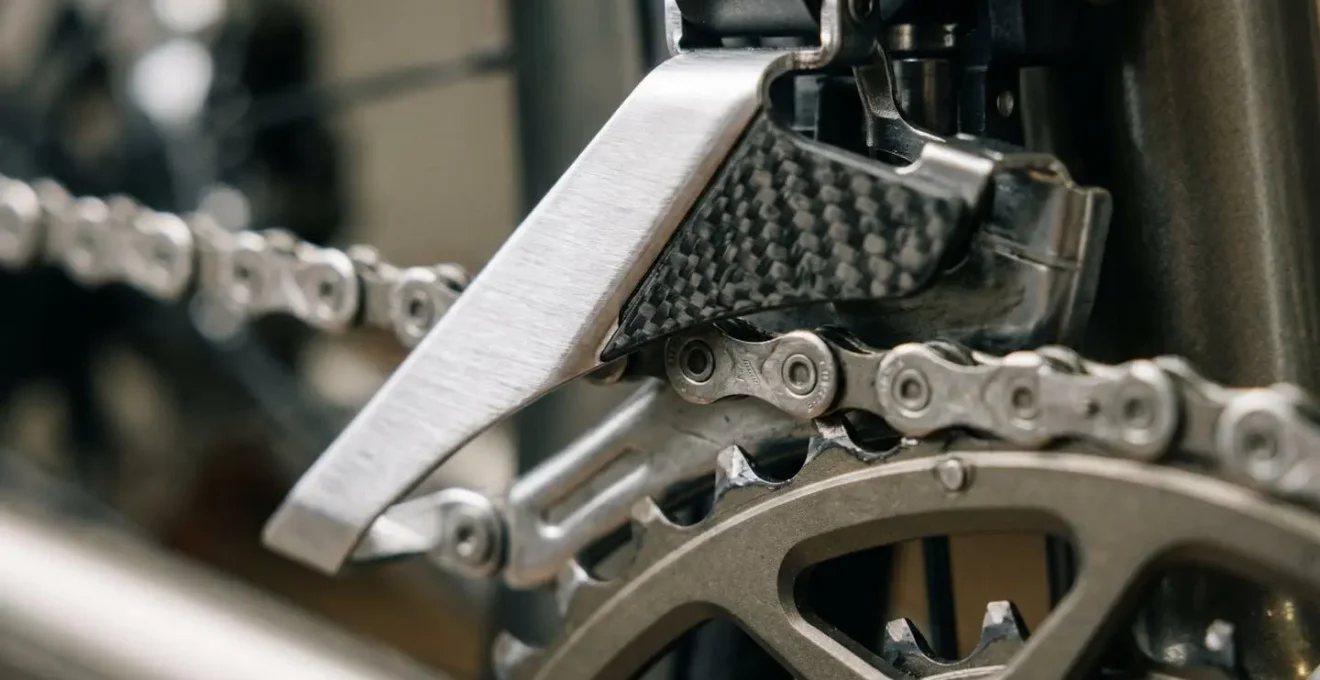
The engineering behind this is impressive, as the derailleur’s motor constantly calculates and maintains the optimal position. For the weekend rider, this translates to a quieter, smoother ride and one less thing to think about. The financial question, however, remains: how much of that £800 premium is this silent convenience worth to you? It provides zero performance gain but offers a significant improvement in quality-of-life on the bike.
Charging Anxiety: How Often Do You Really Need to Plug Your Bike In?
The moment you add electronics, you introduce a battery, and with it, “charging anxiety.” The fear of a battery dying mid-ride, leaving you stuck in your hardest gear miles from home, is a common concern for those considering the switch. However, for most systems, especially Shimano’s Di2, the reality is far less dramatic. The central battery that powers both derailleurs has an exceptionally long life, designed to make charging a rare and predictable event rather than a constant worry.
For a typical club rider, the charging interval is measured in months, not days. Real-world data confirms this, showing that an average cyclist riding three to five times a week may only need to charge their bike four times a year. When the battery does get low, the system provides ample warning. First, the front derailleur will stop shifting, conserving the remaining power for the rear derailleur, which can typically perform another hundred shifts or so—more than enough to get you home. This intelligent power management effectively eliminates the risk of being stranded unexpectedly.
The following table provides a clear comparison of battery performance across the major electronic groupset platforms, showing that modern systems are built for endurance. These figures highlight that charging is a minor, infrequent maintenance task, not a daily burden.
| System | Battery Life (Hours) | Battery Life (km/miles) | Charge Time | Battery Type |
|---|---|---|---|---|
| Shimano Di2 | N/A (distance-based) | 1,000-2,000km (621-1,242mi) | 1.5 hours | Single internal rechargeable |
| SRAM AXS Road | 60 hours | ~1,000-1,500km (variable) | 1 hour | Removable rechargeable per derailleur |
| SRAM AXS MTB | 25 hours | ~500-800km (variable) | 1 hour | Removable rechargeable per derailleur |
While SRAM’s AXS system uses separate batteries with a shorter life per unit, their removable nature allows a rider to easily carry a spare—a different approach to solving the same problem. For a value-conscious rider, the takeaway is that battery life is largely a solved issue and should not be a major financial or practical deterrent.
Derailleur Prices: What Happens When You Drop an Electronic Bike?
This is the question that should be at the forefront of any value-conscious rider’s mind. While electronic groupsets offer sublime performance, they operate in the real world—a world of potholes, accidental drops in the café car park, and occasional crashes. Here, the financial implications of electronic shifting become starkly apparent. The components are not just electronic; they are miniature, sealed computers with motors, and they carry a corresponding price tag.
Let’s perform a simple risk analysis. A replacement Shimano 105 mechanical rear derailleur typically costs around £50-£60. It’s a painful, but not catastrophic, expense. In contrast, a replacement Shimano 105 Di2 rear derailleur can cost upwards of £250-£300. This single component, vulnerable in any crash, costs more than half of the entire groupset premium. It is the single biggest financial risk you accept when choosing electronic.
While some systems like SRAM AXS have a “clutch” mechanism designed to protect the motor in an impact, no system is indestructible. The cost of failure is fundamentally higher. For a professional team with sponsors and spare bikes, this is a non-issue. For the amateur rider paying for their own repairs, a single unlucky incident can turn an £800 investment into a £1,100 one. This high replacement cost is the hidden premium that isn’t advertised on the shop floor. It’s a financial gamble that the convenience and performance are worth the significantly increased risk.
One-Handed Shifting: Is Automatic Front Shifting Useful or Annoying?
Beyond the simple act of shifting gears, electronic systems introduce a level of automation that is impossible with mechanical setups. The most notable feature is “Synchronized Shifting,” which allows for a revolutionary level of control. In this mode, the rider only needs to think about shifting “easier” or “harder.” The system handles the rest. You use a single shifter to move up and down the rear cassette, and the system decides when it is most efficient to perform a front shift automatically.
Shimano’s Synchro Shift feature does it automatically for you, triggering automatic front derailleur shifts, as you move through the rear derailleur gears, allowing for the most efficient chainline possible, with no cross-chaining.
– Quintana Roo Tri, Demystifying Shimano’s Di2 Electronic Shifting
This “one-handed” approach to shifting can be incredibly useful, especially for riders who are less experienced or those who want to focus purely on their effort and the road ahead. It completely eliminates poor gear choices and ensures the drivetrain is always in its most efficient state. However, some experienced riders find the automatic front shift jarring or prefer to control it themselves. This is where the programmability of electronic systems becomes a key selling point.
The true value lies not just in the automation, but in the customization. As detailed in comprehensive electronic groupset guides, all major systems can be configured via a smartphone app. You can decide what each button does, how fast the shifts are, and whether you want full manual, semi-synchro, or full-synchro shifting. This turns your groupset from a static set of components into a dynamic, personalized system tailored to your exact preferences. This level of customization is a genuine benefit unavailable in the mechanical world.
Resale Value: Do Electronic Bikes Hold Their Price Better?
For any significant purchase, the long-term value is a key financial consideration. Bicycles, like cars, depreciate. But do they all depreciate at the same rate? The secondhand market provides a clear answer, and it’s one of the strongest arguments in favour of the electronic premium. While bikes lose value, those with desirable, modern technology tend to hold their value far better.
The baseline for depreciation can be steep; secondhand bicycle market analysis shows that bikes can lose 10-45% of their value in the first year alone. However, this rate is not uniform. A bike equipped with an electronic groupset is immediately perceived as a higher-spec, more premium machine in the used market. This perception translates directly into a higher resale price and often a faster sale.

This isn’t just anecdotal. Pre-owned bicycle retailers have identified this trend, seeing electronic groupsets as a key feature that retains value for the seller. It signals a well-maintained and high-quality bike that is more appealing to discerning buyers.
Premium Component Resale Value Analysis
Market analysis from certified pre-owned bicycle retailers shows that bikes originally retailing for $2,000 or more tend to retain better resale value than entry-level models. Higher-end models with better frame materials and components—including electronic groupsets—are consistently more desirable in the secondhand market, commanding premium prices even after 2-3 years of use. The perceived value of electronic shifting signals a well-maintained, high-specification bike to potential buyers, often enabling faster sales and higher asking prices compared to mechanically equivalent models.
From a purely financial standpoint, this means a significant portion of the initial £800 premium may be recovered when you eventually sell the bike. If you plan to keep the bike for 2-3 years and then upgrade, choosing electronic could mean having several hundred pounds more in your pocket for your next purchase compared to selling a mechanically-equipped equivalent.
Your Pre-Purchase Value Assessment:
- Ownership Horizon: How long do you plan to keep this bike? If less than 2 years, resale value is a major factor. If 5+ years, it’s less critical.
- Local Market Scan: Quickly browse secondhand marketplaces (eBay, Facebook) for 2-3 year old bikes similar to the one you’re considering. Compare the prices of electronic vs. mechanical versions.
- Calculate the “Net Premium”: If the electronic version sells for £300 more after 3 years, your “real” cost for the technology was £500, not £800. Is the convenience worth this adjusted cost?
- Assess Your Tech Adoption: Are you someone who always wants the latest tech? If so, a mechanical bike might feel “outdated” to you sooner, prompting a costly upgrade.
- Risk vs. Reward: Weigh the higher resale value (£200-£400 gain) against the risk of a crash replacement (£250+ cost). This is your personal financial risk profile.
£300 for 2 Watts: Is a Clean Chain a Better Investment?
As a value-conscious consumer advocate, we must ask the crucial question: is electronic shifting the *best* way to spend £800 to improve your cycling experience? The concept of “opportunity cost” is critical here. That £800 could be invested elsewhere on the bike or in your training, potentially yielding far more significant and measurable returns for a weekend rider.
Let’s break down the return on investment. The performance gain from electronic shifting is difficult to quantify for an amateur. A faster shift doesn’t make you faster up a hill; it’s a convenience. Now, consider what else £800 can buy:
- High-Performance Tires (£150): A switch to top-tier, low rolling resistance tires can save you 10-20 watts. This is a real, measurable speed increase on every single ride.
- A Professional Bike Fit (£200): Improved comfort and a more powerful, efficient position on the bike can unlock free speed and prevent injury. The return is immense and lasts for years.
- A Power Meter (£300-£400): This is the single most effective training tool you can buy. It allows for structured training that will make you demonstrably stronger and faster, far more than any groupset could.
- Quality Coaching or a Training Plan (£100+): Structured guidance will provide more performance gains than any piece of hardware.
You could purchase all of the above—tires, a bike fit, and a power meter—for the same cost as the Di2 upgrade and become a fundamentally faster, more comfortable, and more knowledgeable cyclist. The 2 watts you can gain simply by properly cleaning and lubricating your chain (a £10 investment in degreaser and lube) is a perfect example of the low-hanging fruit available. From a pure performance-per-pound perspective, electronic shifting offers one of the worst returns on investment for an amateur rider. It buys convenience and a “pro” feel, but it does not buy speed.
Internal Routing: Why Mechanics Charge Less to Build Wireless Bikes?
One of the less-obvious financial benefits of electronic shifting lies not on the road, but in the workshop. Modern bike frames with internal cable routing look incredibly clean and aerodynamic, but they can be a significant headache for mechanics when dealing with mechanical groupsets. Threading four separate cables (front and rear brake, front and rear derailleur) through the tight confines of a handlebar, stem, and frame requires time, patience, and skill.
Each cable needs to be cut to the perfect length to avoid binding, which could impair shifting or steering. Too short and it’s useless; too long and it looks messy and can cause friction. This process, known as “fishing,” can add a significant amount of time to a bike build or a major service. And in a bike shop, time is money. A more complex and time-consuming job will rightfully command a higher labour charge.
Electronic systems dramatically simplify this. A wired system like Shimano’s Di2 typically involves running a single, thin electronic wire that is easier to route and connect. Wireless systems like SRAM’s AXS eliminate the derailleur wires entirely, making the build process even faster. This simplification has a direct impact on the bottom line. Mechanics may charge less for the initial build of an electronic bike, and future maintenance that requires disturbing the routing (like a headset replacement) will also be quicker and therefore cheaper.
While this might only save you £30-£50 on a bike build or major service, it’s a real, tangible financial saving that contributes to the “total cost of ownership” calculation. It’s a small but definite point in the “pro-electronic” column from a purely financial and maintenance perspective.
Key Takeaways
- Electronic shifting offers unparalleled convenience and perfect gear changes, but its performance benefit for amateurs is marginal compared to its high initial cost.
- The single biggest financial risk is the high replacement cost of electronic components in a crash, which can be 4-5 times higher than their mechanical equivalents.
- The strongest financial argument *for* electronic shifting is its ability to significantly increase a bike’s resale value in the secondhand market.
Cable Stretch vs Dead Batteries: Which Gear Failure Is Easier to Fix Roadside?
Ultimately, every mechanical system will fail. The crucial difference lies in *how* they fail. This is perhaps the most practical, non-financial aspect of the debate, and it comes down to your personal tolerance for different types of risk: the predictable annoyance versus the sudden stop. A mechanical groupset fails slowly and gracefully. The primary culprit is cable stretch. Over time, the gear cable stretches slightly, causing shifting to become imprecise. The fix is simple: a few turns of the barrel adjuster, a task that can be done while riding, with no tools required. It’s a predictable, manageable process. If a cable snaps (a rare event), it’s a problem, but an experienced cyclist can often lock the derailleur into a single gear to limp home.
An electronic groupset fails suddenly and absolutely. A dead battery isn’t a gradual decline; it’s a binary switch from “working” to “not working.” As discussed, systems have safeguards, but if you ignore the warnings, you will be left with a single gear. There is no roadside fix for a dead battery. Your ride is compromised. Similarly, an electronic fault or motor failure is not something you can diagnose or fix on the road. The system becomes an inert, expensive piece of equipment.
The choice comes down to what type of failure you’d rather deal with. Do you prefer the minor, ongoing maintenance of a mechanical system, which gives you constant feedback on its health? Or do you prefer the “set-and-forget” nature of an electronic system, accepting the small but significant risk of a sudden, unfixable (on the roadside) failure? For the self-sufficient touring cyclist, mechanical is often the clear winner. For the weekend club rider on a familiar two-hour loop, the risk of electronic failure is often deemed low enough to be acceptable for the convenience it provides.
Ultimately, the decision to spend the extra £800 is a personal one, balancing tangible financial risks against quality-of-life improvements. There is no single right answer. Before you open your wallet, honestly assess your riding style, your budget, and your personal tolerance for financial and mechanical risk. The “best” bike is the one that gets you out riding with a smile on your face, not the one that leaves you with lingering financial anxiety.