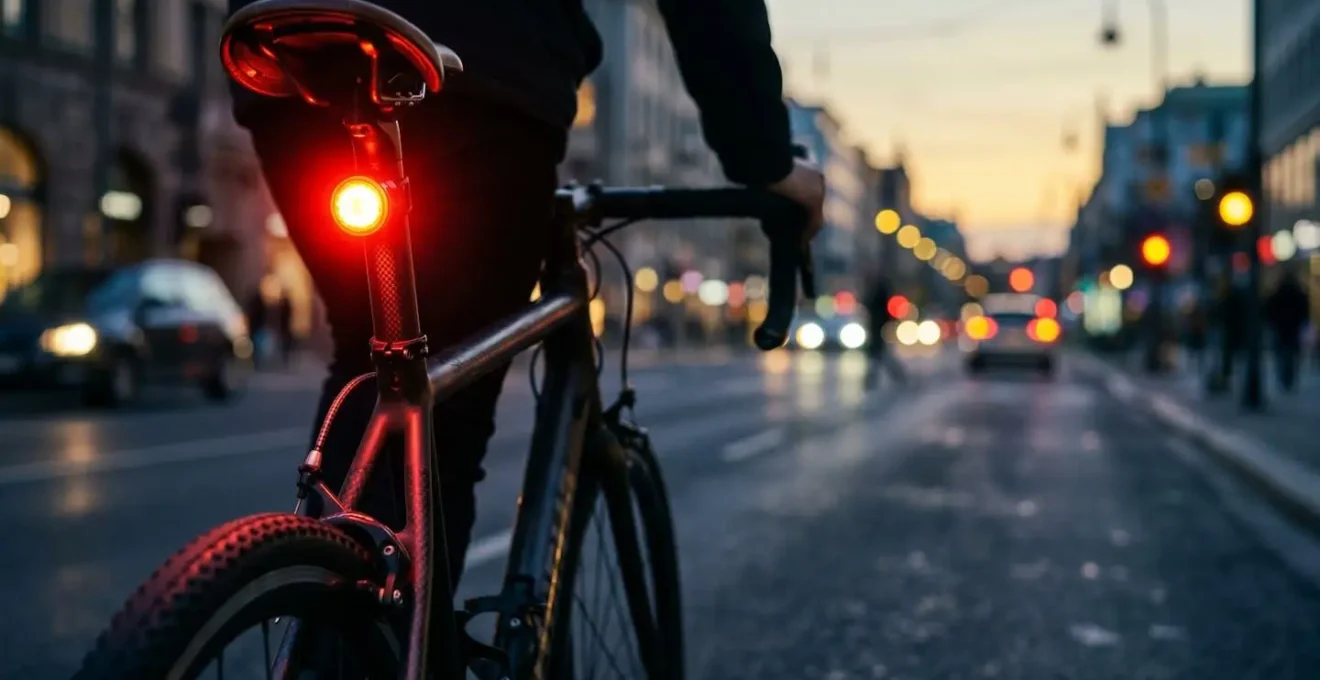
Contrary to marketing hype, the effectiveness of smart safety tech is not in the feature itself, but in how it interacts with human behavior.
- Automated lights and radar provide valuable data, but can lead to over-reliance and a false sense of security (behavioral compensation).
- Increased complexity from IoT features introduces new failure points, such as firmware issues and higher cognitive load for the rider.
Recommendation: Critically assess a technology’s trade-offs and your own riding habits before investing; the most effective safety device remains an attentive rider.
For any cyclist, particularly a daily commuter, the threat of a rear-end collision is a persistent and valid concern. It’s a scenario where you are completely vulnerable, relying on the attention of the driver behind you. In response, the market has produced a wave of automated safety technology, with smart deceleration lights at the forefront. These devices promise a simple, elegant solution: they brighten automatically when you slow down, mimicking a car’s brake lights to signal your intent. This innovation is part of a larger ecosystem of “smart” bike tech, including integrated alarms, radar systems, and networked lights.
The common assumption is that more technology and more information must equal more safety. Manufacturers highlight impressive detection ranges and instantaneous reactions. But this perspective often overlooks a critical component in the system: the human rider. As a researcher in traffic interactions, the more interesting question isn’t just *if* the technology works, but *how* it changes our behavior and what new complexities it introduces. Does a bright, flashing light truly prevent accidents, or does it just add to the visual noise of the road? Does knowing a car is approaching on a screen make us less likely to perform a life-saving shoulder check?
This analysis moves beyond the marketing claims to critically examine the trade-offs. We will investigate the true utility of these systems, not by their list of features, but by their real-world impact on the human-technology dynamic. It’s an exploration of cognitive load, behavioral adaptation, and the potential failure points of turning a simple piece of safety gear into a complex Internet of Things (IoT) device. The goal is to determine if these smart systems are a genuine leap forward in safety or a high-cost distraction from the fundamentals of situational awareness.
This article will deconstruct the most common automated safety technologies for cyclists. By following this structured analysis, you will gain a clearer understanding of the benefits, risks, and practical considerations of integrating these smart systems into your commute.
Contents: A Critical Look at Automated Bike Safety
- ANT+ Light Networks: Is Controlling Lights from Your Computer Useful?
- Tunnel Vision: How Fast Do Auto-Lights React to Sudden Darkness?
- Light-Integrated Alarms: Can They Really Scare Off a Thief?
- Smart Mode: How to Stop Your Flashing Light Annoying Wheel Suckers?
- Bricked Lights: The Risks of IoT on Simple Safety Gear?
- The “White Van” Effect: Does Radar Make You Complacent on Shoulder Checks?
- Anti-Lock Brakes on Bikes: Is It a Gimmick or a Lifesaver in Rain?
- Radar Tech: Is Knowing a Car Is Coming Worth £170 for Solo Riders?
ANT+ Light Networks: Is Controlling Lights from Your Computer Useful?
The concept of an interconnected bicycle is compelling. ANT+ technology allows various devices—lights, heart rate monitors, power meters, and GPS computers—to communicate with each other, creating a centralized control system. With a market of over 100 million ANT+ devices, the ecosystem is vast. The promise is seamless integration: your lights could turn on automatically when you start a ride, and you could adjust modes for your entire light setup from your handlebar-mounted computer. This eliminates the need to fumble with individual buttons on your front light, rear light, and maybe even helmet light while riding.
However, from a human factors perspective, we must question the practical utility versus the added complexity. While convenient, this network introduces another layer of setup, pairing, and potential troubleshooting. Each connected device adds to the cognitive load, not just during the ride but before it even begins. Is the benefit of remote control significant enough to outweigh the time spent ensuring all devices are paired, charged, and configured correctly? For a commuter whose primary goal is a simple, reliable journey, this level of integration might represent a solution in search of a problem.
The technology’s capability is not in doubt. As an expert in the field noted, the system is designed to manage significant complexity. This is where the researcher’s skepticism becomes crucial: acknowledging the technical achievement while questioning its necessity for the average user.
Using a single wireless channel, a bike computer can control a large number of lights, along with other bike sensors, simultaneously — a complexity that relies on the advanced features of the ANT Wireless protocol.
– James Fujimoto, Director – ANT Wireless, quoted in ANT+ Bontrager product announcement
The core question for a commuter is one of reliability and simplicity. A “dumb” light has two states: on or off (or flashing). A networked light introduces multiple potential points of failure: a dropped connection, a software bug on the head unit, or a drained battery in one component affecting another. While the idea of a fully automated, centrally controlled system is technologically elegant, its real-world benefit must be weighed against these new risks.
Tunnel Vision: How Fast Do Auto-Lights React to Sudden Darkness?
One of the most practical “smart” features is the ambient light sensor, which automatically activates your lights when you enter a dark environment like a tunnel or underpass. This eliminates the dangerous moment of being plunged into darkness while fumbling to turn on your lights. The technology relies on a built-in accelerometer to detect deceleration for the brake light function and a photodiode to measure ambient light. The key performance metric here is reaction time—the system must be faster than a human’s ability to react to be truly useful.
Technically, these systems are quite impressive. For deceleration, many smart lights are calibrated to react to very subtle changes in speed. For instance, some brake light functions are designed to activate with a deceleration of around 1.25-1.5 meters per second squared. This is a level of sensitivity that can capture gentle braking or even just the resistance from a steep incline. The reaction to darkness is similarly swift, often activating within a second of the sensor detecting a significant drop in ambient light. This is generally faster and more reliable than a startled rider’s manual response.
The visual below captures the exact moment this technology is designed for: the transition from light to dark, where automated visibility becomes a critical safety function.
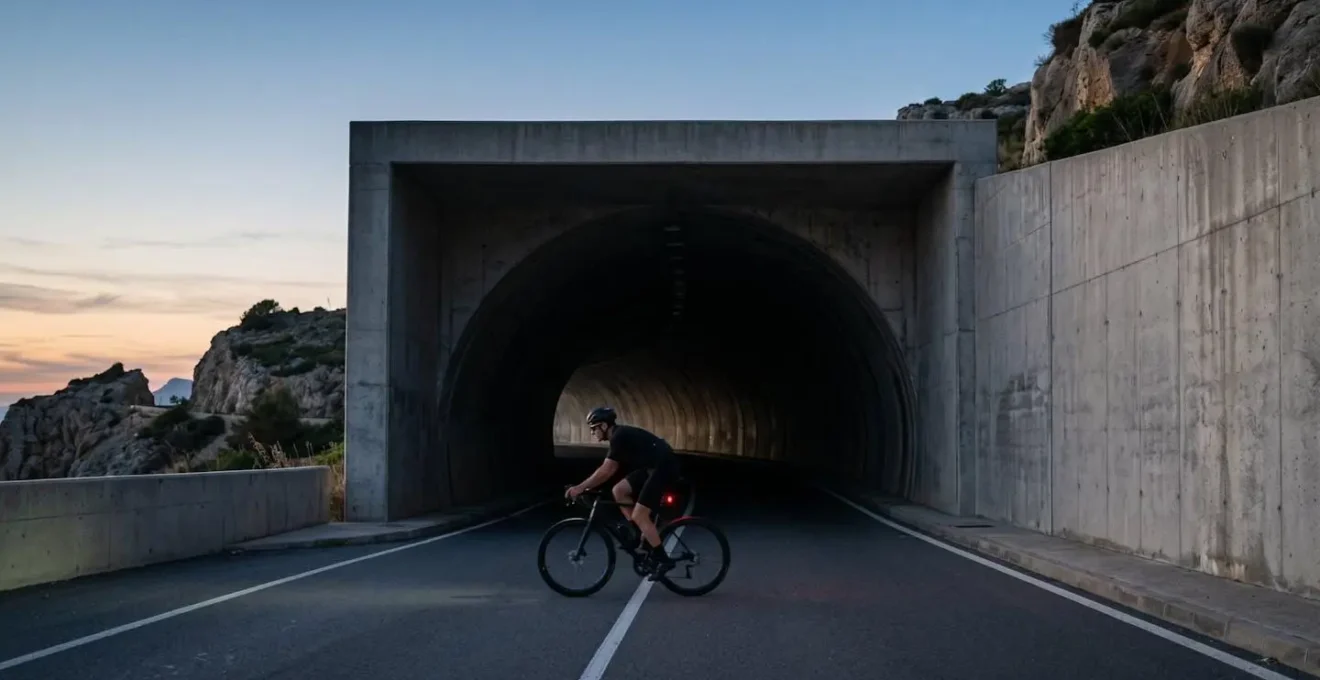
As the image illustrates, the value is undeniable in these specific scenarios. However, the system’s logic is binary; it reacts to a threshold. This can occasionally lead to false positives, like lights turning on under a brief, dark overpass on a bright day. While not a safety risk, it can be a minor annoyance and contribute to battery drain. The primary benefit remains its ability to handle sudden, unexpected environmental changes, acting as a reliable backup for the rider’s own awareness and taking one task off their mental plate at a critical moment.
Light-Integrated Alarms: Can They Really Scare Off a Thief?
The integration of anti-theft alarms into rear lights is another growing trend in the smart-tech ecosystem. The premise is straightforward: an accelerometer detects unauthorized movement of the parked bike, triggering a loud audible alarm and, in some cases, a notification to the owner’s smartphone. Given the scale of bike theft, with reports of over 300,000 bicycles stolen every year in Germany alone, any measure that could deter thieves is worth investigating.
The core question is one of genuine effectiveness versus psychological comfort. An alarm’s success depends on several factors: its volume, the environment, and the thief’s determination. A 95-decibel siren is certainly attention-grabbing in a quiet street or outside a café, but may be less effective in a noisy urban center. The primary mechanism is deterrence through unwanted attention. An opportunistic thief is more likely to abandon the attempt and flee than risk being caught. However, a professional thief may be better equipped to disable the alarm quickly or may simply ignore it, banking on public apathy.
Product testimonials often highlight this deterrent effect. For example, the AlterLock service, which combines a 95dB alarm with GPS, reports many cases where the alarm alone caused perpetrators to flee. Users frequently cite the “peace of mind” it provides during short stops. This psychological benefit is a significant, if unquantifiable, part of the product’s value proposition. It addresses the rider’s anxiety, which is a real and valid concern. The sound of the alarm arming and disarming can also act as a visual (or rather, audible) deterrent, signaling to potential thieves that the bike is protected.
From a research standpoint, the alarm serves two purposes. Its primary function is a deterrent, creating a high-risk situation for a thief. Its secondary, and perhaps more consistently delivered, function is providing the owner with a sense of security. While it’s not a foolproof solution—it won’t stop a determined thief with an angle grinder—it effectively targets the opportunistic “snatch-and-grab” theft, which is a common threat for commuters making quick stops.
Smart Mode: How to Stop Your Flashing Light Annoying Wheel Suckers?
The debate between flashing and steady rear lights is a classic one in cycling. Flashing lights are excellent at capturing the attention of distant drivers. However, for a cyclist riding directly behind in a group—a “wheel sucker”—a constantly flashing light can be intensely distracting and even dazzling, causing eye strain and reducing their ability to focus on the wheel in front of them. This is a perfect example of a conflict between external visibility and internal group dynamics, a classic “signal vs. noise” problem.
This is where “smart modes” come into play. Advanced lights can be programmed with sophisticated patterns that are less jarring, or they can use their network connectivity (like ANT+) to sync with other riders’ lights. Some systems offer a “peloton mode” which switches to a less aggressive, steady light when it detects other paired lights nearby. This is a clever technological solution to a real social-technical problem. It acknowledges that the optimal light pattern is context-dependent: what’s best for being seen by a car a quarter-mile away is not what’s best for the rider two feet behind you.
One of the most respected voices in cycling tech journalism highlights the importance of this consideration. The advice is simple and rooted in the practical experience of group riding.
When riding in a group at night, a steady rear light will be appreciated by your fellow riders – the group needs to be seen, but cycling close to a flashing rear light can be distracting or dazzling.
– Russell Burton, BikeRadar analysis on flashing vs steady bike lights
The challenge, once again, is complexity. Does the average commuter need a peloton mode? Likely not. But for the rider who does a mix of solo commuting and weekend group rides, this feature solves a real pain point. It automates the etiquette of group riding. The trade-off is the need to navigate menus and settings to enable these modes. The “smart” solution requires a “smart” user who is willing to invest the time to configure the device for different contexts, transforming a simple on/off device into a tool that needs to be managed.
Bricked Lights: The Risks of IoT on Simple Safety Gear?
The most significant, and least discussed, risk of “smart” technology is the introduction of new and often unexpected failure points. A traditional, “dumb” bike light fails in predictable ways: the battery dies, or the bulb burns out. An Internet of Things (IoT) device, however, can fail in far more complex ways. A botched firmware update can “brick” the device, rendering it completely unresponsive. An app required to control settings can become incompatible with your phone’s new operating system. The server it needs to connect to for certain features could go offline permanently if the company goes out of business.
This increased complexity comes at a literal cost. As industry analysis points out, the convenience of smart features is not free, and the setup process itself can be a barrier for less tech-savvy users.
Smart bike lights cost significantly more than the best cheap bike lights. The extra complications involved in setting them up can be a downside.
– BikeRadar Editorial Team, BikeRadar smart bike lights buyer’s guide
The See.Sense Icon 3 is a prime example of this trade-off. It offers a powerful 350-lumen output and reactive lighting, plus a Bluetooth-connected theft alarm. This is a highly capable device. Yet, its full functionality is dependent on a smartphone app, requires periodic firmware updates to fix bugs or add features, and demands more diligent battery management. This is the core bargain of IoT safety gear: you gain advanced features and data connectivity, but you lose the simple, robust reliability of a non-connected device. For a commuter, whose primary need is for a light to work every single time they get on their bike, this trade-off must be carefully considered.
Your Smart Tech Pre-Flight Checklist: 5 Points to Verify
- Firmware & App: Check if both your device’s firmware and its companion smartphone app are up to date. An outdated app can cause connectivity issues.
- Battery Levels: Verify the charge on all connected devices—the light, your phone, and your bike computer. A low battery on one can affect the entire system.
- Mode Configuration: Confirm the light is in the correct mode for your intended ride (e.g., solo commute flash pattern vs. group ride steady mode). Don’t assume the setting from your last ride is still active.
- Sensor Functionality: Before setting off, briefly test the key automated feature. Tilt the bike to check the theft alarm or cover the light sensor to see if it activates.
- Manual Override: Know how to operate the light manually. If the smart features or connectivity fail mid-ride, you must be able to simply turn it on.
The “White Van” Effect: Does Radar Make You Complacent on Shoulder Checks?
Rear-facing radar is arguably one of the most significant safety innovations in recent years. Devices like the Garmin Varia and Wahoo TRACKR use Doppler radar to detect approaching vehicles and display their proximity and closing speed on a connected bike computer or smartphone. These systems are impressively effective, with some models able to detect approaching vehicles up to 150 meters (164 yards) away, often long before the rider can hear them.
There is no doubt that this information is valuable. Testers and users alike praise its accuracy and its ability to provide an early warning, especially for quiet electric vehicles. It enhances situational awareness by adding a layer of data that our own senses might miss.
It may sound like a gimmick, but in our experience, it is surprisingly accurate, and often picks up cars before our ears do.
– Cycling Weekly Test Team, Cycling Weekly best bike lights 2026 review
However, this is where the concept of behavioral compensation (or risk homeostasis) becomes critically important. This theory suggests that humans tend to adjust their behavior in response to perceived changes in safety. If a system makes you feel safer, you may subconsciously take more risks. The danger with radar is the “White Van” effect: a rider becomes so reliant on the digital alert that they neglect the fundamental, life-saving habit of performing a physical shoulder check before changing position in the lane. The radar is excellent at detecting vehicles approaching from directly behind, but what about the van in the next lane over that is about to merge into you? The radar won’t see that. Your eyes will. The technology is an aid, not a replacement for human vigilance. A clear screen is not a guarantee of a clear lane.
Anti-Lock Brakes on Bikes: Is It a Gimmick or a Lifesaver in Rain?
Moving beyond lights and sensors, another piece of automated safety tech making its way from the automotive world to bicycles is the Anti-Lock Braking System (ABS). The principle is the same: when the system detects that a wheel is about to lock up during hard braking—a primary cause of skidding and loss of control—it rapidly modulates the brake pressure to maintain traction. The primary use case is in low-traction situations, such as on wet pavement or loose gravel, where a panic-induced wheel lock is most likely and most dangerous.
Is it a gimmick? Not in principle. The physics are sound. Maintaining a rolling wheel provides far more steering control and stability than a skidding one. For a less experienced rider who might grab a fistful of brake in a panic, an ABS system could genuinely be the difference between a controlled stop and a crash. It acts as a safety net, preventing the most common braking error. Especially on the front wheel, where a lock-up almost guarantees a fall, the system offers a tangible benefit.
However, the system has its limits. ABS cannot create traction where none exists. On a patch of black ice or a slick oil spill, the wheels will still slip because the coefficient of friction is simply too low. An experienced rider who has honed their braking technique can often modulate the brakes with a similar, if not superior, level of control by feeling for the point of lock-up. Furthermore, the added weight, cost, and mechanical complexity of an ABS module are significant considerations, particularly for performance-oriented cyclists. For a commuter on an e-bike, where weight is less of a concern and speeds can be higher, the argument for ABS becomes much stronger, especially in regions with frequent rain.
Key Takeaways
- The primary risk of advanced safety tech like radar is “behavioral compensation,” where a rider becomes complacent and neglects fundamental safety habits like shoulder checks.
- IoT-enabled devices (lights, alarms) increase complexity and introduce new failure points, such as firmware errors or app dependency, that don’t exist in simpler, non-connected gear.
- The true value of features like “smart modes” and ANT+ networks depends heavily on the rider’s specific context (e.g., group vs. solo riding) and their willingness to manage the added cognitive load.
Radar Tech: Is Knowing a Car Is Coming Worth £170 for Solo Riders?
We arrive at the ultimate question for many commuters considering this technology: is it worth the significant financial investment? A rear radar unit can cost upwards of £170, a substantial sum for a piece of accessory equipment. To answer this, we must return to the core problem it aims to solve. The startling fact is that, according to a landmark study, 40% of all fatal bicycle crashes involved rear-end collisions by motor vehicles. This single statistic underscores the gravity of the threat and provides a powerful argument in favor of any technology that can mitigate it.
For the solo rider, the radar’s early warning system provides a crucial layer of information. It gives you time to assess your road position and prepare for the vehicle’s pass. It turns an unknown—what’s happening behind you?—into a known quantity. This can significantly reduce the mental stress of riding on busy roads. The system acts as a second set of ears, constantly monitoring your six o’clock.
Ultimately, the decision comes down to a personal cost-benefit analysis framed by the “human-in-the-loop” principle. The technology is not an autonomous safety shield. It is a data-delivery system, and you, the rider, are still the primary safety controller. Its value is directly proportional to your ability to integrate its information without abdicating your own vigilance. If you can treat the radar as an advisory tool—a helpful partner that enhances your awareness—then the cost may be justified. If there is a risk you will treat it as a foolproof guardian, allowing your own skills to atrophy, then it could paradoxically introduce new dangers. The £170 buys you information, not immunity.
Therefore, before investing in any automated safety technology, the most critical action is to perform a rigorous self-assessment of your riding needs, typical environment, and, most importantly, your own discipline to use these tools as aids rather than crutches.