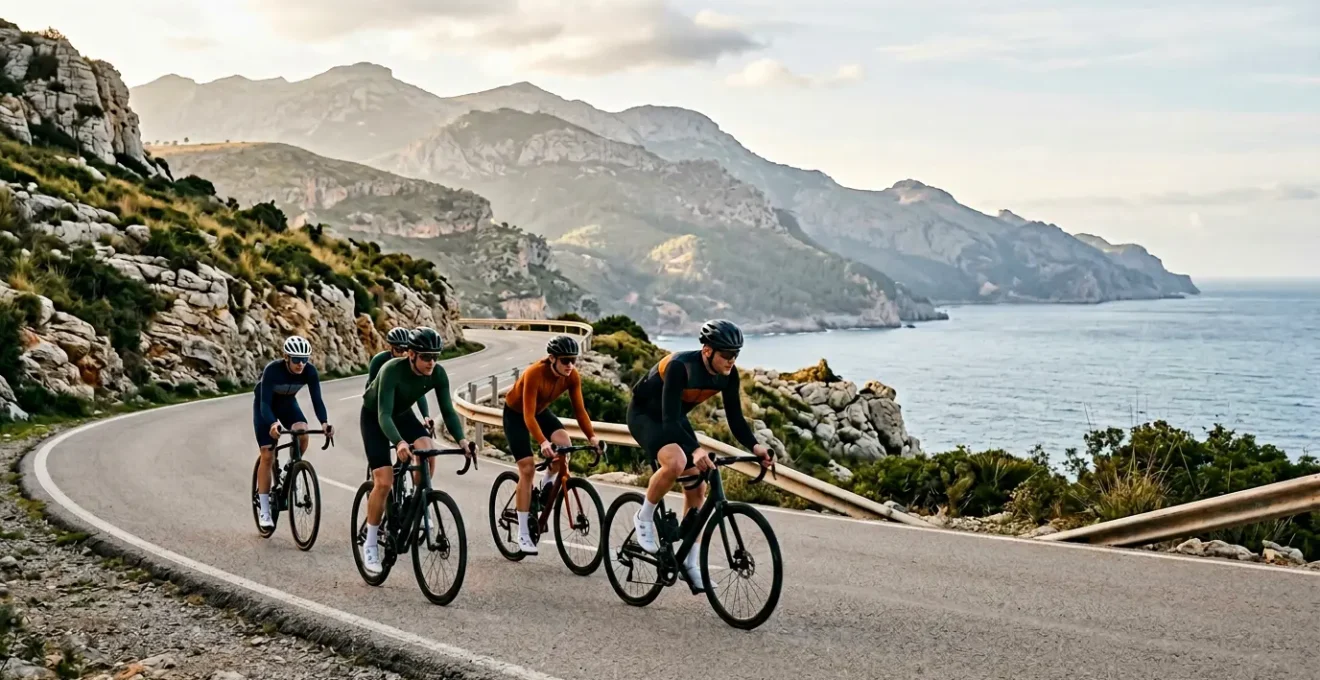
Fitting into a local peloton in Spain isn’t about having the strongest legs; it’s about mastering the unwritten social rules that show respect and cultural fluency.
- Group safety and cohesion rely on a shared language of hand signals and predictable pacing.
- Joining an established group is a delicate process of observation, contribution, and polite communication.
Recommendation: Prioritize understanding the group’s ‘social contract’—its unspoken rules and rhythms—over displaying individual strength to truly enjoy the ride.
The debate between Mallorca and Tenerife for a winter training camp often revolves around climbs, road surfaces, and weather. But a successful trip for any serious cyclist hinges on something far more subtle: navigating the local group rides. You can have the best fitness in the world, but if you’re “that guy”—the one who surges, half-wheels, or commits a social faux pas at the café—you’ll miss out on the very soul of cycling culture. You’re not just a tourist on a bike; you’re a guest in a moving, breathing community.
Many guides will give you a basic list of rules. This article goes deeper. We’re not just listing what to do; we’re explaining the ‘why’ behind the etiquette. This is about understanding the social contract that binds a peloton together. It’s a shared understanding built on predictability, safety, and mutual respect. Mastering this isn’t about memorizing rules, it’s about developing a cultural fluency that allows you to integrate seamlessly, whether you’re on the sweeping roads of Mallorca or the volcanic slopes of Tenerife.
This guide will deconstruct the unspoken language of the European peloton. We will explore everything from the nuances of hand signals and pacing to the vital rituals of the post-ride debrief and the all-important cake stop. By the end, you won’t just know the rules; you’ll understand the culture, ensuring you’re a welcome addition to any group you join.
To help you navigate these social intricacies, this guide is structured to build your understanding from the ground up, covering the essential pillars of group ride etiquette.
Summary: Your Guide to International Cycling Etiquette
- Pointing vs Waving: How Pothole Signals Differ Across Europe?
- Pacing Etiquette: Why Overlapping Wheels Is Considered Rude Globally?
- Cycling Vocab: The 5 Words You Must Know in Spanish/French/Italian?
- Two Abreast: Is It Legal to Ride Side-by-Side in Spain?
- Respecting the Locals: How to Join a Peleton Without Upsetting the Elders?
- The “Post-Mortem”: Why Discussing the Sprint finish Bonds the Group?
- Removing Derailleurs: Why Wireless Is Safer for Bike Boxes?
- The Cake Stop: Why Social Nutrition Is Vital for Club Cohesion?
Pointing vs Waving: How Pothole Signals Differ Across Europe?
The first language you must learn is not Spanish or Italian, but the silent, universal dialect of hand signals. A peloton moves as one organism, and its nervous system is a series of gestures that communicate danger and intent instantly. Failing to pass on a signal is a cardinal sin, as it breaks the chain of trust that keeps everyone safe. While most signals are universal, their execution can have regional accents.
The most critical signals are for hazards. Pointing directly down at a pothole or obstacle is standard practice. If you have time, a circling motion with the finger adds emphasis. For looser surfaces like gravel or broken tarmac, the signal changes to a flat, open palm facing down, with a side-to-side sweeping motion, as if you’re wiping dust off a table. If a major obstacle like a parked car requires the group to move over, the rider at the front will put their arm behind their back and point in the direction the group needs to move.
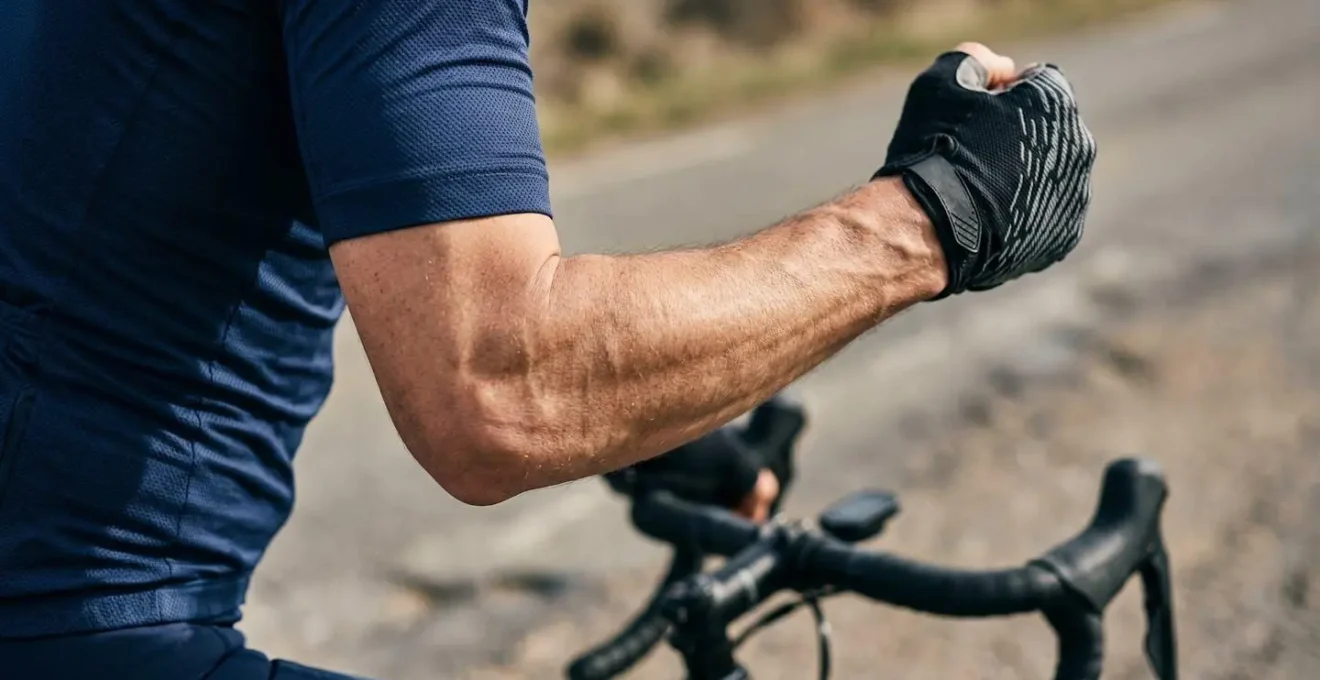
This is a close-up of the ‘elbow flick’, a subtle but crucial signal indicating you are about to pull off the front and want the rider behind you to come through. It’s the key to a smooth paceline rotation.
Verbal calls supplement these signals. A sharp shout of “Hole!” for a sudden hazard or “Car back!” for an approaching vehicle is essential. The expectation is that every rider relays these signals and calls down the line, ensuring the information reaches the back of the group. Your role is not just to see the signal, but to become the signal for the person behind you. It’s the most fundamental part of the group’s social contract.
Pacing Etiquette: Why Overlapping Wheels Is Considered Rude Globally?
Overlapping your front wheel with the rear wheel of the rider in front of you is the most dangerous and universally condemned act in group cycling. It’s not just rude; it’s a recipe for disaster. If the rider ahead moves even slightly sideways, your wheels will touch, and you will almost certainly go down, likely taking several others with you. It signals to everyone that you are either inexperienced, careless, or both—a clear violation of the group’s trust.
Beyond this critical safety rule, pacing etiquette is about creating a smooth, predictable, and cohesive experience for everyone. The goal is to maintain a steady effort, eliminating the jarring accelerations and decelerations that create a “snapping elastic band” effect. As an in-depth look at peloton dynamics reveals, drafting can reduce drag by up to 50%, but this benefit is lost if the pace is erratic. Surging when you get to the front is seen as arrogant and disruptive, as it forces riders at the back to expend huge amounts of energy just to stay in touch.
A respected rider is a smooth rider. This means gentle accelerations out of corners and maintaining a consistent pace on climbs. As legendary coach Chris Carmichael advises, displaying consideration for the group’s average speed is far more important than showing off your strength.
If you’re feeling like superwoman or you’re the fast rider of the group, don’t ramp up the speed when you get to the front. It’s not nice and it makes the pace uncomfortably hard for your friends.
– Chris Carmichael, Carmichael Training Systems
The ultimate sign of an experienced rider is not how fast they can go, but how smoothly they can hold a wheel and contribute to a steady, rhythmic paceline. It is a shared effort, not an individual time trial.
Cycling Vocab: The 5 Words You Must Know in Spanish/French/Italian?
While hand signals are universal, a few key verbal calls in the local language will elevate you from a silent follower to an integrated group member. In Spanish cycling hubs like Mallorca and Tenerife, learning these phrases demonstrates respect and enhances safety. You don’t need to be fluent, but knowing the right word at the right time is a sign of cultural fluency.
These are not just words; they are commands and encouragements with specific contexts. Shouting the wrong one can cause confusion or even danger. Here are the essentials for any ride in Spain:
- ¡Ojo! (Pronounced “o-ho”): This means “Watch out!” or literally “Eye!”. It’s a sharp, urgent warning for an immediate and unseen hazard, like a pedestrian stepping out or a car pulling out unexpectedly. It requires an instant reaction.
- ¡Venga! / ¡Vamos!: While both can mean “Let’s go!”, they have different flavors. ¡Venga! is a versatile cheer of encouragement, often used on a climb to motivate a struggling rider. ¡Vamos! is more of a collective command to get the group moving or to initiate an effort together.
- A la derecha / A la izquierda: “To the right” / “To the left”. These are directional commands used to signal a turn or to instruct the group to move over within the lane. They are often shouted from the front and relayed back.
- Coche atrás: “Car back”. This is a critical safety call, usually from the riders at the rear, to alert the entire group of a vehicle approaching from behind. It’s the trigger for the group to form a single file to allow the car to pass safely.
Using these terms correctly shows you’re not just along for the ride; you’re actively participating in the group’s safety and morale. A simple “¡Venga!” to a fellow rider on a tough section can build more goodwill than a thousand watts of power.
Two Abreast: Is It Legal to Ride Side-by-Side in Spain?
One of the most common points of confusion for visiting cyclists is the legality of riding two abreast. In many countries, it’s a grey area or outright forbidden, but in Spain, the law is both clear and accommodating to cyclists. This legal understanding is crucial for riding confidently and defensively, without causing unnecessary friction with local drivers.
The general rule is that cyclists are permitted to ride two-by-two. This is not just a tolerated behavior; it’s a legally recognized formation. The logic is that a compact group of cyclists riding two abreast is easier and quicker for a car to overtake than a long, stretched-out single file line. However, this right comes with important responsibilities and conditions that are enforced.
The Spanish Traffic Directorate (DGT) provides clear guidelines on this matter. Their official stance is a cornerstone of the country’s road-sharing philosophy.
Cyclists are permitted to ride two abreast, but are required to always ride in single file if the road is not clearly visible or overtaking is not possible, or they impede the flow of traffic.
– Dirección General de Tráfico (DGT), Spanish Traffic Directorate Official Guidelines
This means you must revert to single file on tight bends, during periods of low visibility (like fog or heavy rain), or when you hear the “Coche atrás!” call and a long line of traffic is forming behind you. The key is to facilitate flow. Riding two abreast is a privilege, and the responsibility is on the cycling group to not abuse it by blocking traffic unnecessarily. Knowing and respecting this nuance is a clear sign of an informed and considerate visiting rider.
Respecting the Locals: How to Join a Peleton Without Upsetting the Elders?
There is no greater thrill than latching onto a fast-moving local peloton, but there is also no quicker way to earn a bad reputation than doing it incorrectly. Joining an established group is a delicate social dance that requires patience, observation, and respect. Simply riding up and saying “hello” is often considered disruptive and presumptuous. You must first prove you are competent and not a liability.
The first step is observation. Assess the group from a safe distance. Are they in matching club kits? This often signifies a closed, formal training ride that may not welcome outsiders. Is it a mixed group of jerseys? This is more likely an informal bunch that might be open to guests. Watch their speed, their rotation, and their general cohesion. This is not just a group of riders; it is a finely tuned machine, and you need to understand how it works before trying to become a part of it.
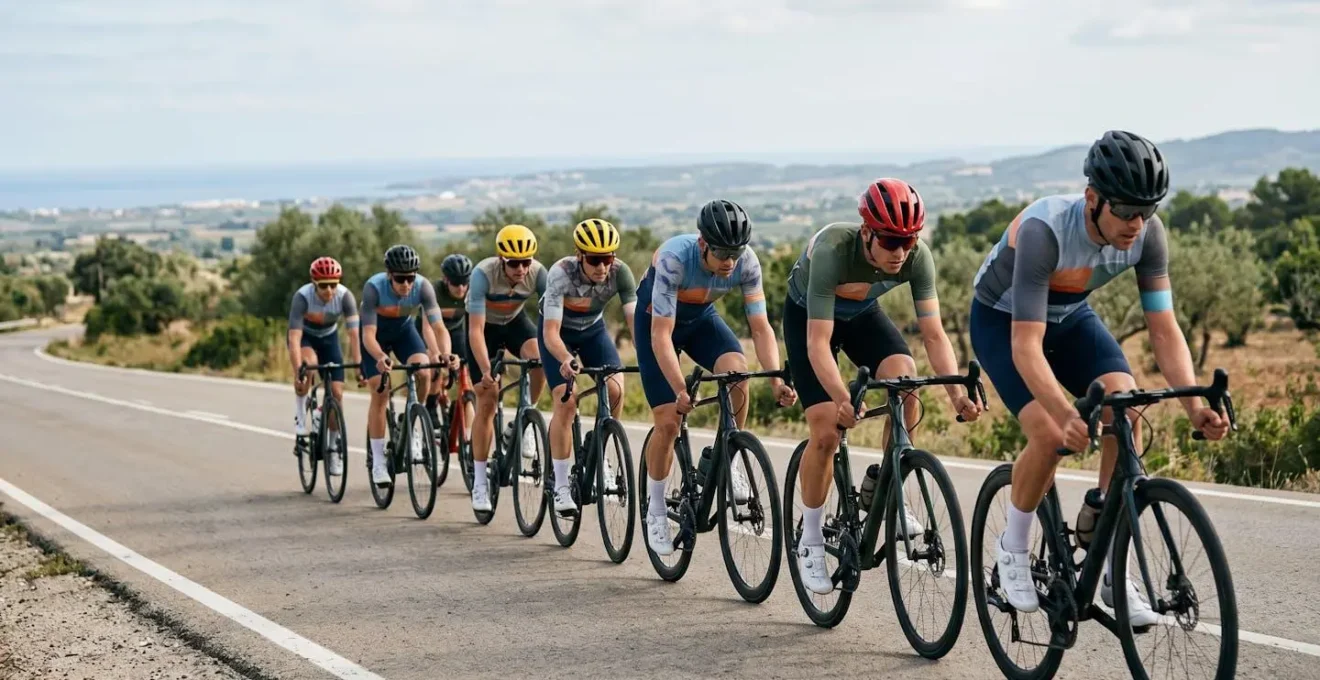
The “Silent Approach” is the most respectful method. Bridge the gap slowly and sit at the very back of the group without saying a word. Your job is to be invisible. Hold your line, don’t overlap wheels, and demonstrate that you can ride smoothly and safely. After a few minutes, if you haven’t been waved off, you can offer a quiet greeting to the rider directly in front of you. Never join mid-pack or, even worse, at the front. Your place is at the back until you have earned the group’s tacit approval.
Action Plan: Joining a Local Peloton with Respect
- Observation Phase: Assess the group’s speed, structure, and style from a distance (approx. 50m back) to read their dynamic.
- Silent Approach: Bridge the gap slowly and position yourself at the very back for several minutes to demonstrate competence.
- Polite Integration: Offer a brief verbal greeting to the last rider only after being tacitly accepted without disruption.
- Show Contribution: The currency of respect is effort. Once integrated, take a short, steady pull at the front at the group’s existing pace, proving you are a contributor, not a ‘pirate’.
- Graceful Exit: When leaving, signal your intention, verbally thank the group (e.g., ‘Gracias, ¡buena ruta!’), and pull away safely.
The “Post-Mortem”: Why Discussing the Sprint finish Bonds the Group?
The ride doesn’t end when the pedaling stops. One of the most important bonding rituals happens in the moments after a town sign sprint or a hard effort up a climb. This is the “post-mortem,” a shared debrief where the story of the ride is told and retold. Far from being about bragging, this discussion serves a vital social function: it transforms a moment of competition back into a shared memory.
This process is what experienced riders call a ‘ritual of demilitarization’. During a sprint, riders are competitors, each fighting for position. The moment it’s over, that competitive energy needs to be dispelled and replaced with camaraderie. The post-mortem is how this happens. It’s where you relive the key moments, analyze tactics, and, most importantly, acknowledge the efforts of others. This is a crucial element of the social contract that builds trust and strengthens group cohesion.
There’s an unwritten rule to this ritual: praise someone else’s effort before you discuss your own. “That was a great jump you made!” or “I couldn’t hold your wheel on that last kick” are phrases that build bridges. As noted by leaders in group ride dynamics, this positive feedback loop turns individual achievements into collective learning experiences, reinforcing the bonds that make a group ride more than just a training session.
Experienced ride leaders describe the post-sprint debrief as a ‘ritual of demilitarization’—the process of turning competitive moments back into shared social memories. The unwritten rule is to praise someone else’s effort before discussing your own performance, creating a feedback loop that builds trust and tactical understanding for future rides.
– The Social Function of Post-Ride Analysis
By participating constructively in the post-mortem, you show that you value the group’s experience as much as your own performance. It’s a sign that you understand the culture, and it’s what will get you invited back for the next ride.
Removing Derailleurs: Why Wireless Is Safer for Bike Boxes?
The title of this section might seem purely technical, but its implications are deeply rooted in group etiquette. While a wireless derailleur is indeed easier to pack and less prone to damage in a bike box, its real “safety” benefit in the context of a training camp is for the group’s social cohesion and schedule. Arriving prepared is the first and most fundamental sign of respect for the people you are about to ride with.
Group ride culture operates on an unwritten ‘social time limit’ for mechanical issues. A simple puncture will see the whole group stop, offer help, and wait patiently. However, a major, preventable problem—like a bent derailleur hanger from poor packing or a bike that needs assembly while everyone else is kitted up and ready to roll—is a serious breach of etiquette. It signals a lack of preparation and a disregard for the group’s time.
This is where the concept of “mechanical preparedness” comes in. As highlighted in guides on group ride culture, showing up with a bike that is not only clean but perfectly functional is paramount. The night-before rule is sacred: your bike should be fully assembled, tires inflated, and chain lubed well before you meet the group. Spending the first 15 minutes of a scheduled ride fiddling with your bike is the quickest way to be seen as “that guy.” Wireless systems can simplify this, but the principle applies to all equipment: your preparation happens on your own time, not the group’s.
Ultimately, your mechanical self-sufficiency is a core part of the social contract. You are responsible for your equipment so that you do not become a burden on the group. A smooth-running bike is the ticket that grants you entry to the ride.
Key Takeaways
- Group etiquette is a ‘social contract’ based on safety, predictability, and mutual respect, not just a list of rules.
- Mastering non-verbal signals and a few key local phrases is crucial for integration and safety.
- Your primary responsibility is to contribute to the group’s smoothness and cohesion, which is valued more than individual strength.
The Cake Stop: Why Social Nutrition Is Vital for Club Cohesion?
The café stop is not an interruption to the ride; in many ways, it is the entire point. It’s where “social nutrition” happens, transforming ride partners into genuine friends. In Spain, the “parada para el café” is a hallowed institution, and how you conduct yourself here is just as important as how you ride in the paceline. It is the final and perhaps most telling test of your cultural fluency.
Experienced groups are identifiable before they even order. The bike stacking method is a tell-tale sign: bikes are leaned rear-wheel-to-the-wall, with each subsequent bike resting on the pedal of the previous one. This compact and stable formation prevents a disastrous domino-effect and marks you as part of a considerate, knowledgeable group. Once inside, the unspoken “cleat cover rule” comes into play. Walking on a café’s floor with exposed metal cleats is noisy, slippery, and damaging—a clear mark of an amateur.
The payment protocol is another crucial piece of etiquette. To avoid burdening staff with splitting a bill ten ways for ten coffees, one person typically pays for the entire group. Others can then reimburse them with cash or a payment app, or simply rotate who pays on subsequent stops. This simple act shows respect for the establishment and reinforces the group’s collective identity.
Finally, conversation should follow the informal ‘Rule of Thirds’: one-third reliving the ride, one-third talking about gear and bikes, and one-third dedicated to non-cycling topics like work, family, and life. This is how you build real connections. By being quiet, respectful, and appreciative, you ensure that cyclists remain welcome guests in local cafés, preserving this vital part of cycling culture for everyone.
Now that you understand the unwritten rules from the pre-ride check to the post-ride coffee, you have the tools not just to join a group, but to become a valued member of the cycling community in Mallorca, Tenerife, or wherever your wheels take you.