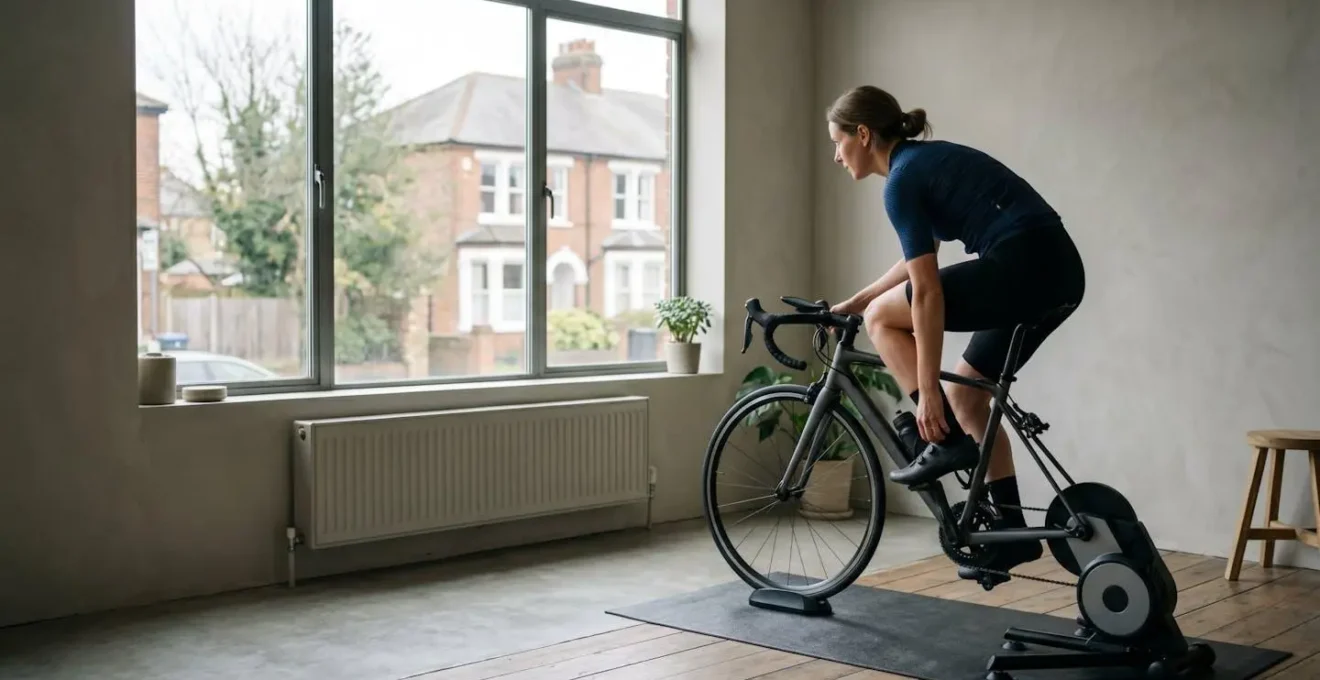
Successfully preparing for Alpine climbs from a flat UK region requires abandoning hill repeats and instead engineering the specific demands of mountain cycling indoors.
- Utilise smart trainer ‘Slope Mode’ and specific difficulty settings to simulate the relentless gradients and inertia of a real mountain.
- Focus on a combination of low-cadence muscular endurance and high-cadence neuromuscular efficiency to handle variable pitches.
Recommendation: Shift your training focus from chasing raw power (FTP) to mastering pacing, gearing, and breathing under simulated high-altitude, long-duration conditions.
The daunting beauty of an Alpine cycling holiday, with its legendary climbs like Alpe d’Huez, is a powerful goal for any UK-based cyclist. Yet, for those living in flatter regions like East Anglia or the Midlands, the goal can feel impossibly distant. The common advice—”find a hill and do repeats”—is impractical when the local ‘summit’ is a 30-second rise. This leaves riders undertrained, focusing on the short, sharp power needed for British hills, which is a completely different physiological challenge from a 90-minute Alpine ascent.
Many turn to indoor trainers, but simply following a generic FTP-building plan is a trap. It builds a powerful engine but fails to teach you how to drive it on the unique terrain of a mountain pass. The key isn’t just to get stronger, but to get specifically stronger. It’s about simulating the relentless resistance, the need for efficient gearing, the oxygen deprivation of altitude, and the mental fortitude required for hour-long efforts.
This guide moves beyond the platitudes. We will adopt the mindset of a performance coach, focusing on meticulous simulation techniques. We will deconstruct the Alpine challenge into its core components and show you how to engineer specific training protocols on your smart trainer and local roads. We will cover everything from optimising your trainer settings to mimic a real gradient, to choosing the right gearing, mastering descent safety, and structuring your weeks to build both explosive power and inexhaustible endurance. This is your strategic blueprint for arriving in the Alps not just with strong legs, but with the skills and confidence of a seasoned climber.
This article provides a structured coaching plan to transform your flat-land training. Explore the sections below to build your comprehensive strategy for conquering the mountains.
Summary: Your Strategic Guide to Alpine Preparation from the Flats
- Smart Trainer Difficulty: What Setting Best Mimics Alpe d’Huez?
- Standard vs Compact Cranks: Do You Need a 34t Chainring for the Alps?
- Rim Brake Fade: How to Descend Safely Without Overheating Your Wheels?
- Breathing Techniques: How to Cope with Thin Air Above 2000m?
- VAM Explained: How Vertical Ascent Speed Helps You Pace a 1-Hour Climb?
- Cadence Drills: High RPM vs Grinding for Sprint Power?
- Erg Mode vs Slope Mode: Which Is Better for FTP Intervals?
- HIIT Cycling Workouts: Boosting Power for Short Steep British Climbs?
Smart Trainer Difficulty: What Setting Best Mimics Alpe d’Huez?
The “Trainer Difficulty” setting on platforms like Zwift is the most misunderstood, and therefore misused, tool for Alpine preparation. It does not make the workout harder or easier in terms of power output; an instruction to hold 250 watts is 250 watts regardless of the setting. Instead, it changes how a gradient *feels*. By default, Zwift defaults to a 50% Trainer Difficulty setting, which means an 8% gradient on screen feels like a 4% gradient on your legs. For flat-land riders, this is a missed opportunity.
To truly simulate the relentless nature of a climb like Alpe d’Huez, you must move away from the default. Setting the difficulty to 100% is the purist’s choice. It forces you to use your gears exactly as you would outside, making every change in gradient palpable. This teaches you pacing, gear selection, and how to manage cadence on steep pitches. However, for a 1-hour climb simulation, this can lead to constant, noisy gear changes and excessive drivetrain wear.
A more strategic approach is to set the difficulty between 75% and 100%. This range provides a realistic sensation of the gradient’s weight and forces you to engage with your gearing meaningfully, without the hyper-sensitivity of the 100% setting. It’s the sweet spot for building both the physical and mental adaptations for long climbs, training your body to handle sustained resistance and your mind to stay engaged with gear management. This is the foundation of engineering a true climbing experience indoors.
Ultimately, the goal is to make the trainer a tool for skill acquisition, not just a power-measuring device. Using a higher difficulty setting is your first step towards true simulation.
Standard vs Compact Cranks: Do You Need a 34t Chainring for the Alps?
Your gearing is your primary weapon against gravity, and arriving in the Alps with the wrong setup is a recipe for a miserable experience. Many UK riders, accustomed to shorter, punchier climbs, use a “standard” (53/39t) or “semi-compact” (52/36t) crankset. While effective for generating speed on rolling terrain, this gearing can be brutally unforgiving on the sustained 8-10% gradients of an Alpine pass, forcing you into a low-cadence grind that rapidly fatigues muscles and strains knees.
The answer for the vast majority of amateur cyclists is an emphatic yes: you need a compact crankset (50/34t). This, paired with a wide-range cassette (e.g., 11-32t or even 11-34t), is the modern standard for sportive and mountain riding. The smaller 34-tooth inner chainring provides the lower gears essential for maintaining an efficient cadence when the gradient bites. This isn’t a sign of weakness; it’s a sign of strategic intelligence. Professional riders have immense power-to-weight ratios; amateurs must rely on mechanical advantage.
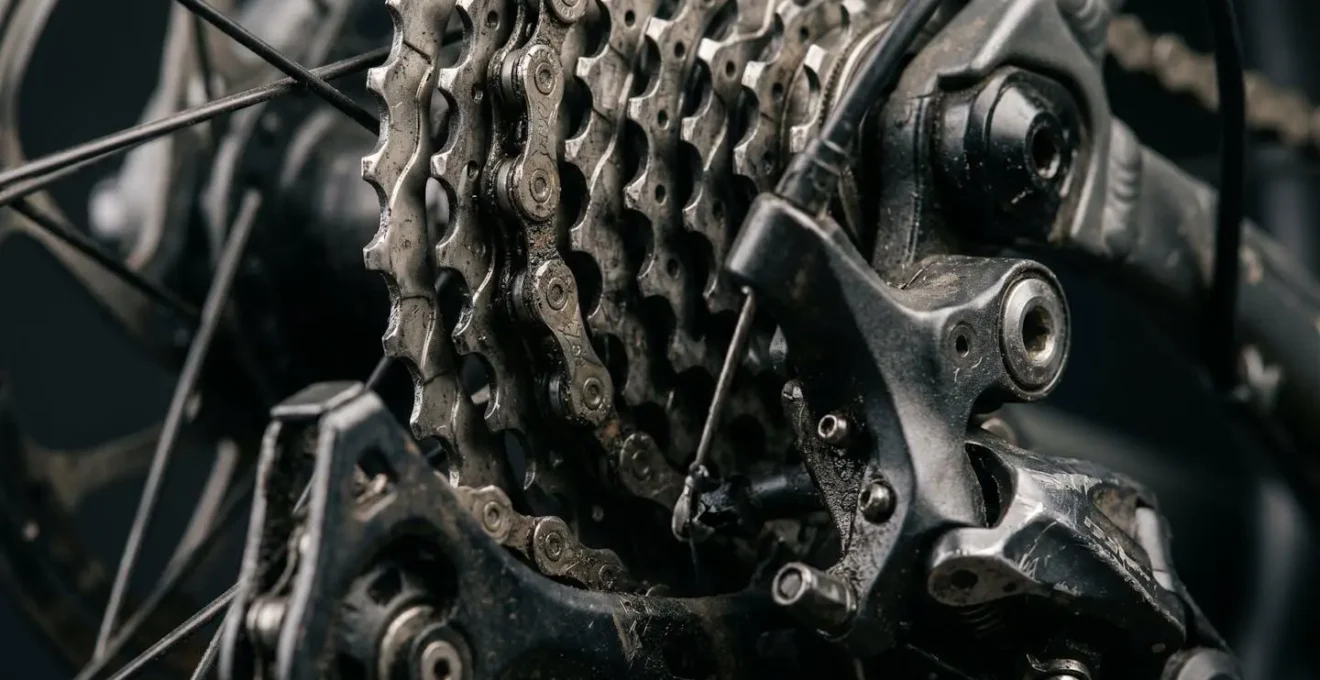
Indeed, compelling research indicates that a 1:1 gear ratio (e.g., a 34t chainring with a 34t largest cassette cog) is the optimal setup for amateur cyclists tackling steep, long climbs. This allows for a cadence of 70-80 RPM on even the most challenging sections, preserving muscular endurance for the hours to come. Don’t let ego dictate your gear choice. A compact crankset is the single most important equipment upgrade you can make for an Alpine trip.
Switching to a compact setup before you start your dedicated training block allows your body to adapt to the different feel and muscle activation, ensuring you’re fully prepared when you hit the real mountains.
Rim Brake Fade: How to Descend Safely Without Overheating Your Wheels?
The reward for every gruelling ascent is a thrilling descent, but for riders on rim-brake bikes, this part of the ride carries significant risk. Unlike the consistent performance of disc brakes, rim brakes—especially on carbon wheels—are susceptible to overheating on long, technical descents. This leads to a dangerous phenomenon known as “brake fade,” where the heat buildup dramatically reduces stopping power precisely when you need it most.
The natural but incorrect instinct is to gently “drag” the brakes to control speed. This is the fastest way to induce fade. As experts from BikeRadar warn, this technique creates a constant, low-level friction that generates immense heat without effective deceleration.
It can be tempting to keep your brakes on slightly – brake dragging – but this is best avoided as it can cause them to overheat and become less effective, a phenomena known as brake fade.
– BikeRadar, How to descend safely on a road bike
The correct technique is progressive or “pulse” braking. This involves applying the brakes firmly and decisively before a corner to scrub off the necessary speed, and then releasing them completely as you turn in. This allows the rims moments to cool, preventing the critical heat buildup. You should also alternate between front and rear brakes on straighter sections to distribute the heat load. Furthermore, use your body as an air brake by sitting up to catch the wind, saving your brakes for when they are truly needed. Mastering this technique is not just a performance skill; it’s a critical safety requirement for Alpine cycling.
Practice these techniques on the steepest, longest descents you can find in the UK. While they may not replicate the scale of the Alps, they provide a valuable opportunity to build the muscle memory and confidence needed to descend safely.
Breathing Techniques: How to Cope with Thin Air Above 2000m?
For a cyclist training at sea level in the UK, the most alien aspect of the Alps isn’t the gradient, but the altitude. As you climb above 2000 metres (a common height for Alpine passes), the air becomes noticeably “thinner.” This isn’t just a feeling; the partial pressure of oxygen is lower, meaning each breath delivers less of the vital gas to your working muscles. The physiological impact is significant: studies show there is an equivalent 25% reduction in oxygen availability at 2400m compared to sea level. Your heart rate will be higher for the same power output, and your breathing will become more laboured.
You cannot fully negate this effect without acclimatisation, but you can manage it with proper technique. The key is to switch from shallow, panicked chest breathing to deep, diaphragmatic or “belly breathing.” Focus on pulling air deep into the bottom of your lungs by expanding your abdomen on the inhale, then forcefully expelling it. This technique maximises the surface area in the lungs for gas exchange and helps to fully purge carbon dioxide, staving off the feeling of breathlessness.
Case Study: Power Output Reduction at Altitude
A cyclist with a 380-watt FTP at sea level can expect to see their sustainable power drop to approximately 335 watts at 2400m altitude – a 16% reduction. This demonstrates why breathing techniques and pacing strategies become critical for managing oxygen debt during Alpine climbs, even for well-trained athletes.
Practice this on your indoor trainer during hard intervals. Synchronise your breathing with your pedal stroke: for example, a full breath in over three pedal revolutions, and a full breath out over the next three. This rhythmic breathing helps you stay calm, improves oxygen uptake, and prevents the hyperventilation that can lead to dizziness. This conscious control of your breath is a powerful tool to manage the unavoidable stress of high altitude.
By turning an automatic process into a deliberate, efficient action, you gain a significant advantage in coping with the demands of thin air.
VAM Explained: How Vertical Ascent Speed Helps You Pace a 1-Hour Climb?
On a long Alpine climb, pacing is everything. Go out too hard and you’ll explode spectacularly; go too easy and you’ll miss your time goal. While power meters are useful, they don’t tell the whole story. The metric that truly matters for climbing performance is VAM, or Velocità Ascensionale Media. It is a measure of your vertical ascent speed, expressed in vertical metres per hour (m/h).
VAM is the great equaliser. It strips away variables like wind resistance and focuses on the single most important factor: how quickly you are gaining altitude. For a flat-land cyclist, this is the ultimate pacing tool because it’s directly tied to a tangible outcome. For instance, to climb the 1120 vertical metres of Alpe d’Huez in the iconic time of under 60 minutes, you need to sustain a VAM of over 1100 m/h. A more relaxed, sportive-level pace might be in the 700-900 m/h range.
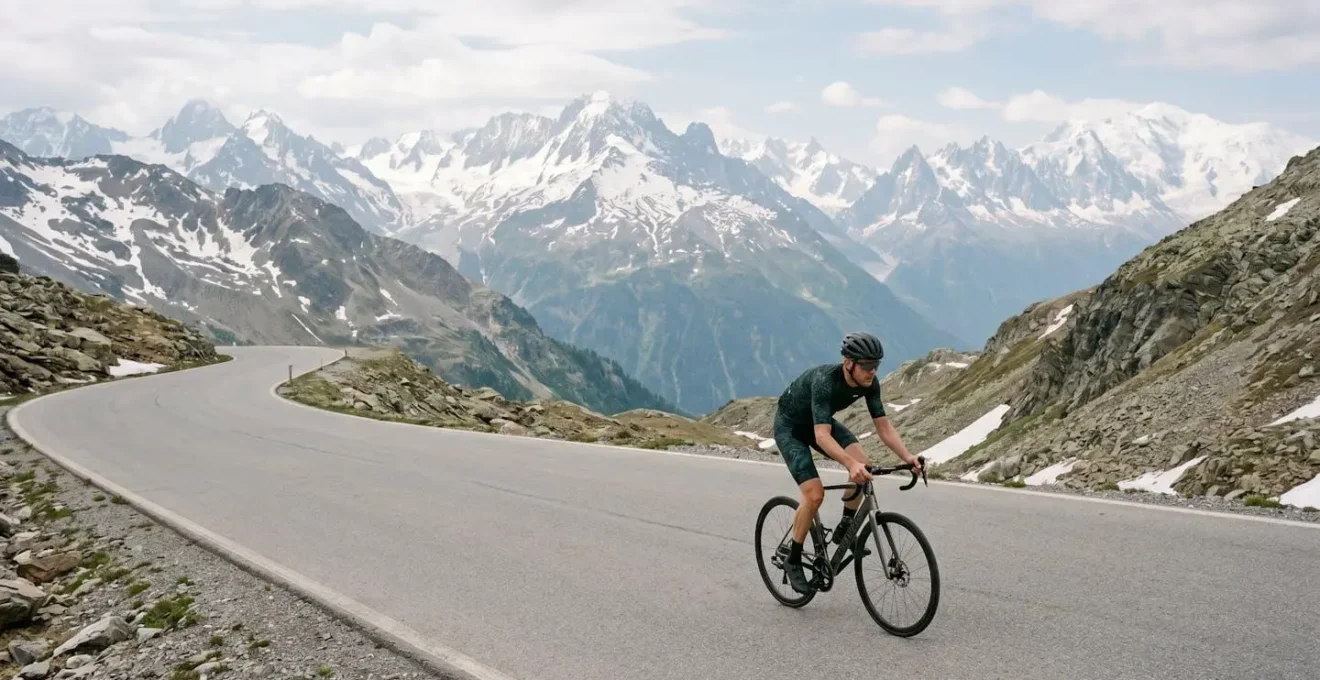
Modern cycling computers can display VAM in real-time. During your indoor simulations, you can calculate it manually (Vertical Metres Gained / Time in hours) to get a feel for the power required. On a simulated Alpe d’Huez ride on Zwift, monitor your VAM. If your goal is 60 minutes and your VAM drops below 1100 m/h, you know you need to lift your effort. If it’s consistently higher, you might be going too hard. It transforms pacing from a vague feeling into a concrete, manageable number, allowing you to dole out your effort with the precision of a professional.
By training with this metric in mind, you’re not just getting fitter; you’re learning the specific language of mountain climbing.
Cadence Drills: High RPM vs Grinding for Sprint Power?
The cadence debate—spinning (high RPM) versus grinding (low RPM)—is often framed as a matter of style. For Alpine climbing, it’s a matter of strategy. The varied gradients of a long climb demand versatility. You need the ability to spin efficiently at a high cadence (90-100 RPM) on steadier sections to conserve muscular energy, but also the strength to grind at a low cadence (60-70 RPM) to power over short, steep ramps without losing momentum. Training exclusively in one zone leaves you vulnerable.
Your training plan must therefore build cadence versatility. This involves specific drills that target both ends of the spectrum. High-cadence drills, like spinning for 1-minute intervals at 110+ RPM in a low gear, improve your neuromuscular efficiency and pedalling smoothness. Low-cadence drills, such as 5-minute intervals at 60 RPM in a big gear (at a sustainable power), build the muscular endurance and torque needed to handle steep pitches. Research shows that maintaining a cadence lower than 60 RPM for extended periods can lead to excessive muscular strain and potential injury, making this a critical floor to train above.
A great way to integrate this is with “alternating cadence climbs” on your smart trainer. Find a simulated climb and practice holding a steady 90 RPM. When you hit a steeper pitch, consciously shift to a bigger gear and drop your cadence to 65 RPM for 30 seconds to power over it, then shift back down and recover your spin. This directly mimics the demands of a real-world mountain pass and trains your body to be adaptable and resilient.
Your Cadence Versatility Training Protocol
- Muscular Endurance: Incorporate intervals of 5 minutes at 60 RPM in a big gear to build low-cadence torque strength.
- Neuromuscular Work: Perform intervals of 1 minute at 110+ RPM in a small gear to improve pedalling smoothness.
- Alternating Climbs: Practice switching between 90-100 RPM on steady gradients and 60-70 RPM on steep ramps within a single simulated climb.
- Establish a Floor: Always aim to maintain a minimum of 60 RPM on the steepest sections to avoid excessive muscular strain.
- Consistent Practice: Integrate these drills 2-3 times per week in the final 8 weeks before your trip to develop full-range climbing capability.
This adaptability is what separates cyclists who merely survive the Alps from those who truly conquer them.
Erg Mode vs Slope Mode: Which Is Better for FTP Intervals?
The smart trainer offers two primary modes for structured training: ERG mode and Slope (or Simulation) mode. Understanding when to use each is central to a successful Alpine training strategy. ERG mode is the “robot” mode: it locks you into a specific power target regardless of your cadence or gear. It’s incredibly effective for building your base fitness with workouts like FTP intervals (e.g., 2×20 minutes).
However, relying solely on ERG mode is a critical mistake for an aspiring Alpine climber. The Alps don’t have an ERG mode. The resistance is variable, and it’s up to you to manage it with your gears and cadence. This is where Slope mode becomes essential. Slope mode simulates a specific gradient, and it’s your job to produce the required power by selecting the right gear and cadence, just like on a real road. This is skill training. It teaches you to pace by feel, to make smooth gear changes under load, and to respond to changes in resistance.
A periodised approach is optimal. In the early phases of your training plan (e.g., 12-16 weeks out), use ERG mode for 80% of your interval sessions to build a strong aerobic engine and increase your FTP. As you get closer to your trip (final 8 weeks), you must flip this ratio. At this stage, 75% of your training should be in Slope mode. Download GPX files of your target climbs and ride them in Slope mode. This is your dress rehearsal. It allows you to practice your pacing strategy, your nutrition plan, and your mental game under conditions that are as close to the real thing as possible. ERG mode builds the engine; Slope mode teaches you how to race it.
This progressive shift from general fitness to specific simulation is the hallmark of an intelligent and effective training plan.
Key Takeaways
- True Alpine simulation on flat terrain is about engineering resistance, not just chasing power.
- Combine specific indoor training (Slope mode, cadence drills) with hardware choices (compact cranks) for a complete strategy.
- Pacing (using VAM), descending safely, and breathing at altitude are trainable skills that are just as important as your FTP.
HIIT Cycling Workouts: Boosting Power for Short Steep British Climbs?
High-Intensity Interval Training (HIIT) is fantastic for building the explosive power needed to attack the short, steep climbs common across the UK. Workouts involving short bursts at or above your VO2 Max are perfect for raising your performance ceiling. However, an entire training plan built around HIIT will leave you unprepared for the unique challenge of the Alps: sustained, hour-long efforts at a sub-threshold intensity.
The key to Alpine fitness is not just a high power ceiling but also the ability to hold a significant percentage of that power for a very long time. This is where “Sweet Spot” training becomes invaluable. The Sweet Spot zone, defined as training at 88-94% of your FTP, is known as the most efficient way to increase your aerobic endurance and fatigue resistance. It provides a potent training stimulus without generating the deep fatigue of full-on threshold or VO2 Max efforts, allowing for more volume and faster recovery.
A balanced weekly structure is the solution. You should combine the power-boosting benefits of HIIT with the endurance-building qualities of Sweet Spot and long-duration rides.
Weekly Protocol: Combining HIIT and Sweet Spot
A comprehensive weekly protocol balances high-intensity VO2 Max work with sustained endurance: Tuesday features 5×4 minute HIIT intervals at VO2 Max to raise the performance ceiling; Thursday incorporates 2×20 minute Sweet Spot intervals (88-94% FTP) to build fatigue resistance; Saturday includes a long endurance ride with extended Tempo/Sweet Spot efforts. This combination addresses both the power demands and the hour-plus duration requirements of major Alpine climbs like Alpe d’Huez.
This combined approach ensures you develop the top-end power to handle steep sections while building the deep endurance base required to keep going for hours. It’s the synthesis of the British climber’s power and the Alpine climber’s resilience.
Now that you have the strategic blueprint, the next step is to implement these principles consistently. Start building your custom training plan today to turn your Alpine dream into a reality.